April 2025

when your name gets dragged online mental health & online reputation damage in the age of ai, by recover reputation

When Your Name Gets Dragged Online: Mental Health & Online Reputation Damage in the Age of AI

Let’s be honest—no one talks enough about how bad it feels when your name shows up online for the wrong reasons, especially when it’s not even true. A fake quote, a twisted summary, some AI-generated image, or worse—a deep fake video that you didn’t consent to and don’t even know how to take down. This all hits hard. And if you’ve ever experienced it, you know it’s not just “bad PR.”It’s personal. It’s terrifying. It messes with your sense of control. The Emotional Gut Punch You go from scrolling your feed to seeing your name pop up in a way that makes your stomach drop. First there’s confusion:“Wait, what is this?” Then panic:“Is this showing up in Google? What will people think? Will my future employer see this?”  Then anger:“Who would do this to me?” And underneath all of that is something way hurtful, a feeling of shame. Even when you’ve done nothing wrong. What people don’t understand is that online reputation hits are mental health damage too. When the internet starts rewriting your identity, it doesn’t just live on the screen—it can live on, impacting sleep, losing your appetite and second guessing every post, text, silence from a friend or classmate. You Are Not Overreacting This is a real, valid, modern mental health crisis. And we have to talk about it like that. Because the whole “just ignore it” advice can be completely useless when it’s your face in a viral deepfake, or your name tied to a fake article. So let’s break down what actually helps. Step One: Pause, Don’t Spiral When damaged online reputation like this happens, it’s easy to panic-scroll, screenshot everything, and start imagining worst-case scenarios. But that just locks you deeper into a fear cycle. Take a breath. Literally.Step away from your screen for 10 minutes. Go outside, take a walk, drink water, text someone you trust. You need to be grounded before you go into fix-it mode. Step Two: Get Context, Not Just Clicks Sometimes what feels huge to you isn’t even trending. Google yourself in a private tab. See what’s showing up and take a real assessment of the damage. Is it one page, or multiple? Does it appear in social media and Reddit? AI-generated summaries? Then document everything. Screenshots, links, dates. You don’t need to act on it all yet, but you want a record. Step Three: Don’t DIY Your Healing This is where a lot of people struggle—we think we have to handle it all ourselves. But just like you wouldn’t treat a broken leg with a YouTube video, you shouldn’t try to navigate reputation trauma solo either. Talk to a therapist. Seriously. They can help you unpack the fear, the helplessness, the shame, and rebuild your emotional baseline. Also, if your case is serious, there are professionals (like Recover Reputation) who specialize in online reputation management and know how to fix what AI or trolls have messed up. Step Four: Reclaim Your Story This isn’t about “faking a new persona.” It’s about building your version of yourself back up. Start publishing. Post something thoughtful on LinkedIn, write a Medium article, and speak your truth. You should address the drama directly—but you can drown it out by being loud in the right way by building your voice and values. That’s not just strategy, that’s healing. Final Thought We’re all living in this new, weird era where a tweet, a photo, or an AI hallucination can rewrite how we’re seen. But your worth is not decided by search engines.Your identity isn’t up for crowd-sourced approval. So yes, this is painful. But you’re not powerless. If you’re going through it right now, I see you. And if you need help cleaning it up—emotionally and digitally—don’t be afraid to reach out. Your name matters. So does your peace. — Want to talk more about this? I’m open to DMs, or check out what Recover Reputation is doing to help people take their digital lives back. ??✨


When Your Name Gets Dragged Online: Mental Health & Online Reputation Damage in the Age of AI Read More »

online reputation management and student visas, social media: what families need to know, recover reputation

Online Reputation Management and Student Visas: What Families Need to Know

Let’s Talk About the New Visa Reality If you’re a student—or the parent of one—looking at colleges in the U.S., you’re probably already juggling a million things: applications, tuition, housing, culture shock. But as very recently, there’s something way bigger and way more personal now on the table: your online reputation. Thanks to a new order from U.S. Secretary of State Marco Rubio, U.S. diplomats are now required to comb through the social media accounts of certain student visa applicants. If you’ve posted anything that could be seen as “anti-American” or “critical of Israel,” you might be flagged, delayed, or denied a visa altogether—even if you’re already studying here. Let that sink in: a post, a tweet, a caption, even a retweet from years ago could jeopardize your academic (and more) future. And it\’s not just about applying for a visa—students who already have visas are now being deported for their past posts. This isn’t hypothetical; it’s happening now and requires online reputation management awareness. How Did We Get Here? The Trump administration’s new policy is using AI and federal scrutiny to surveil international students online. The stated goal is to detect \”hostile attitudes\” through social media activity. In practice, this means: Student protesters are being deported and detained. Green cards are being revoked. Visa applications are being denied based on speech that was once protected. AI tools are scanning social media accounts for content considered “un-American” or “destabilizing.” Basically, your feed isn’t just personal anymore—it’s evidence. If this happens, the student’s–and family’s–reputation can cause long-lasting online reputation damage. What Can You Do About It? Here’s how families are beginning to respond—and how professional help can make a difference. 1. Clean Up Your Online Footprint Audit and optimize your social media presence, ensuring that posts from the past (and present) don’t put your future at risk. That includes removing or replacing content that could trigger red flags during visa evaluations. 2. Correct AI Misinterpretations AI isn’t perfect. Sometimes it mislabels sarcasm, humor, or activism as threats. If an AI system flags your content unfairly, work to correct those interpretations and provide the context necessary to restore your standing. This is part of a developing field of GenAI Reputation Management. 3. Suppress Negative AI Content If there’s misinformation or damaging AI-generated content about you online—deepfakes, out-of-context quotes, or biased summaries—try to suppress it using ethical and strategic content and social media posting. 4. Build a Positive Online Presence The best defense is a strong offense. Students should always build professional, academic, and positive web identities—on platforms like LinkedIn, Medium, and even AI platforms like ChatGPT. This shows visa officials and professionals that you’re serious, smart, and safe. 5. Create Custom Tools for Long-Term Safety Continue and monitor results constantly, from search results to AI summaries to social media algorithms. This isn’t just political—it’s personal and practical. This is about protecting your dreams—whether that’s going to MIT, joining a research program at Stanford, or just experiencing life abroad. You shouldn’t have to choose between expressing your beliefs and pursuing your education. But in this new AI-driven world, you need to be smart about both. Parents: If your kid has a shot at studying in the U.S., don’t let an old Instagram caption ruin it. Students: If you\’re already here, don’t assume you’re safe. Keep your online life in check. Get Ahead of the Problem If you’re concerned, it’s smart to get ahead of it. Recover Reputation offers one-on-one consultations and custom packages for students and families—especially those navigating the tricky intersection of immigration, AI, and academic opportunity. Your future is worth protecting.We’ll help you stay visible for the right reasons.

Online Reputation Management and Student Visas: What Families Need to Know Read More »

navigating political storms: essential online reputation management strategies for law firms

Navigating Political Storms: Essential Online Reputation Management Strategies for Law Firms

Navigating Political Storms: Essential Online Reputation Strategies for Law Firms In recent days and weeks, law firms across the US have found themselves in unprecedented and tumultuous waters. The current administration\’s increasingly aggressive stance towards major law firms—characterized by specifically targeted executive orders and scrutiny of firms’ employment practices—has thrust the legal sector into the uncomfortable spotlight.  If they respond or push back, they risk raising the ire of the White House; if they compromise, they could lose their reputation to client’s and peers.  A critical lesson for all firms, unfortunately, is the necessity of developing a robust and proactive online reputation management (ORM) strategy. Law firms have historically built a reputation quietly through quality, discretion, and winning cases, eventually building trust and prestige. However, the current political climate has rapidly shifted away from this reality.  Recent governmental moves, including attempts to sanction firms deemed to engage in \’frivolous litigation\’ and extensive probes into diversity, equity, and inclusion programs, highlight incongruous new vulnerabilities that go beyond the courtroom and directly at public perceptions. The strategic response to this new environment requires firms to lean heavily into proactive online reputation management. Effective ORM creates a strong web presence that serves both as a anticipatory advocacy platform and a defensive barrier against political targeting and negative publicity. 1. Online Reputation Management for Law Firms: Enhancing Credibility Establishing a credible and trustworthy online presence is the foundation for legal reputation management. This begins with showcasing expertise, successful outcomes, and a clear commitment to being ethical. By actively sharing case wins, client testimonials, industry recognition, and community involvement, law firms can build public trust and online authority. Highlighting integrity reinforces confidence among clients and other firms, particularly during times of controversy or investigations that appear in Google search results. 2. Strategic Content Development for Legal Reputation Protection Creating and disseminating well-crafted content is one of the most powerful tools in online reputation management for law firms. This includes case studies, client success stories, thought leadership articles, presentations, and whitepapers that demonstrate the firm’s knowledge and professionalism.  For example, a law firm focused on the hedge fund industry was targeted by a false report online. By producing and distributing high-quality financial-related content, and optimizing SEO on key platforms, the negative link was suppressed within four months. This highlights how strategic content can control the narrative and neutralize harmful online attacks. 3. Transparency and Compliance: Safeguarding Your Law Firm\’s Online Reputation Public trust is built on this kind of transparency, and for law firms, detailed compliance with legal and ethical standards should be disseminated online. Proactively sharing these compliance efforts, ethical policies, and broader initiatives communicates openness and reliability, which are key for building an online reputation. When scrutiny comes up, these standards serve as proof of responsible governance. Transparency transforms potential vulnerabilities into strength, showing clients and regulators that a firm is accountable, ethical, and trustworthy. 4. Thought Leadership: Elevating Legal Reputation Online Establishing a reputation as a thought leader can significantly elevate a law firm’s online standing. Contributing expert insights on legal and regulatory developments, engaging in high-level industry discussions, and participating in public forums builds authority and influence. Firms that consistently share their perspectives on complex legal issues signal depth, competence, and leadership. This not only improves online search visibility but also positions the firm as a reliable voice during turbulent times. In the current politically charged environment, online reputation management for law firms is no longer optional—it is a critical strategic imperative. Firms that proactively implement comprehensive ORM strategies will protect their reputations, sustain trust, and maintain resilience amid unprecedented political challenges.

Navigating Political Storms: Essential Online Reputation Management Strategies for Law Firms Read More »

online reputation ceos recover reputation

Beyond First Impressions: The Critical Role of Online Reputation for CEOs

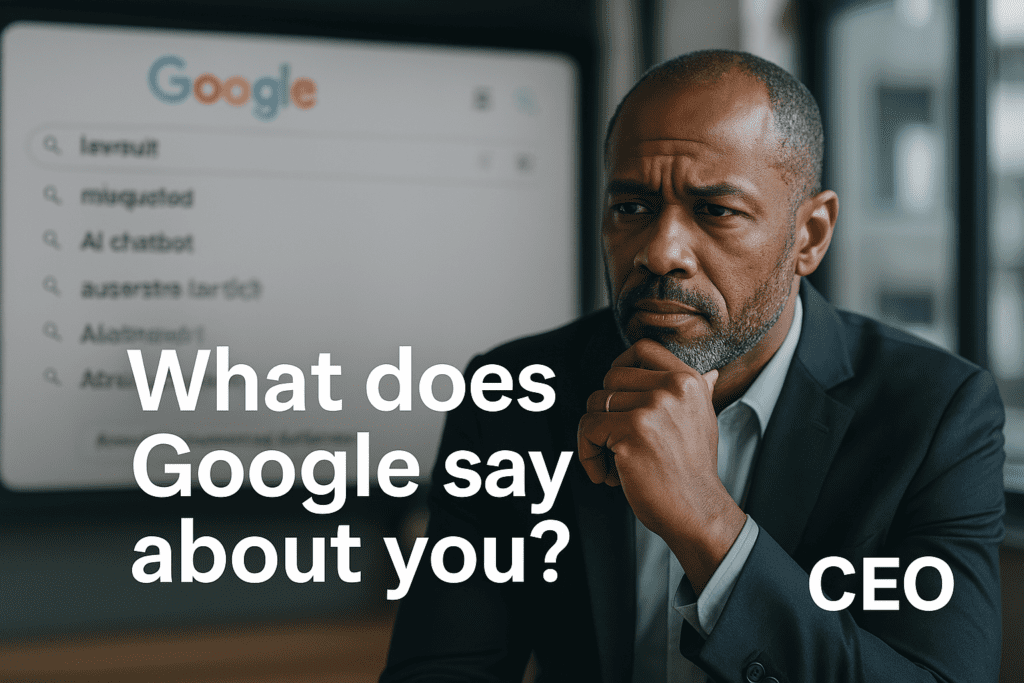
A few months ago, I met with a CEO who built a million-dollar company from the ground up. Smart, respected, trusted by his team. But when you Googled his name? You’d never know it. Instead of achievements, the top results were a years-old lawsuit (dismissed), a misquoted article, and a surprisingly off-base summary from an AI chatbot. He looked at me and said, “This isn’t who I am—but it’s what people see before I even speak.” That’s the reality today. Reputations are not shaped just by what we say or do, but by what Google and algorithms decide to show. And for CEOs, the stakes are even higher—investors, talent, partners, and the public are all forming first impressions before you ever enter the room. Online reputation management isn’t about vanity. It’s about trust and making sure leadership, values, and CEO voice come through clearly online that often misrepresents. Taking Back Control: How CEOs Can Reclaim Their Web Presence We helped that CEO reclaim his narrative. Not by spinning stories, but by telling the real one—amplifying leadership, correcting misinformation, and building a web presence that genuinely reflects who he is. We started by proactively correcting inaccurate AI-generated content through strategic outreach and updating information across platforms, such as LinkedIn, their websites, Crunchbase, etc. We then created and distributed high-quality, authentic content that highlighted true achievements and leadership qualities. Finally, we consistently monitored online mentions and engaged thoughtfully to maintain and further solidify his credible online presence over months. Because when you\’re leading a company, your reputation isn’t just personal—it’s foundational. What does the internet say about you when you\’re not in the room?

Beyond First Impressions: The Critical Role of Online Reputation for CEOs Read More »

Scroll to Top