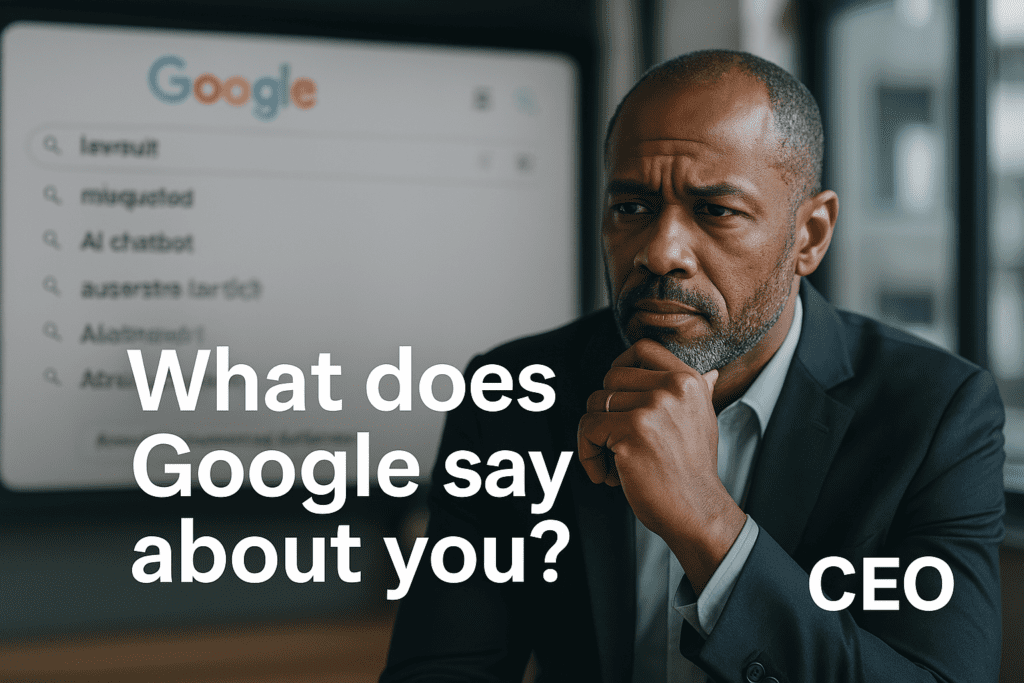
AI Search Shift: Is Your Online Brand Ready for the New Reality?
The way we all find information online is changing dramatically, and is reshaping how brands need to think about their visibility. Search engines, i.e., Google, a long-standing cornerstone, are undergoing transformation. This isn\’t just a minor update; it\’s an evolution that impacts how everyone connects with audiences, makes sales and communicates. I highly suggest viewing a compelling video by SomeOrdinaryGamers aka Mutahar, “Google Has Completely Ruined Its Search Engine…,” discussing this trend, highlighting a noticeable decline in online search effectiveness alongside the quick rise of AI and Large Language Models (LLMs) as go-to sources for information. This resonates with what I am seeing (I personally have almost abandoned Google for LLMs) as a growing trend. Mutahar says, “Nowadays, I feel like in the big year past 2023, Google has completely demolished what made that search engine so great and has effectively tanked it to the point where I personally feel that it is nearly unusable.” This connects to the \”Dead Internet Theory.\” The video says that major search platforms might be \”…letting the internet completely demolish itself from the outside in.” At its core, this theory says that most of the internet is no longer driven by authentic human interaction and content but instead, it\’s increasingly filled with AI-generated slop, bot activity, and a general deluge of low quality noise, making it hard to uncover genuine, human-created information. Understanding Traditional SEO: The Foundation We Built On For many years, the primary strategy for online visibility for businesses and individuals has been Search Engine Optimization (SEO). SEO is about understanding how search engines discover, interpret, and rank web pages. This involves identifying relevant keywords people might use, strategically incorporating them into website content (like titles, headings, and body text), building authoritative backlinks from other credible websites, ensuring that it loads quickly, is mobile-friendly, and structured in a way that search engine crawlers could easily understand. The consistent aim was to achieve higher rankings in search results, as a top position translates to increased visibility, more website traffic, potential leads, and stronger brand recognition–and more money. The Current Disruption: AI and LLMs Redefining Information Access However, this established approach is now facing disruption. More and more, users are moving beyond traditional search queries. Many are turning directly to AI-powered chatbots and interfaces that leverage LLMs to get immediate, conversational answers. “It just shows you how bad Google search has gotten when literally the alternatives are these ChatGPT-like interfaces,” says Mutahar. It might be a minor trend at the moment but it\’s a fundamental shift in how an online presence needs to be constructed and managed. Brands that don\’t recognize and adapt to this evolution risk a gradual decrease in visibility where it\’s beginning to matter most: within the answers and information provided by AI systems. While there\’s no need for immediate alarm, relying solely on past strategies leads to less engagement and a lower influential brand voice. Schedule Your Free 15-Min Consult Schedule Your Free 15-Min Consult Online Reputation in the AI Era: New Challenges for ORM This change has profound implications for Online Reputation Management (ORM) as well. Traditionally, ORM focuses heavily on managing perceptions by shifting what appeared in search engine results and across various online platforms. If those search results are becoming a less central part for the user, then an ORM strategy confined to traditional SERPs is now incomplete. An online reputation is now significantly shaped by AI models. If an LLM surfaces outdated, negative, or simply incorrect information in its responses, that is a new frontier for reputation damage. Forging the Path Forward: Evolving ORM for an AI-Driven World So, what is the most effective strategic response to this changing environment? It’s certainly not about discarding proven ORM and SEO practices. Foundational elements like high-quality content, a well-structured website, and ethical reputation management principles remain crucial. However, these must now be significantly enhanced with strategies tailored for the AI-driven ecosystem. Based on our work in this emerging field, key areas of focus include: Proactive Data Updates and Correction: Implementing robust processes to feed LLMs the most accurate, current, and positive datasets related to your brand. This can involve structured data optimization, contributions to relevant knowledge bases, and ensuring your core digital assets are definitive sources of truth. Leveraging Human Feedback Mechanisms: Utilizing available channels and tools to provide corrective feedback to AI systems, helping to refine and improve how they represent your business or personal brand. Prioritizing Excellent Homepage & Core Website Development: Your primary website, especially its homepage and key informational pages, must be an unimpeachable, clearly structured, and easily parsable source of accurate information. This is fundamental to \”teaching\” AI models what they should understand and convey about you. Shaping Your Narrative within AI: Actively working to ensure that your brand’s authentic story, core values, and key messages are accurately and favorably reflected in AI-generated summaries and responses. Navigating this new digital environment requires a sophisticated blend of established ORM expertise and a deep understanding of the evolving dynamics of artificial intelligence. It\’s about ensuring your positive reputation is not only discoverable through search but is also deeply embedded within the AI models that are shaping online interactions. This specialized understanding is central to our approach in helping clients not just adapt, but truly thrive in today and tomorrow.
AI Search Shift: Is Your Online Brand Ready for the New Reality? Read More »