Steven W. Giovinco

mrbeast in 2022

MrBeast’s Challenges: A Case Study in Online Reputation Management

Introduction MrBeast is a digital phenomenon–you might have heard of him or seen some of his videos. With 320 million subscribers, his influence is massive, going beyond the online realm into restaurants, philanthropy, branding, and merchandise, etc.  But the massive rise has recently come with cracks in his overwhelmingly wholesome persona that has lead to online (and offline) reputation damage. Recent controversies surrounding a Netflix special, his newly launched kids\’ meal, and legal disputes highlight reputation vulnerabilities faced by high-profile figures—especially when their brand is inextricably tied to their personal identity. In this article, I want to show how developing an online reputation management strategy is critical for brands mitigating crises and point out lessons businesses can learn from a seemingly unlikely example–MrBeast. By the way, disclaimer: this is not to single out any creator. It’s to show, in my opinion, how reputation damage can happen to anyone, at almost any time. Sources Smith, A. (2024). Legal Issues Facing MrBeast and the Impact on Business Reputation. Business Insider. Williams, J. (2024). MrBeast Burger Lawsuit: A New Challenge for the YouTube Star. New York Times. Digital Marketing Institute. (2022). The Role of Reputation Management in Business Success. Sherman, R. (2023). Why Influencer-Backed Product Launches Often Face Criticism. Forbes. Weber Shandwick. (2022). The CEO Reputation Premium: Why Reputation Who is MrBeast? Let’s start with Jimmy Donaldson. Better known as MrBeast, he is an American YouTuber who started back in 2012, when he was 13. First videos were about gaming and challenges.  In 2017, he spent over 40 hours counting to 100,000 nonstop. This video went viral.  Since then, MrBeast’s focus has been on high-budget challenges, elaborate competitions, and generous giveaways with prizes that can reach hundreds of thousands of dollars with views of twenty million (for example, he gave away a private island for winning a survival challenge). MrBeast also participated in a bunch of high profile charities, including organizing Team Trees, which raised more than $24 million to plant trees, and Team Seas, a campaign that collected millions to remove plastic waste from oceans. Entertainment, spectacle, and philanthropy videos generate billions of views. But with such massive influence also comes increased scrutiny, and his reputation has recently faced challenges. What is Online Reputation Management? To understand the issues at play, I want to briefly go over online reputation management and why it’s important.  Everything appears in search results and on web platforms makes up your online reputation. The best approach to rank high in Google is to show authenticity,  build trust and maintain a solid public image to have strong relationships with customers, stakeholders, and the public—whoever you are trying to reach. The way to do this is showcase expertise through well-crafted articles, blog posts, and videos that highlight real achievements. ORM is crucial because when people search for you (or your business), if something negative appears, they move on to someone else like a competitor. Basically, a damaged reputation leads to lost clients and business (and more). How does this relate to MrBeast (and Why Should I Care)?  There are lessons to be learned in this case study. Responding correctly to problems can migrate online damage. There are several examples to choose from but I’ll highlight  three below. The Netflix Special: Big Visibility MrBeast moved beyond YouTube to Netflix. Heading to a mainstream platform seemed like the next logical step. Some fans loved the stunts and challenges. But a few were critical that the show seemed to exploit vulnerable participants for entertainment and focused more on promoting a personal brand than creating meaningful change.  As a result, some reviewers questioned his well-known philanthropy was genuine or more of a strategy to generate more clicks and subscriptions (after all, this is the whole point of most content. But still…). As this spread on social media, concerns seemed to gain traction, generating a rare backlash against a previous stellar reputation. For a figure like MrBeast—whose public persona is built on authenticity and altruism—this kind of criticism might have serious consequences. When negative narratives appear online, trust from fans, business partners, and collaborators can erode. Lessons in Online Reputation Management MrBeast’s experience highlights a problem faced by public figures, leaders, CEOs and businesses. While you will likely never ever reach the fame of having a Netflix special or millions of YouTube views, even the most well-intentioned projects can be misinterpreted or go off the rails. When the messaging goes awry, trust can fade. This is a reminder that a successful online presence requires not just good intentions but also extremely careful strategic reputation management planning. Staying ahead of the narrative is key, as reputational damage—no matter how small for no matter who big—can grow unexpectedly. See some detailed solutions below. The Kids\’ Meal Controversy: Brand Under Fire Around the same time, Lunchables-style kids’ meal, called Lunchly, was launched with other huge and controversial YouTube stars Logan Paul and KSI. The product, aimed at kids, ran into criticism by some. Reports emerged that nutrition advocates and parents raised questions, leading to reputational damage for both the influencers and possibly the retailers. The result led to social media backlash. Negative headlines soon followed, forcing MrBeast to release statements addressing the issue and clarifying the purpose. Lessons in Online Reputation Management Partnerships of nearly any kind have inherent online reputation pitfalls. Businesses working with influencers or managing their own reputation are required. Plan for potential criticisms to avoid negative reputations and protect brand integrity. The best solution is to constantly build a positive online presence on multiple platforms to better buffer problems when they appear in search results. Ongoing Legal Challenges: A Growing Threat to Credibility In addition, MrBeast has faced public disputes with former business partners and lawsuits related to his food venture, MrBeast Burger. create headlines that can damage the brand\’s credibility and make it harder to focus public attention on positive initiatives. For example, a lawsuit filed by MrBeast against his own restaurant partner alleged poor quality control and mismanagement of operations.

MrBeast’s Challenges: A Case Study in Online Reputation Management Read More »

ceo online reputation management recover reputation 4

How CEOs Can Manage and Protect Their Online Reputation in 2024

Introduction In today’s digital age, a CEO’s online reputation isn’t just about personal pride—it’s a critical business asset. Your personal brand shapes how investors, employees, and customers perceive your leadership. One viral tweet or damaging headline can disrupt years of hard work. This guide will show you how to proactively manage your reputation, protect your image, and maintain trust in 2024. Summary A CEO\’s online reputation directly impacts investor confidence, customer trust, and employee morale. Problems happen—how you handle them can make or break your image. Proactively manage your reputation with a personal website, thought leadership content, and social media engagement. Transparency, authenticity, and timely responses are key to building trust and ensuring long-term success. Why Your CEO Reputation Can Make or Break Your Business A CEO’s reputation is critical to company success, shaping perceptions among investors, employees, and customers. Negative events—like a bad tweet or damaging news article—can hurt both personal and business credibility. Clients and investors often choose companies based on the CEO’s reputation. How Online Reputation Shapes Company’s Success? As a CEO, your online reputation is a massive part of your company’s success. It’s not just about how people view your business; it’s how they see you. Whether you\’re in the headlines for all the right reasons or trying to navigate a damaged online reputation, your personal brand is out there shaping how people—employees, investors, customers—perceive your leadership. In this article, I aim to show you why it matters and help you build, protect, and grow that reputation in a way that’s genuine and proactive. It’s a long slog, but it works. What is the Cost of a Poor CEO Reputation? Your reputation as a leader directly affects your firm’s bottom line. One negative news article,  or even a tweet taken out of context can go viral—and not in a good way, since with social media, everyone’s watching. And when that happens, it’s not just your name that suffers—your company’s credibility, sales, and team morale take a hit, too. Would You Trust a CEO with a Bad Reputation? Think of it from a client’s perspective: would they invest in a company whose CEO has a questionable online reputation? They would just move on to a competitor. So, not actively managing your reputation means you\’re leaving a lot of your company’s future up to chance or exposure to potential damage. What is the Direct Link Between Reputation and Business Success? The impact of a CEO\’s reputation on a company’s bottom line is profound and multi-faceted. A CEO’s reputation is often directly linked to investor confidence, employee retention, customer loyalty, and overall business success. Here’s some more details: 1. Investor Confidence and Stock Performance A positive CEO reputation significantly affects investors\’ perception. Up to 44% of a company’s market value is attributed to the CEO’s reputation, according to Weber Shandwick. When a CEO is trusted and respected, investors are more likely to buy or hold onto shares, which in turn drives up the company’s stock price. On the other hand, a scandal or negative press quickly leads to a stock dip and a loss of market confidence. 2. Sales and Revenue Growth A CEO’s public image directly impacts customer trust. Consumers are more inclined to buy from companies whose leadership they have faith in. Research suggests that 75% of customers base their purchasing decisions on the company’s leadership, including the CEO. CEOs who are perceived as ethical, transparent, and socially responsible fosters loyal customers, which leads to growth. However, negative search results around the CEO can damage customer trust, leading to reduced sales. 3. Talent Attraction and Employee Morale A CEO’s reputation is critical when attracting and retaining talent. Surveys show that 71% of job seekers will avoid companies with negative reputations. A positive CEO image helps in recruiting top-tier talent, which is essential for innovation and growth, especially for smaller firms. Also, a well-regarded CEO boosts employee morale and productivity, which directly affects overall business performance. A CEO perceived as distant or controversial can lead to higher employee turnover, resulting in increased recruitment and training costs. 4. Cost of Online Reputation Management A poor reputation often leads to crises, which comes with high costs. Companies spend millions on crisis management, public relations campaigns, and damage control when their CEO’s actions or statements generate bad press. Online reputation recovery is costly—not just in terms of immediate financial resources but also in long-term brand rebuilding. Real-world online reputation management prices range from $4,000 to $20,000 per month, for six to 12 months, depending on severity. The time spent addressing these issues also is a distraction for the CEO, and takes the focus away from the core business. 5. Long-Term Business Sustainability In the long run, a CEO’s ability to inspire trust and lead ethically creates a foundation for business sustainability. The impact of maintaining a strong personal and corporate reputation helps protect the company from both market volatility and competitive pressures, ensuring steady growth over time. In short, a CEO’s reputation affects almost every aspect of a company’s success—from stock prices and sales to talent retention and crisis costs. For a company to thrive, its CEO must be proactive in managing both their personal and professional image, as it directly ties into the business\’s financial health. What to Do When Your Web Reputation Is Damaged? No matter how careful you are, issues happen. It could come from an unethical competitor, an incorrect news story, or a genuine mistake that gains traction online. When a crisis hits, the way you handle it matters just as much as the event itself. Own Up to Mistakes: If there’s truth to the negative publicity, be transparent. Acknowledge the mistake and outline the steps you’re taking to fix it. A heartfelt apology can do wonders. Correct Misinformation: If the story is false or exaggerated, act fast. Contact the source directly, clarify the facts, and work to have the misinformation corrected or removed. Push Positive Content: In times of crisis, flood the web with positive

How CEOs Can Manage and Protect Their Online Reputation in 2024 Read More »

sec delete recover reputation pxl 20240721 211049442

How to Remove or Push Down SEC Records from Google Search Results

If your name or business appears in an SEC filing, it damages your online reputation. Getting these records removed or suppressed in Google search results can be tough, since search engines (basically, Google) view SEC and .gov websites as reliable and important sources. Still, here are options I’ve used to minimize the impact of these records in search results. How Do SEC Records Affect Your Online Reputation? The Securities and Exchange Commission (SEC) is a U.S. government agency responsible for regulating the securities industry. This includes overseeing stock exchanges, brokers, investment advisors, and mutual funds. The SEC’s main goal is to protect investors and ensure that markets function fairly and efficiently. As part of its role, the SEC enforces federal securities laws and monitors the information that companies and individuals share with the public. While the SEC is vital transparency in the financial industry, being mentioned in an SEC filing can almost immediately damage your reputation, even if there was no wrongdoing on your part. These records often show up prominently at the very top of Google search results, which can leave a lasting negative impression on anyone searching for your name or business. When prospective or current clients see it, they stop calling and move on to working with someone else. Thus the serious nature of this issue. Steps to Remove or Suppress SEC Records from Search Results Contact the SEC: If the information in the SEC record is incorrect or outdated, you can try asking them to correct or remove it. Reach out to the SEC’s Division of Corporation Finance and explain your situation. Although this won’t probably won’t result in the removal of the record, it’s worth trying if the data is wrong. Or, try submitting a correction or deletion request. Reach Out to the Website Hosting the Records: If the records appear on a third-party website, you can contact the site owner and request removal. However, in my experience, they don’t really care, and usually do nothing. Website owners aren’t obligated to remove content unless it violates privacy or legal standards, but if the information is incorrect, they might take it down. Request Google to Remove Specific Information: Google allows the removal of content that includes sensitive personal information, such as financial details or Social Security numbers. If your SEC records include these, you can file a removal request with Google using their content removal tool. Of course, though, this option is only available in very specific circumstances. Promote Positive Content: One of the best ways to counteract negative search results is by creating and promoting positive content. Publish blog posts, professional profiles, and social media updates that reflect positively on you or your business. The more you optimize this content with relevant keywords, the more likely it will rank higher in search results, pushing down the SEC record. But, this can take six to 12 months or longer, and is incredibly time intensive. Consult a Reputation Management Expert: Consider consulting a reputation management specialist. These professionals specialize in improving online reputations and can offer expert guidance or even take over the process for you. How to Suppress SEC Records on Google Search I’ll focus a bit more on content suppression, i.e., pushing down the SEC record in search results so it’s less visible. Usually, having it drop off the first page is effective. Although it’s not a guaranteed fix, you can often minimize the impact by boosting the visibility of positive info. Here’s what has been effective in the past for similar clients: Audit Your Current Search Results: Start by searching your name or business to see where the SEC records show up. This will give you a sense of how much work you’ll need to do to push them down. If it’s at the top, which is likely, it will take a huge effort; if it’s at the bottom, the process could be much easier. Create High-Quality, Positive Content: Develop engaging, positive content—such as blog posts, personal website creation, and social media updates—that highlights your strengths. Make sure this content is well-optimized with keywords related to your business or personal brand to help it rank in search results. Focus on Key Platforms: Besides your business and personal sites, be very active on LinkedIn, Twitter, Facebook, Reddit, Quora, Instagram, Google Business Profile and more. Optimize Your Social Media Profiles: Ensure your social media profiles are complete and use your real name and relevant keywords. Link to your positive content and personal site where appropriate. This not only helps these profiles rank higher but also establishes a strong, positive online presence. Build Backlinks to Your Content: Increase the authority of your positive content by earning backlinks from reputable websites. These links can help boost your content’s visibility in Google searches, which can push down SEC links. Monitor Your Search Results Regularly: Keep an eye on search rankings and update your content frequently. ORM is an ongoing effort, so regular updates help maintain and improve your rankings over time. This includes daily updates, and weekly blog posts. Consider Professional Help: Suppressing negative content is a long-term effort, and it may take months or even longer to see significant results. If you don’t have the time or know-how to handle this yourself, consulting an online reputation management firm can make the process smoother and more effective. Bottom Line It’s important to remember that removing or suppressing SEC records from Google isn’t straightforward. In most cases, it may not be possible to fully remove them. However, by following the steps outlined above and maintaining a consistent online presence, you can work toward minimizing their impact and improving your online reputation over time. If you have any questions, feel free to reach out to me.

How to Remove or Push Down SEC Records from Google Search Results Read More »

Online Reputation Management for CEO

A CEO\’s online reputation is important to their personal brand and corporate leadership.  CEOs can\’t–and shouldn\’t–hide online because they are increasingly seen as the face of their business or brand. Online reputation management (ORM) for CEOs is not a one-size-fits-all solution. Each case demands a customized strategy based on the individual’s professional trajectory and personal values. In my experience, this is the only approach that works. Here are some key aspects of ORM for CEOs: Proactive Monitoring: It\’s crucial for CEOs to monitor their online references, such as news articles, social media posts, and industry forum discussions. Regularly check for new negative content and use tools like Google Alerts. Strategic Content Creation: Creating and sharing impactful content is vital. This includes crafting thought leadership articles, presentations, and participating in interviews to showcase expertise and achievements. Personal Branding: Aligning online presence with personal branding and company ethos is important. This can be accomplished by ensuring consistent messaging across all platforms to maintain a cohesive personal brand and uniform messaging. Engagement and Responsiveness: Active participation in discussions and responsiveness to client or user feedback is important. Privacy and Security: Ensuring the security of personal information is critical in preventing unauthorized access and misuse, to avoid associated reputational risks. Consistent Online Presence: Maintaining consistency across all online profiles is necessary because inconsistencies or outdated information can impact a CEO’s reputation. For example, ensure that LinkedIn, corporate bios, and media presence are aligned to convey a unified professional identity. Feedback Loop: Attentive review of business and reputation trends helps keep stakeholders connected. Professional Guidance: Engaging with reputation professionals can offer specialized expertise for managing and enhancing a CEO’s online reputation. Legal Considerations: It is crucial to understand legal considerations, particularly when handling potentially defamatory content. Here is real-world example of online reputation management for CEOs: Case Study  CEO Needed a New Reputation and New Position: A highly successful 55-year-old CEO with a stellar career running media organizations was unable to get a new job because a nearly two-decade-old issue from a holiday party was hurting his online reputation. These case studies highlight that CEOs need to manage their online reputation proactively because even past events can resurface and damage their careers.

Online Reputation Management for CEO Read More »

online reputation management for university/college students, recover reputation

Online Reputation Management for University/College Students

\”The only source of knowledge is experience.\” — Albert Einstein Inappropriate party photos? Offensive public comments? Negative social media posts? Discovery of plagiarized content? Political protests?  One or more of these can have potential life-long consequences and are just a few ways a college student can have their reputation damaged. Why is Online Reputation Management Important for University Students?  From a thoughtless social media post to the tussles of hashing out political discourse, students navigate a minefield of potential hiccups that could ripple through the rest of their lives. This article goes into why students need to build a strong online reputation and how it can be accomplished. Whether it is repairing past mistakes or building a positive online identity that opens the doors to future opportunities, the insights here should empower students to take more control of how they are being portrayed online. We know that reputation management is an essential step for job seekers. 71% of hiring decision-makers think that social media is effective for screening applicants, according to a recent survey by The Harris Poll. Colleges are increasingly adopting online screening for potential students as well. That means a strong online reputation isn\’t just an important tool for college graduates, it\’s one that students may need to gain admission to top programs and jobs. We\’ll focus mostly on the next steps for graduate students: employment opportunities, professional advancement, graduate school and post-grad education. Understanding the Impact Professional Implications: Future employers and admissions officers often review candidates\’ social media profiles (as mentioned). Posts perceived as unprofessional, intolerant, or overly polarizing may adversely affect job and academic opportunities. Balancing Activism and Rhetoric: There is a clear distinction between constructive political activism and harmful rhetoric. Engaging in peaceful protests or articulating well-thought-out perspectives on social media are generally viewed more favorably than posting aggressive or one-sided arguments. How to Start Begin with a few questions: What are you sharing, who are you sharing with, and what does that say about you—both personally and professionally?  Managing an online reputation can be complex and is in constant flux: Google’s algorithm always changes, AI platforms are swiftly developing, new services appear, giving people more ways to connect. While it can seem overwhelming, stick to these basic tenets: Be authentic, honest, and helpful Make everything you post, interact with, or share something you would be proud reveal with a family member or future boss If not, don\’t post it The Internet Has a Really Long Memory \”To be prepared is half the victory.\” — Miguel de Cervantes One inappropriate post on TikTok, Reddit, or Instagram, is likely to remain online, perhaps indefinitely. Instead, consider sharing for the long term and be real when connecting to headhunters, admission officers, and everyone else. That means pause and think before posting. Avoid acting on the spot or falling for impulsive responses, especially when involved in hot/controversial issues. Continually monitor your online reputation before, during, and after college—the critical junctures of entering the workforce. Employers Checking Students Online The use of online reputation management by employers to screen graduating students is a significant factor in hiring processes. According to recent statistics, a vast majority of employers now consider a candidate\’s online presence as a critical part of the hiring process. Key points include: Prevalence As mentioned above, 71% of hiring decision-makers think that social media is effective for screening applicants. This varies by industry, company size, and country, but the trend is increasingly upwards. Impact on Hiring Decisions Negative findings on social media can impact a candidate’s job prospects significantly. For example, posts simply showing inappropriate photos or videos, discriminatory comments, evidence of criminal behavior or even just poor communication skills can all lead to a candidate being passed over. Positive Impacts On the flip side, a positive online presence that aligns with an employers’ values, showcases accomplishments, or demonstrates a professional image enhances a candidate\’s chances of being hired. Platforms Scrutinized  LinkedIn remains the most reviewed platform due to its professional focus, but employers also look at Facebook, X/Twitter, and increasingly, Instagram and other visual media platforms to gauge a students’ personal life and character. Future Trends The integration of artificial intelligence in the screening process is growing. Tools that can analyze vast amounts of data from social media and other online sources to assess candidates\’ personalities and predict their cultural fit within a company are being developed and deployed–however, the answers could be incomplete or even wrong. For a deeper understanding of the statistics and trends in employer use of online reputation management, you can visit the Wikipedia page on Social media use in hiring. Ready to Regain Control of Your Online Reputation? Get in touch with us today for a free consultation. Let\’s work together to restore your online reputation and get your life back on track. Please enable JavaScript in your browser to complete this form.Name *Phone Number *Email *MessageWebsite Submit 10 Ways Students’ Reputation Can Be Damaged \”Your brand is what people say about you when you\’re not in the room.\” — Jeff Bezos Inappropriate Images/Embarrassing photos Selfies of yourself are normal, but anything suggesting negativity is a poor choice to share. Images from parties or social gatherings where inappropriate behavior such as excessive drinking, drug use, or partial nudity will hurt a student’s reputation. These show a lack of judgment and professionalism, which deters potential employers or academic programs from considering the student seriously. Political Extremism Expressing extreme political views or participating in polarizing debates can alienate potential employers, particularly if the views involve violent rhetoric or discriminatory statements. While having political opinions is normal, extreme expressions can suggest intolerance or a propensity for conflict. (See the section below). Negative Comments Engaging in online insults, threats, or hate speech can be particularly damaging, especially if shared across social media by others. These can indicate hostility or instability. Of course, no one, especially universities and employers, find these posts acceptable in any way. Unprofessional Behavior and Vulgar Language Insensitive comments, as well

Online Reputation Management for University/College Students Read More »

what is ai reputation management: recent real world examples, urban street dystopian scene night, by recover reputation

Why Generative AI Reputation Management Is Important: Recent Real-World Examples

Internal Server Error The server encountered an internal error or misconfiguration and was unable to complete your request. Please contact the server administrator at webmaster@recoverreputation.stevegiovinco.com to inform them of the time this error occurred, and the actions you performed just before this error. More information about this error may be available in the server error log. Additionally, a 500 Internal Server Error error was encountered while trying to use an ErrorDocument to handle the request. What Is AI Reputation Management? The surge of deep fakes and misinformation–like Taylor Swift photos or inaccurate ChatGPT answers–underscores the need for guardrails in today’s digital “Wild West.” AI Reputation Management is the new field I developed to counteract and correct some of these abuses and issues.  The Impact of AI-Generated Misinformation: How Individuals and Businesses Can Protect Themselves from False AI Information  Strategies for Building a Positive AI Presence: Ways to Create Accurate ChatGPT and Gemini Representations of You or Your Brand Case Study Showcasing Success: A Real-World Case Study Describing Before-and-After Successful Results  Real World Recent Examples of AI Causing Reputation Damage Hundreds of businesses just killed their websites with AI https://blackbeanmarketing.com/insights/hundreds-of-businesses-just-killed-their-websites-with-aiBusinesses are increasingly using AI to generate website content, leading to poor quality and loss of brand identity. The No. 1 AI mistake job seekers make, from a career expert https://www.cnbc.com/2024/03/18/dont-use-chatgpt-to-write-your-resume.htmlMany job seekers use ChatGPT to write their resumes, which is the wrong way to utilize the AI tool. 6 harmful ways ChatGPT can be used by bad actors, according to a new study https://www.zdnet.com/article/6-major-risks-of-using-chatgpt-according-to-a-new-study/A study found that ChatGPT can be misused for plagiarism, misinformation, and other malicious purposes. Samsung bans use of A.I. like ChatGPT for employees after misuse of the chatbot https://www.cnbc.com/2023/05/02/samsung-bans-use-of-ai-like-chatgpt-for-staff-after-misuse-of-chatbot.htmlSamsung has banned the use of AI chatbots like ChatGPT for its employees due to concerns over misuse. ChatGPT’s unhelpful responses might be your fault https://www.sectionschool.com/blog/chatgpt-bad-responsesThe quality of ChatGPT\’s responses can be influenced by the prompts and instructions provided by the user. Key Points AI reputation management is a new field that counteracts and corrects misinformation presented in AI platforms.  It has become necessary because of the rise of deep fakes and misinformation.  Why Copywriting with AI is Bad Idea https://www.plena.io/blog-post/why-copywriting-with-ai-is-bad-ideaUsing AI for copywriting can lead to generic, unoriginal, and potentially harmful content. TurboTax and H&R Block now use AI for tax advice. It’s awful. https://www.washingtonpost.com/technology/2024/03/04/ai-taxes-turbotax-hrblock-chatbot/The use of AI for tax advice by popular tax preparation services has resulted in poor and unreliable recommendations. ChatGPT for SEO: 9 Best Use Cases (And 4 Suboptimal Ones) https://ahrefs.com/blog/chatgpt-for-seo/While ChatGPT can be useful for certain SEO tasks, it should be used cautiously and not as a replacement for human expertise. Researchers tested leading AI models for copyright infringement using popular books, and GPT-4 performed worst https://www.cnbc.com/2024/03/06/gpt-4-researchers-tested-leading-ai-models-for-copyright-infringement.htmlA study found that GPT-4 was the most prone to generating content that infringed on copyrights. Google\’s Gemini AI Vulnerable to Content Manipulation https://www.darkreading.com/cyber-risk/google-gemini-vulnerable-to-content-manipulation-researchers-sayResearchers have found that Google\’s Gemini AI chatbot can be manipulated to generate harmful or biased content. Google\’s Gemini firestorm shows the risks of the company\’s race to catch up with its AI rivals https://www.businessinsider.com/google-gemini-firestorm-big-tech-ai-arms-race-2024-3The issues with Google\’s Gemini chatbot highlight the risks of rushing to develop AI technologies to compete with other tech giants. In The Wake of Google Gemini’s Chatbot Debacle, An Object Lesson for Banks https://thefinancialbrand.com/news/data-analytics-banking/artificial-intelligence-banking/in-the-wake-of-google-geminis-chatbot-debacle-an-object-lesson-for-banks-175892/The problems with Google\’s Gemini chatbot serve as a cautionary tale for banks and other financial institutions considering the use of AI chatbots. 4 Of The Most Concerning Things In Google\’s Gemini AI Privacy Policy https://www.slashgear.com/1528329/google-gemini-ai-privacy-policy-concerns/The privacy policy for Google\’s Gemini AI chatbot raises several concerning issues regarding data collection and usage. ChatGPT\’s implementation of DALL-E is so dumb The integration of DALL-E image generation capabilities within ChatGPT is criticized as being poorly implemented. AI image generators often give racist and sexist results: can they be fixed? https://www.nature.com/articles/d41586-024-00674-9AI-generated images can often reflect societal biases and prejudices, and researchers are exploring ways to address this issue. Microsoft engineer warns company’s AI tool creates violent, sexual images, ignores copyrights https://www.cnbc.com/2024/03/06/microsoft-ai-engineer-says-copilot-designer-creates-disturbing-images.htmlA Microsoft engineer has raised concerns about the company\’s AI tool, Copilot, generating inappropriate and copyright-infringing content. How AI-generated disinformation might impact this year’s elections and how journalists should report on it https://reutersinstitute.politics.ox.ac.uk/news/how-ai-generated-disinformation-might-impact-years-elections-and-how-journalists-should-reportResearchers warn about the potential impact of AI-generated disinformation on upcoming elections and provide guidance for journalists on how to report on it. Midjourney bans prompts with Joe Biden and Donald Trump, heeding election misinformation concernshttps://mashable.com/article/midjourney-blocks-joe-biden-donald-trump-prompts-election The AI image generator Midjourney has banned the use of prompts involving US presidential candidates Joe Biden and Donald Trump to address concerns over election misinformation.

Why Generative AI Reputation Management Is Important: Recent Real-World Examples Read More »

ai reputation management solutions, process, & case study: chatgpt after screenshot

What is Generative AI Reputation Management and Why It\’s Important?

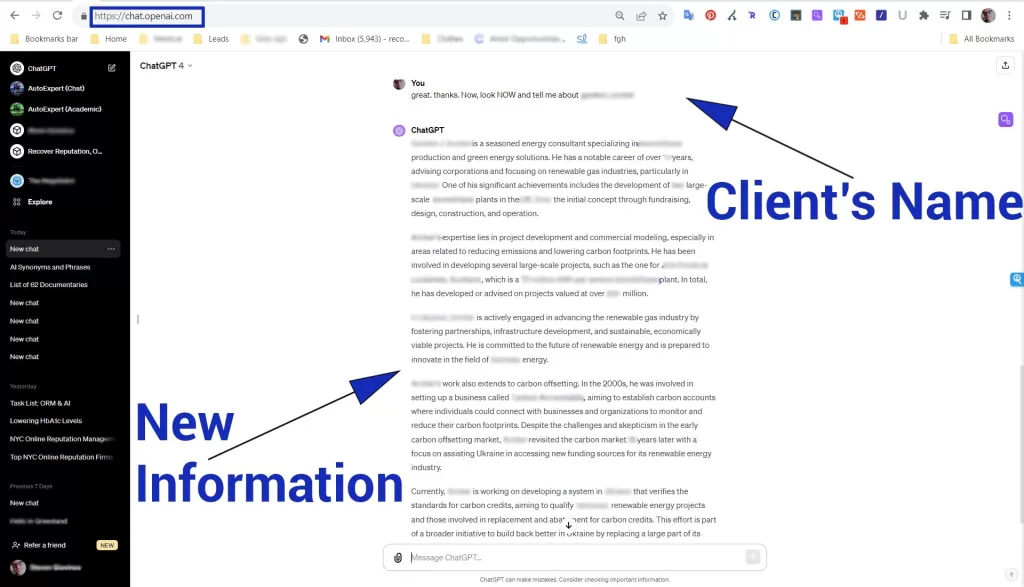
What is AI Reputation Management?  AI reputation management optimizes how people, businesses and brands appear in AI platforms such as ChatGPT and Gemini (Bard). The ultimate goal is to correct  generated answers or images in order to present you accurately and authentically. Since AI is rapidly becoming an alternative to traditional Google search results, it is essential to maintain a positive presence within these new platforms. Some questions:  Is your business, brand, or personal profile missing from AI results? Have you found inaccurate AI responses about you or your brand? Are you facing negative or false AI-generated answers? Unsure how to remove deep fake images associated with you? Key References Deep Fake Detection AI Help Cyber Civil Rights  Instagram Safety TikTok Safety Facebook Safety Snapchat Safety AI Reputation Solutions Build AI Presence: Establish your brand or self on pivotal platforms like ChatGPT, DALL-E, and Gemini (Bard), etc. ensuring you\’re represented authentically. Suppress Negative AI Answers: Systematically replace negative AI-generated content with factual, positive information, promoting your true narrative. Correct AI-Generated Responses: Proactively identify and remove deep fakes from DALL-E, Midjourney and the internet; repair poor AI-generated answers. Customize Tools and Consulting: Create custom GPTs, AI systems and strategies; offer AI education and marketing support; devise rapid responses to AI misinformation to protect and enhance your reputation. AI Reputation Process 1. Comprehensive Research and Strategic Planning: After an in-depth analysis/review of current web and AI presence, a customized strategy is crafted to align with your objectives and goals, emphasizing strengths. This strategy becomes the blueprint going forward. 2. Tool Optimization and Engagement: AI text and visual tools are reviewed to enhance any existing platforms and create new ones tailored to your industry trends and needs. This involves influencing, guiding and directing results as well as using some traditional SEO, ORM and engagement with key influencers. 3. Dynamic Content Development: Content creation and distribution of premium, impactful written and/or visual content across the network of platforms that have been optimized or established. This ensures your narrative remains authentic, engaging, and precisely what your clients are seeking. 4. Continuous Strategy Evolution: Constantly adapt, refine and improve strategies, making regular updates, engaging with key communities, and conducting ongoing research to stay successful. Case Studies and Client Success Real Before Screenshot: Bard (Gemini) Optimization Real Before Screenshot: Bard (Gemini) Optimization Situation: A sustainable energy entrepreneur faced a non-existent Gemini presence and a severely negative Google reputation due to false accusations, hindering business growth and investment opportunities. Outcome: Negative articles were quickly demoted within three months in two countries, and within six months for others. Achieved a positive Gemini presence rapidly. Why Choose Us? Education, Vision, Experience: Holding an MA from NYU\’s Interactive Telecommunications Program and an MFA from Yale University, Steven W. Giovinco blends technical and creative expertise. This educational foundation fuels our vision to provide innovative, ethical reputation management solutions across various industries. Direct experience spanning finance, law, medicine, arts, and more, reflecting a deep depth of industry knowledge. He is author of a comprehensive e-book, “Holistic Reputation Management,” and has ten years in boutique online reputation management. Contact Founder, Steven W. Giovinco Reach out and speak directly to CEO/Founder Steven W. Giovinco–no salespeople or chatbots here. Evaluations are always free. Recover Reputation +1-347-559-4952steve@recoverreputation.comwww.recoverreputation.com166 Second Avenue, Suite 11HNew York, NY 1ooo3

What is Generative AI Reputation Management and Why It\’s Important? Read More »

the willy wonka debacle: a cautionary tale of ai misuse and reputation damage

The Willy Wonka Debacle: A Cautionary Tale of AI Misuse and Reputation Damage

The Willy Wonka Experience, organized by Billy Coull, has morphed from a poorly managed event into a case study of AI technology gone awry. What initially appeared as a simple case of mismanagement has unraveled to reveal a deeper issue: the irresponsible use of AI. AI-Fueled Mismatched Expectations Vibrant, AI-generated posters promised an immersive chocolate wonderland–albeit with strange misspellings. Indeed, children experienced a frightening sparse warehouse. This setting of unrealistic based on fantastical visions collided harshly with reality, resulting in disappointment and anger. AI Scripts Amplify the Chaos Further compounding the problem were AI-generated scripts written for the actors. These lacked coherence and strayed far from any kind of anticipated whimsical and fun narrative. Instead of engaging audiences, they contributed to the event\’s overall chaos and downfall. Beyond the Event: A Pattern of AI Reliance? Billy Coull\’s alleged use of AI to write books, just makes things worse. This pattern of overreliance on AI, without proper comprehension of the terrible results, is a recurring theme in his work. A Lesson Learned: Responsible AI Implementation So, what can we learn? The Willy Wonka Experience serves as a stark reminder of the importance of responsible usage of AI. While it holds major potential for creativity and efficiency, its misuse can lead to significant consequences, i.e, severely damaged reputations and worse, impacting venues, participants, and the organizer. The Willy Wonka Debacle: A Cautionary Tale of AI Misuse and Reputation Damage AI Reputation Management is a cutting-edge service addressing the need for visibility in this new era. Basically, it builds a presence on AI platforms, corrects inaccuracies, fixes negative answers, or undesirable results generated by ChatGPT, DALL-E, Bard, and other tools.

The Willy Wonka Debacle: A Cautionary Tale of AI Misuse and Reputation Damage Read More »

Get to the Point: What CEOs Need to Know About Online Reputation Management in 2024

Get Right to the Point Google\’s recent algorithm update is a significant change that could impact your online reputation. The bottom line is that your website traffic might decrease significantly. This article explores the implications for businesses and offers solutions. What is the Recent Google Update? You might have noticed a decline in website traffic. This is likely due to the Helpful Content Update (HCU), which Google concluded in late September 2023 (the March 2024 Update is mostly a continuation. This update aims to prioritize high-quality content that genuinely informs and assists users. Websites with content solely focused on search engine ranking are probably going to be penalized. How Does HCU Impact Your Online Reputation? HCU can negatively affect your online reputation in several ways. Reduced website traffic means fewer people see your brand or services, potentially leading to decreased sales and a suppressed online presence. This makes you vulnerable to negative articles with minimal positive links. CEOs and those managing SEO or online reputation need to address this right away. What is HCU? Complete in late September 2023, Google\’s HCU prioritizes high-quality, informative content that genuinely assists users. It rewards websites that create content with a user-centric approach, rather than solely focusing on search engine ranking. What Should You Do? Focusing solely on blog posts for traffic and sales is no longer effective. Here are some solutions: Utilize Forums: Google prioritizes user-generated content. Actively participate on forums like Reddit and Quora. Some of these rank higher than Forbes and related media sites. Create branded accounts: Establish accounts for your name and brand on relevant forums, including StackExchange, DigitalPoint, etc. Engage in discussions: Be active on subreddits and threads related to your business. Provide valuable insights and answer user queries genuinely. Avoid spamming or overt sales tactics; doing so could result in further reputation damage. Expand your reach: Consider platforms like Medium, LinkedIn Articles, and even Tumblr. Focus on quality: Write informative, well-written content free from spam and sales pitches. Target specific topics: Address specific issues relevant to your target audience. Prioritize user value: Rewrite website content with the goal of providing genuine value to users, not just attracting clicks. Focus on user intent: Conduct competitor research and identify unique approaches. Target long-tail keywords: Use long-tail search terms based on user queries. Be authentic: Don\’t shy away from expressing your opinions (excluding highly political topics) to build trust and relatability. Avoid unethical practices: Never buy links or overly use poor AI-written content. Engage with others: Actively read, like, share, and leave genuine comments on others\’ content. Go local: Build a local presence on Patch and other sites. Optimize Google Business Profile: Ensure your Google Business Profile (formerly Google My Business) is complete. Consider Bing Places as well. Engage with local communities: Utilize platforms like Yelp to leave reviews for other businesses and encourage genuine reviews for yours. The Bottom Line In the current search and reputation landscape, focusing solely on manipulation tactics can damage your online reputation. CEOs must prioritize providing genuine information, building trust through authentic engagement, and actively participating in online communities to maintain a positive online presence.

Get to the Point: What CEOs Need to Know About Online Reputation Management in 2024 Read More »

A Suspicious Text Exchange and the Importance of Online Reputation Management

Recently, I received an unknown text. It started with, \”This is David from Laura\’s Office. Steven W Are you accepting new clients right now?\” While the message itself wasn\’t overtly alarming, several red flags stood out. The informality of being addressed by just my first name and middle initial was odd and is only on my LinkedIn profile. Also, capitalization \”Are\” at the beginning of the sentence is incorrect, and the phrasing was odd. Intrigued by the vagueness of the message, I decided to investigate further. A quick online search revealed no reference to the number. Obviously, another red flag. Next, I looked up the company website mentioned in the text. While it did exist, a glaring omission was clear- there was no contact information listed whatsoever. No address, no email address, not even a simple contact form – just a lone phone number. This is a major problem. Taking a deeper dive, I discovered the company\’s alleged address in \”Tampa.\” However, upon closer inspection using Google Maps, the site was actually a generic shopping center outside of town. Searching on LinkedIn, I saw that \”David,\” the individual who contacted me, was likely operating from a completely different location: Nigeria. A few takeaways: Exercise caution: Always be wary of unsolicited contacts, especially those lacking basic professionalism in their communication. Verification is key: Before engaging with ANYONE, conduct a thorough online search. Look up the phone number, browse the website\’s, and be sure a physical address is readily listed. A reputable business will have a transparent online presence. Professionalism matters: The way a company communicates reflects its reputation. Unpolished communication, especially when reaching out to potential clients, can severely damage a company\’s reputation. This serves as a reminder that even seemingly minor details like the way a text message is phrased, the lack of proper contact information on a website, and inconsistencies in a company\’s online presence are red flags. By exercising caution and conducting thorough verification, we can protect ourselves from potential scams and ensure we\’re dealing with legitimate businesses.

A Suspicious Text Exchange and the Importance of Online Reputation Management Read More »

Scroll to Top