Steven W. Giovinco

navigating the ripple effects: how openai's leadership shakeup impacts online reputation management, recover reputation

Navigating the Ripple Effects: How OpenAI\’s Leadership Shakeup Impacts Online Reputation Management

What is the fallout? And how will this impact your online reputation? If you are not a ChatGPT user, you might shrug your shoulders at the news of the ouster of Sam Altman and wonder what the fuss is all about. The answer might be a surprising yes, this could impact you—whether you use ChatGPT or not. Key References How AI ChatGPT Can Damage Your Online Reputation Microsoft hires former OpenAI CEO Sam Altman OpenAI board faces growing revolt over Sam Altman’s ousting OpenAI employees threaten to quit en masse after former CEO Sam Altman joins Microsoft Sam Altman joins Microsoft as OpenAI names its third CEO in 3 days   Background: What Happened?   OpenAI, the firm behind the disruptive ChatGPT, at the time of this writing, cryptically fired the CEO and founder, Sam Altman (Greg Brockman resigned too, among others). Without warning, this changed everything. Headline news and shock across the tech and business world was immediate. At the moment, we don\’t really know what happened, except that there was a “deliberative review process by the board, which concluded that he was not consistently candid in his communications with them, hindering its ability to exercise its responsibilities.” Maybe we will never know. How Is ChatGPT Helpful as a Reputation Tool? ChatGPT can be an online reputation repair tool (among other things, of course). It suggests content topics, assists in writing blogs, and summarizes white papers to be submitted elsewhere. (Note, however, when used improperly, AI can actually lead to further reputation damage if clients discover poorly written, unedited articles leading to an inauthentic experience). Remember, it\’s just a tool, not a replacement for well-thought-out content development, and should always be used as such. Who Does This Impact? The reason this affects everybody is that AI swiftly infiltrated businesses at all levels at an astonishing rate. If further development is impeded at OpenAI due to internal turmoil, this could have a ripple effect across multiple industries, including your own. Could This Affect Online Reputation Management? If you are using ChatGPT to correct or build a poor reputation, this could certainly have an impact. If you hire someone, an agency or reputation firm, they might use ChatGPT—either to cut corners to churn out poor content or to legitimately streamline their process. Development suppression due to “brain drain” and continued internal struggles might thwart application development. This, in turn, could ultimately weaken the work you are making—after all, if AI is helping to write a blog post, it might take more work than planned. Bottom Line Stay informed of developments. Be flexible and ready to shift strategies. Be ready to jump to a new platform and quickly pivot to another solution. As always, the best solution is to develop personal, well-written articles that lead to improved trust.

Navigating the Ripple Effects: How OpenAI\’s Leadership Shakeup Impacts Online Reputation Management Read More »

how to find an online reputation management firm

How to Find an Online Reputation Business You Can Trust

12 Questions to Ask When Looking for a Reputable Online Reputation Management Firm Summary Having a positive online reputation is invaluable for individuals and businesses, right?. Yet, sifting through the myriad of online reputation management (ORM) firms to find one that\’s both trustworthy and effective can seem like a minefield. With some ORM firms leaning into dubious tactics, your selection process becomes even more vital. This guide offers 12 pivotal questions to help your evaluation, touching on aspects from website quality to pricing strategies and the very techniques these firms champion. Free Evaluation Key References Leaked files reveal reputation-management firm’s deceptive tactics Black-Hat (computer security) The Definitive Guide To Reputable And Disreputable Online Reputation Management Pricing Understanding the Online Reputation Landscape How can you find the right firm to help repair or build your online reputation? More importantly, who is trustworthy and can deliver a legitimate solution at a fair price? The choice and selection can be daunting.  Unfortunately, unscrupulous online reputation management firms seem to proliferate. Finding the right one is paramount – getting this right can mean the difference between success and failure. Some companies buy reviews, purchase low-quality links from India, overcharge, engage in hacking, or follow “black hat” techniques. Ironically, the industry could use a reputation management overhaul itself. Working with the wrong firm can actually lead to additional reputation damage. Key Questions for Evaluating ORM Firms Here are some key questions to ask when seeking a reputable online reputation management firm. 1. What is the Website Like? Review the website. Is it helpful? Does it answer your questions in a clear and concise manner? Have they published recent blog posts? Can you spot typos or AI-written language? Is it filled with popups, phone numbers, and a push to sign up? Carefully evaluate their site to glean insights into the firm’s process – after all, if it appears careless or sloppy, you might expect the same poor work on your project. 2. What Is the First Contact Like? What is the first contact like with the reputation firm? If via email, does it seem formulaic or a hard sell with an urgent time to respond? If on the phone, do they seem distracted, disinterested, or unable to answer technical or procedural questions? Get a sense of the reputation management firm through your introductory contact.  A competent web reputation analyst should listen intently to your specific issue, offer a detailed solution, and be well-versed in web reputation and repair issues. Since some large firms use quota or commission-based salespeople, try talking with someone who will actually be doing the work. 3. Is the Pricing Realistic or Does It Change Quickly? Do they offer a set price and then drastically reduce it? Some reputation firms quote an initial fee but quickly lower it. Beware: this could indicate that the firm is overcharging, is providing substandard work, or is basing their fee on what they think you can afford.  Also, is the proposed amount realistic? Some companies might offer a woefully inadequate fee that should be ten times larger to be successful. A price quote should be based on how many hours it takes to solve the issue and the complexity of the task. 4. Quick Solution Within Weeks? Are they promising a fast solution in weeks? Although total removal or suppression in less than a month might be possible depending on the severity, an average online reputation repair case takes six months or more.  People who promise nearly immediate results are over-promising or are purposely deceptive. It\’s wise to move on. 5. Are They Using Bad or Blackhat Techniques? Does the reputation firm use shady or “black-hat” techniques? Disreputable firms engage in bad practices ranging from buying followers, falsifying reviews, and even hacking. Most egregiously, I’ve heard of reputation businesses purposely damaging a random person and then contacting them to offer a solution! Also, be aware of the term “proprietary solutions”.  This often refers to things such as “link-farms” or a series of low-quality websites made that link back to each other to artificially boost their client’s web presence. Options such as these have no or minimal reputation value, and can actually incur further reputation damage. Reputable firms focus on analysis, research, excellent content creation, and consistent monitoring. 6. Do They Guarantee Removal? Do they guarantee outright removal? While images or videos which violate copyright rules are possible to delete, most articles are not, especially if they are journalistic or media-related.  If a firm says they can remove any type of content, they are probably engaging lawyers who submit dubious take-down requests, which is often not effective with Google search results. In reality, suppression is often the only option. Transparency in their approach is key. Ready to Regain Control of Your Online Reputation? Get in touch with us today for a free consultation. Let\’s work together to restore your online reputation and get your life back on track. Please enable JavaScript in your browser to complete this form.Name *Phone Number *Email *MessageEmail Submit 7. Do They Have Relevant–and Real–Case Studies? Do they have real case studies? If the company has no or minimal examples of their solutions, move on to someone else. Also, since testimonials or case studies could be fabricated, review them carefully for veracity. Look for detailed case studies that outline the problem, solution, and results.  Also, if you are in the financial sector but they handle auto dealership or restaurant reviews, it’s not a good match. 8. Do They Have a Real Location? Where is the business located – and are they really there? Believe it or not, this is an issue. I’ve seen companies claiming to be in the US but are actually in Russia, India, or China. Since nearly all reputable firms post their location, phone number, email, and other pertinent information, not having a street address could mean the company is not legitimate or is located overseas. (However, some sole proprietorships prefer to use P.O. box offices.). A simple way to

How to Find an Online Reputation Business You Can Trust Read More »

the $100 million gamble: unraveling the online reputation battles of twitch, kick, and reddit, by recover reputation

The $100 Million Gamble: Unraveling the Online Reputation Battles of Twitch, Kick, and Reddit

Summary This article is about the attempt to build the online reputation of a business and the self-inflicted unraveling reputation of another. I specifically focus on the recent events involving streamers, a $100M deal and the sites Twitch, Kick, and Reddit. An analysis of the hugely popular xQc\’s and Amouranth’s move to Kick and Reddit\’s API pricing controversy highlights the critical importance of transparency, community engagement, and strategic planning in online reputation management for businesses and individuals alike. Introduction I’ll address a seemingly obscure realm of the internet but one that holds significant lessons for businesses, brands, or C-Suite executives. You probably have no idea who xQc or Amouranth are, or are familiar with Twitch, Kick, or Reddit. No worries.  However, if these names sound vaguely familiar, it’s because they recently made front-page headlines in the New York Times. It involves a $100 million payment, akin to what LeBron James might receive, to a 27-year-old, which is attention-grabbing.  The story surrounding these events provides valuable lessons in business and reputation management. In summary, one platform paid streamers multi-million dollars to repair its reputation, while another, Reddit, damaged its credibility due to greed. Below is some background on what this is all about. If you are familiar with what I mentioned, feel free to skip to the “100 Million Dollar Move” section.  Key References Kick Just Stole xQc And Amouranth, Twitch’s Top Male And Female Streamers, Within 48 Hours Thousands of Reddit communities go dark to protest company’s controversial new policy Twitch Star xQc Signs $100 Million Deal With Kick, a Rival Platform Greece Bans Streaming Platform Kick Over Gambling Content Case Study 1: Twitch Streamers First, let’s understand the sites and players.  Twitch is a platform for real-time live streaming. Think of it as a fusion between YouTube and a live broadcaster. Initially, the platform carved a niche for itself by focusing on gaming, where players share live footage of themselves playing video games (which personally, seems odd–but thousands watch them). It has since diversified into many other categories, some of which feature live journalists, comedy, etc. (even The Washington Post has a channel). One key feature of Twitch is the ability for people to interact with the streamer live through chats. This makes it a very engaging platform, as viewers can ask questions, make comments, and receive immediate feedback. Advertisers love Twitch as a marketing tool. Popular Twitch streamers monetize their channels through advertisements, subscriptions, and donations from viewers. Businesses can also sponsor streamers to promote their products or services to a targeted but coveted audience. Millions of dollars are made by both the brands and streamers. What is Kick? Kick is also a video live-streaming platform, but it was launched in 2022. It was designed to rival Twitch, which is owned by Amazon, by offering a more relaxed moderation policy (i.e., edgier, and perhaps less controlled) and giving a higher revenue share to streamers. It is owned by one of the largest online gambling entities, Stake, and as a result, many streamers who focused on controversial content, such as gambling, migrated to Kick. Kick also made headlines recently by signing deals with several high-profile streamers who previously had a strong presence on Twitch, including xQc and Amouranth. Who Is xQc? xQc, aka Félix Lengyel, is a Canadian internet personality and former Twitch streamer. He is considered an entertaining and often eccentric online persona by fans (I’ve never seen him). xQc initially gained fame as a professional gamer, representing Team Canada in the Overwatch World Cup–a big deal in the streaming realm. He transitioned to full-time video gaming and real-life (IRL) content.   Who is Amouranth? Also a former Twitch streamer, Amouranth streams games and other content but is known for sitting in a hot tub (that’s right). She’s been banned from Twitch for controversial sharing but is immensely popular and has millions of followers.   The 100 Million Dollar Move Now that we’re finished with the background, let’s get to the meat of the matter. Platforms and streamers are constantly evolving. xQc and Amouranth are prime examples of mega online influencers who have made huge paychecks through ad revenue and other sources. With a massive following on Twitch, they recently made the move to Kick.  Overall Business Implications These moves have implications beyond xQc, Amouranth, Twitch, Kick, or any specific platform.  Actually, it’s a reflection of the broader online landscape where businesses and brands often believe they can swiftly change the narrative surrounding a negative reputation. Kick, for instance, has faced criticism due to its association with gambling and controversial streamers such as Adin Ross, who was banned several times on other platforms. It seems that luring big-name streamers is an attempt to repair Kick’s reputation. This should serve as a cautionary tale for businesses and brands on the complexities of reputation management. Motives Behind the Move Both xQc’s and Amouranth’s decisions to transition to Kick could be attributed to a plethora of factors, but it probably comes down to money. They might want to pursue creative freedom or a change of scenery, but financial incentives seem central since Kick offered insanely lucrative contracts. However, such a move is not just a simple switch; it carries a reputational impact for both the streamers and the platforms. Impact on Kick\’s Reputation Kick’s “acquisition” of proven talent in xQc and Amouranth is evidently an attempt to leverage their extensive followers for greater visibility and user acquisition, to potentially earn more money. But more importantly, the association with prominent streamers seems to be a strategic plan to fix Kick’s negative reputation and rebrand itself. After all, if major stars are there, it must be a good platform, right? Potential Risks However, this strategy is fraught with risks. Although unlikely, the streamers\’ past (an apparently, new) controversies and bans might cast a negative shadow over Kick. More importantly, it could easily be seen that the platform is attempting to “whitewash” its poor reputation. Critically, this could be seen as blatantly inauthentic, since reputations

The $100 Million Gamble: Unraveling the Online Reputation Battles of Twitch, Kick, and Reddit Read More »

Kickstarting Your Online Reputation Repair: A Comprehensive Initial Client Questionnaire for Success

We Need to Know Who You Are This questionnaire is designed to gather comprehensive information about new online reputation management clients, their businesses and future plans. This research is vital for the reputation repair process, as it helps Recover Reputation understand a client’s background in detail, develop content topics, connect with industry leaders, and establish suitable online platforms.    Social Media Presence Please list all social media platforms where you currently have a presence, with credentials. Which websites and publications do you frequently visit? What are the key industry platforms you follow? Personal Information When is your birthday? What was your college major, and where and when did you graduate? Where did you attend high school/secondary school? Were you involved in any clubs or special classes? Did you have any classmates who have since become noteworthy? Family Background Could you provide your spouse\’s occupation and educational background? What are your parents\’ names, and where do/did they live and work? Could you provide details about your children, if you have any (names, ages, education, location, occupation, and significant accomplishments)? Where have you lived previously? Interests and Achievements What are your hobbies or interests? Are you a member of any clubs, charities, or groups? Have you received any awards? Have you served on the board of any groups or companies? Career and Business Are you pursuing any other industries apart from what we\’ve discussed? Who are your key competitors? How do you perceive their online reputation? Who is your target audience? What are their demographics and what online platforms do they typically use? What countries are you targeting? How would you describe your brand\’s voice or personality? Are there specific values or characteristics you want to emphasize in your online presence? Content and Account Guidelines Add any proprietary content, articles, or images that we might use to the Google Drive. What Should Be Avoided Are there any other topics or content that should be avoided (apart from the negative links)? Are there any existing links, articles, images, or videos that should not be included on new sites or platforms? Are there any platforms where you should not have a presence? Are there any previous employers or companies that I should avoid adding your information to their Wikipedia articles? Are there any positions, co-workers, or employees I should avoid mentioning?

Kickstarting Your Online Reputation Repair: A Comprehensive Initial Client Questionnaire for Success Read More »

The Role of Online Reputation Management in the Downfall of CNN\’s Chris Licht

Unraveling the Impact of Reputation Narratives: How Media Portrayal and Internal Strife Led to a Leadership Crisis at CNN Chris Licht, the now-former CEO of CNN, was dismissed following a whole range of upheavals, controversial decisions, internal strife, and a decline in viewership–within his 13-month reign. These problems culminated in a critical piece in The Atlantic, however, which painted Licht as a leader struggling to manage the news division in a time of widespread mistrust. This article seens to have been the final straw. While news and corporate leadership analysts will have their own take on the dismissal, I\’d like to focus on the role of online reputation management in this situation. Yes, problems had been brewing for months or years at the network, but the problematic depiction of Licht in the media and online seems to have been a major factor in his downfall. The Atlantic\’s article, which was widely shared and discussed, certainly cast a negative light on Licht\’s leadership and approach. This unfavorable online image, combined with CNN\’s internal challenges, appears to have led to his firing. The Atlantic\’s piece, initially pitched as a look at cable news through Licht’s first year, instead became a damning series illuminating hubris and arrogance, painting a deeply unflattering depiction of Licht. This, coupled with the criticism of Donald Trump’s Town Hall, angered CNN staff. Later, even major anchors lost confidence in him. But regardless of whether The Atlantic piece was fair or unfair to the CEO, the damage was done, and it became clear that Licht could not continue as CNN’s leader. This situation emphasizes the importance of online reputation management, especially for high-profile individuals and organizations. Information—either positive or negative—is spread quickly and broadly, often within minutes. A single negative article or social media post can inflict considerable harm on an individual\’s or an organization\’s reputation. In Licht\’s case, it seems his online reputation outpaced any attempts to control or mitigate it. This highlights the need for online reputation management strategies, including responding to negative articles (which he did, to some degree).  However, sometimes, despite apologies and internal discussions, there is no chance to recover if the damage is too severe, and in this case, it seems appropriate.

The Role of Online Reputation Management in the Downfall of CNN\’s Chris Licht Read More »

strategies for businesses to avoid greenwashing and foster sustainability: the importance of transparency, authenticity, and online reputation management

Strategies for Businesses to Avoid Greenwashing and Foster Sustainability: The Importance of Transparency, Authenticity, and Online Reputation Management

Original photos taken and edited by the author. Online Reputation Strategies for Businesses to Avoid Greenwashing and Foster Sustainable Practices Key Points: Businesses exaggerate their environmental efforts in the deceptive practice \’greenwashing\’ to appear more sustainable. Greenwashing can damage a company\’s online reputation, leading to loss of consumer trust, negative publicity, potential legal consequences. Online reputation management can repair greenwashing. Buyers want to buy “green”. In the era of conscious consumerism these days, many businesses are trying to signal their commitment to the environment and sustainability in a bunch of ways. However, not all are really eco-friendly.  As a result, \’Greenwashing\’ is somewhat rampant, and is the term used for the deceptive practice where companies exaggerate or falsify their efforts to appear more sustainable than they really are. I’ll delve deeper into greenwashing, its reputation implications, and how consumers and businesses can navigate this deceptive landscape. Key References Investopedia: Greenwashing The Legal Risks of Greenwashing Are Real  What Is It  Greenwashing is a seemingly benevolent but false tactic where a corporation, business, or brand presents itself as more environmentally friendly than they are. This can come in various forms, each designed to create a false impression of sustainable responsibility. Where it Started First, let’s examine the term. “Greenwashing\” was coined by environmentalist Jay Westerveld back in a 1986 essay, where he criticized the hotel industry\’s practice of placing placards in each room suggesting the reuse of towels to essentially \”save the environment\”. But in most cases, little or no effort toward waste recycling was being used by these businesses. Westerveld discovered that the actual objective of this \”green campaign\” was to make more money (shocking!). He labeled this tactic to maximize profits as greenwashing. The Many Forms of Greenwashing Ambiguous Language Commonly, greenwashing uses vague or suggestive language. Companies might mention terms like \’green\’, \’eco-friendly\’, \’natural\’, or \’sustainable\’ without defining what they are really talking about. For instance, a product might be labeled as \’all-natural\’, but since it has no standard definition, it can be used to describe nearly anything. Misleading Labels Another form of greenwashing is the use of misleading labels. A business might create a label or logo that looks like an environmental certification, even though it has no official standing to back it up. Or, a company might use a legitimate certification deceptively, such as by placing it prominently on a webpage when only a small part of the product/service meets that criterion. False Advertising False advertising is a more blatant form of greenwashing. This involves making false, unreal or unsubstantiated claims about environmental benefits. For example, a company might claim that its service is \’carbon-neutral\’ or \’zero-waste\’ without providing any evidence to back this up. Lack of Transparency Simply omitting facts can also be a form of greenwashing. A company might make very broad claims about its environmental commitment without being transparent about its actual practices. For instance, they might claim to be \’committed to sustainability\’ without providing any detailed information about their carbon footprint, waste management practices, or sourcing policies. Deceptive Imagery in Greenwashing Imagery plays a powerful role in shaping perceptions and influencing behavior. In the context of greenwashing, companies often exploit this to create a fake impression of environmental responsibility. This tactic is prevalent and can be hard to spot. Lush green landscapes, clean rivers, and nature-related images often appear in a business’s products or in its advertising. These evoke feelings of serenity, purity, and harmony with nature, leading buyers/consumers/clients to associate positive feelings with the company or product. This can create the idea that they are environmentally friendly and care about the planet. However, these images often mask the reality of the company\’s environmental record. For example, a financial company might use images of a pristine forest throughout its branding, even though the services they promote contribute to deforestation. Or, a company might use photos of clean water in its advertising, even though it discharges pollutants into local rivers. Also, the deception of imagery can make it difficult for consumers to make the right choice, especially as AI becomes more prevalent. It can be confusing and make it harder for people to distinguish between companies that are genuinely sustainable and those that are merely greenwashing. Social media allows the swift sharing of images, making deception a powerful tactic. However, as people become more aware, companies that engage in it risk damaging their online reputation and losing consumer trust. False Accusations  Competitors attempting to gain a competitive edge may resort to spreading false rumors or information about a business\’s environmental practices. They could allege that the company is not following regulations, is harming the environment, or is not genuinely committed to its initiatives. These false claims can quickly spread online through social media platforms, blogs, and review sites, harming the company\’s online reputation and potentially leading to lost business and more. Disgruntled ex-employees can also threaten a company\’s online reputation. Given their insider knowledge and potential access to sensitive information, they could make false claims about the company\’s environmental practices out of spite or to retaliate. These can be particularly damaging since they appear credible due. So,  greenwashing can take many forms, all designed to mislead consumers and create a false impression of environmental responsibility. It\’s important for consumers to be aware of these tactics and to scrutinize environmental claims carefully. Examples of Greenwashing Several high-profile greenwashing cases have come to light in recent years. Here are some examples.  BP (British Petroleum) Back in the early 2000s, BP, one of the world\’s largest oil and gas companies, launched a $200 million advertising campaign to rebrand itself as \”Beyond Petroleum\”. The idea was to portray the company as a forward-thinking corporation committed to renewable energy. The rebranding included a new logo, and a green and yellow sunburst, illustrating clean energy. However, only a small portion of their total investment outlay was in renewable energy. It seemed that the rebranding was just a tactic designed to distract from the company\’s continued dependence on oil.

Strategies for Businesses to Avoid Greenwashing and Foster Sustainability: The Importance of Transparency, Authenticity, and Online Reputation Management Read More »

revamping recover reputation: a comprehensive guide to our enhanced services and client centric approach

Revamping Recover Reputation\’s Website: A Comprehensive Guide to Our Enhanced Services and Client-Centric Approach

New Site We redesigned the Recover Reputation website to focus on reputation services, core clients, ethics, and transparent pricing. Central to our vision is providing comprehensive, ROI-driven solutions to reclaim and build a stellar reputation. The focus is always being committed to integrity, customization, and selectivity, leading to a recovery rate of 90%. We also are AI-ready to adapt to the quickly evolving search industry. New Dedicated Pages  Reputation Repair Providing a comprehensive solution for online reputation management, focusing on the creation of high-quality, persuasive content to suppress negative links and promote positivity. Our approach includes an in-depth analysis of the client\’s reputation, followed by a tailored strategy that includes platform creation, content creation, and consistent updates to improve search engine rankings and suppress negative links. Reputation Building Committing to building a robust and credible online presence that accurately reflects a brand\’s values and achievements. We work closely with clients to understand your brand values and accomplishments, which then highlight through various online platforms, ensuring a true representation of you or your business to attract more business and mitigate potential future harm. Image Reputation Excelling in managing image and video-related reputation issues, such as embarrassing photos, mugshots, or cyber extortion incidents. Our process involves analyzing the negative content, devising a strategy for suppression or removal, and promoting positive media to enhance your online image. Reputation Removal Specializing in the removal of detrimental online content such as negative links, reviews, articles, videos, images, AI-generated content, or comments. Our approach involves identifying the negative content, assessing its deletion possibility, and initiating necessary actions to either remove or suppress the content, thereby enhancing your online reputation. We have added dedicated pages for our clientele: CEO/C-Suite Maintaining a positive online presence for CEOs and C-suite executives, providing targeted and effective reputation repair services tailored to their specific needs. High Net-Worth Individuals Addressing negative online content impacting high net-worth individuals, affecting financial performance, damaging credibility, infringing on privacy, and increasing vulnerability to threats. Finance/Law Catering to a broad range of clients, including financial advisors, hedge funds, banking managers, and law practices, covering areas like lending, SEC issues, and more.  Arts/Education/Non-Profit Targeting those in the arts, entertainment, education, or non-profit fields, offing effective reputation repair services. Other pages include: Testimonials Showcasing various testimonials and case studies of successful interventions in enhancing clients\’ online reputations. It highlights instances where we’ve helped clients ranging from CEOs to young professionals overcome reputation crises caused by negative online content, with a success rate of 90% in suppressing negative links. Resources Offing a wealth of information for managing online reputation. It provides a free e-book that serves as a comprehensive guide to establishing and maintaining a positive online presence, along with a variety of articles, case studies, and videos on related topics. Investment Understanding online reputation is a valuable asset, seeing costs not as just expenses, but as an investment. We’ve also listed prices ranging from $1,500 to $7,000 per month, depending on the project. Ethics Adhering to strict ethical guidelines for online reputation management. We discourage the creation of fake reviews or comments, which is not only unethical but potentially illegal and damaging to your reputation. We never use black hat techniques like link farms, bots, hacking, plagiarism, spam, or related tactics. We advocate for partnering only with ethical reputation management firms that demonstrate honesty and transparency to avoid subpar services. What is Online Reputation We’ve crafted an in-depth article on online reputation management, what it is, and how it is repaired. We discuss the process of controlling and influencing an individual\’s or business\’s reputation, encompassing everything from Google search results, social media posts, SEO, media, and even print products. It\’s crucial because it builds trust, conveys a professional and experienced tone, and substantiates confidence, making potential clients feel more comfortable choosing you over competitors. Other New Features Our team undertook a comprehensive redesign of the website with a focus on enhancing user experience. We prioritized creating a user-friendly interface that is intuitive and easy to navigate, ensuring that visitors can find the information they need with minimal effort. In addition to improving the site\’s structure and navigation, we also enriched the content available on the site. We meticulously curated and expanded the information provided, ensuring that it is detailed, accurate, and valuable to our users. The redesign aims to make the website not only more aesthetically pleasing but also more informative and efficient for our users. Real Photographs We take pride in the authenticity and originality of our content. All the photographs featured on our web pages are captured directly through a camera by our team. This means that every image you see is the result of careful planning, composition, and execution, rather than being AI-generated or sourced from generic stock photo libraries. We believe in the power of genuine, high-quality visuals to convey our message and represent our brand. This commitment to authenticity not only ensures the uniqueness of our content but also aligns with our mission to provide honest, tailored, and quality-centric services to our clients. Real Before-and-After Screenshots These \’before and after\’ images serve as tangible proof of our success, demonstrating how we\’ve helped our clients overcome their online reputation challenges. They show the transformation from a tarnished online reputation to a restored and positive one, highlighting the impact of our tailored strategies and diligent efforts. By sharing these real-life success stories, we aim to give potential clients a clear understanding of what they can expect from our services. We believe that this level of transparency not only builds trust but also reinforces our commitment to delivering successful outcomes for our clients. AI Information We’ve included information on technology advancements such as the impact of AI on online reputation management. We can pivot quickly to industry changes since the old way of doing things will probably be obsolete.

Revamping Recover Reputation\’s Website: A Comprehensive Guide to Our Enhanced Services and Client-Centric Approach Read More »

the rise of ai generated photos using midjourney: an online reputation risk?

The Rise of AI-Generated Photos Using Midjourney: An Online Reputation Risk?

The use of AI-generated photos is becoming increasingly prevalent. Platforms such as Midjourney have emerged, offering a simple and quick solution to generate realistic images. However, this introduces potential pitfalls regarding online reputation. As straightforward as it may seem to use these AI-created images, both businesses and individuals should be aware of the possible reputation risks. Authenticity Concerns: The Illusion vs Reality A major concern lies in the question of authenticity, or the lack thereof. Businesses and individuals should strive for genuine engagement with their clients. However, resorting to stock images or poorly-made AI-generated photos from Midjourney can significantly diminish the perceived integrity of your brand or identity. In an era where transparency is highly valued, using artificially created images could potentially harm the credibility that you\’ve worked hard to establish. Customers and clients are discerning and possess a keen eye for generic and inauthentic imagery. The overuse of AI-generated photos might result in poor consumer confidence and decreased interest in your products, services, or personal brand. If the audience can’t trust your images, they might question your authenticity and, ultimately, your integrity. Online Reputation Management Ramifications: The SEO Perspective Beyond the issues of authenticity, there are also ramifications to consider regarding the technical side of online reputation management. Search engines like Google and Bing prioritize websites that feature original, high-quality content. Resorting to AI-generated images could potentially result in lower page rankings in searches. This could lead to decreased website traffic and visibility, adversely affecting your online reputation. Appearing less prominently in search rankings could hinder potential customers or followers from finding your website or social media platforms, further harming your online reputation. Therefore, considering the SEO implications of using AI-generated images is essential for maintaining a positive online presence. Unique Risks with Midjourney: It’s Not Always Private Midjourney, in contrast to other AI photo-generation platforms, poses a distinctive risk. Unless users opt for the premium version, it offers visibility into the activities of other users, including their image creations, text requests, and usernames. This level of transparency could inadvertently invite online trolling and disclosure of users\’ utilization of AI-generated photos, both of which could potentially tarnish their online reputations. Or, an individual may repurpose or take someone else\’s image. This underscores the importance of considering the privacy implications of using platforms like Midjourney. Diversity and Inclusion: The AI Bias Another issue surrounding AI-generated images relates to diversity and inclusion. Despite advancements in AI technology, it is currently incapable of adequately replicating the unique traits that distinguish individuals or groups. As a result, using AI-generated images may inadvertently exclude certain demographics or perpetuate damaging stereotypes. If not handled carefully, these can harm your reputation and alienate potential customers, followers, or partners. As we become more conscious of diversity and inclusion, it is essential to consider how your online presence reflects these values. Legal Implications: The Copyright Conundrum There might also be potential legal complications associated with using AI-generated photos. Platforms like Midjourney utilize algorithms to produce images that bear a striking resemblance to real-life pictures. This could inadvertently lead to copyright infringement. Legal repercussions and fines from using an AI-generated image that mirrors a copyrighted one could be damaging not only to your reputation but also to your financial standing. Therefore, understanding the legalities surrounding AI-generated photos is essential. The Bottom Line: Invest in Authentic, High-Quality Photos While the allure of quick and easy AI-generated photos through Midjourney can be tempting, it\’s crucial to weigh the possible implications for your online reputation. The optimal strategy lies in dedicating time and resources to produce authentic, high-quality content that genuinely mirrors your brand\’s core values. This approach, though requiring more effort, is best for your reputation. The photograph included is original, made by a camera and was created by the author.

The Rise of AI-Generated Photos Using Midjourney: An Online Reputation Risk? Read More »

decoding ai in online reputation: a guide to doing better, recover reputation

Decoding AI for Online Reputation Management: A Brief Guide to Doing Better

Understanding AI and Its Role in Online Reputation Management Let’s take a moment to ponder the impact of artificial intelligence (AI) and its role in online reputation management. You\’ve heard of AI, and perhaps even used ChatGPT. The Misuse of AI: A Case Study I noticed a website’s blog—another online reputation management firm, actually—that seemed slightly off, prompting me to run it through an AI-checker tool, GPTZero. The article was AI-generated. This is a perfect example of what not to do: copy and paste a result. The Double-Edged Sword of AI Tools This underscores the problem that AI and tools like ChatGPT represent. They’ve started to revolutionize multiple industries, making it easier to write or produce blogs, articles, white papers. Yet misuse or over-reliance on AI can lead to a tarnished online presence as readers discover the shortcut. The Limitations of AI in Content Creation Often, content completely generated by AI lacks the nuanced understanding and emotional intelligence that human writers pose. AI can analyze patterns and trends, but can it truly understand the cultural, social, and emotional contexts that often drive our online interactions? An over-reliance on AI creation and interaction can lead to a lack of authenticity, trust, or real connection with clients or readers, resulting in online reputation management damage. Striking a Balance: AI and the Human Touch It\’s important to strike a balance between leveraging AI for efficiency and maintaining the human touch that makes you and your brand relatable. AI Usage Best Practices Here are a few tips: Limit AI Usage: AI can be a great assistant, but it shouldn\’t replace your own unique voice and personality. Make sure the AI-generated content aligns with your brand\’s messaging. Review and Edit: Always review AI-generated content for errors and tone since AI isn’t perfect. Never simply “copy and paste.” Be Human: Balance AI content with human-generated content to ensure your audience still feels a personal, authentic connection. Mindful AI Usage: The Way Forward So, it’s hard to dismiss AI completely but use it mindfully, as you would any tool.

Decoding AI for Online Reputation Management: A Brief Guide to Doing Better Read More »

mastering the future of online reputation management: white label solutions for 2023's digital landscape

Mastering the Future of Online Reputation Management: 6 White Label Solutions for 2023\’s Digital Landscape

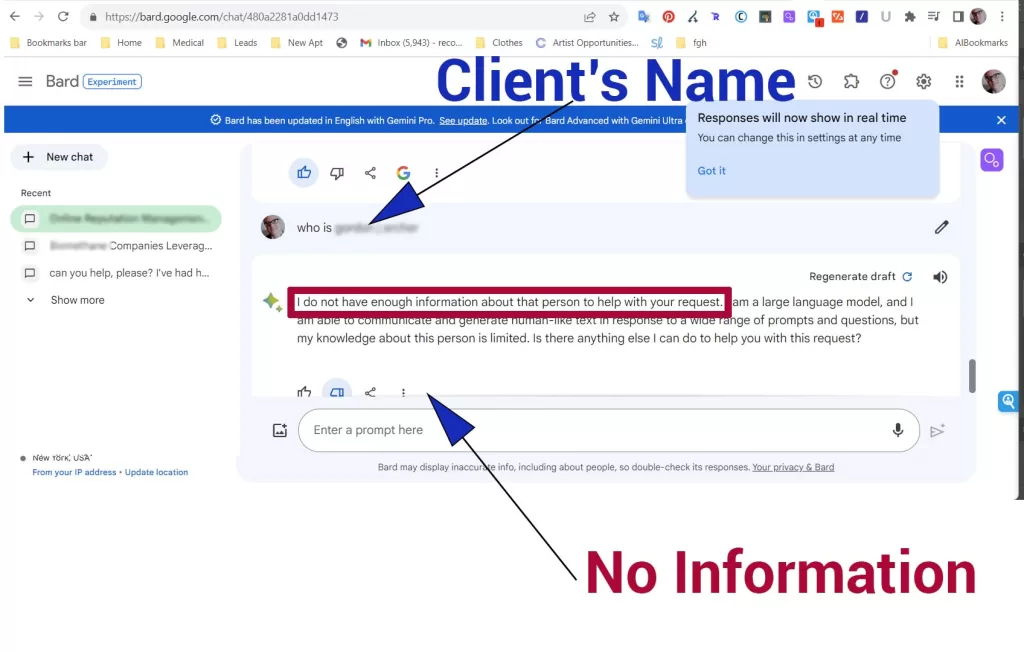
Times Are Changing… In 2023, online reputation management (ORM) solutions have grown increasingly complex, rendering previous approaches less effective in the current landscape.  Crisis management agencies, internet law firms, larger ORM firms, PR agencies, and SEO firms need up-to-date solutions as traditional methods of reputation management are now less effective or are in flux. Quickly pivoting to new techniques is essential to address artificial intelligence while remaining visually relevant and individualized. White label solutions ensure your clients\’ online presence thrives in this ever-evolving digital environment. New Problems The Invisible Business Problem Reputation management has changed significantly in recent months due to Google updates, new competition, and especially with the advent of AI tools such as ChatGPT. Many praise the time-saving efficiencies and cost reductions, but they may not recognize a looming problem for clients: their curated online presence, including their website, social media platforms, and client engagement, could disappear. This means that unless you are extremely prominent, won’t appear in ChatGPT answers.  As more people use AI-powered tools, it becomes increasingly difficult for small and mid-sized businesses to appear in AI responses, diminishing the online visibility of brands, individuals, and most businesses, and adversely affecting their online reputation. Try it yourself. In ChatGPT, ask, “Would you recommend [Your Company’s Name]?” or, “Is [Your Company’s Name] trustworthy?” What do you see? Do the same search in Google, and see the results–the results can be unexpected (and not in a good way). Hidden Reputation Dangers of AI If a brand uses AI to save money by writing blogs, whitepapers, website content, or social posts, and it\’s detected, this could lead to online reputation damage. Poorly written articles, automated responses, and inaccurate answers can harm clients\’ reputations if discovered.  If you\’re not an expert in navigating AI tools, prompts, and usage, white label solutions might be a great way to serve your clients. 6 Solutions for ORM Success It still remains crucial to conduct thorough research and analysis of clients\’ issues, optimize platforms for backlinks, create distribution networks, and foster genuine connections with key influencers to amplify and suppress negative content. However, the \”antidote\” for ORM in 2023 has expanded to include creating meaningful content, incorporating stunning visuals, developing ideas, engaging authentically, pivoting quickly, and providing individual attention to clients. 1. Google and Bing Google has shifted into \”code red\” mode, altering their algorithm in response to ChatGPT, emphasizing natural language queries. For online reputation management, this highlights the importance of exceptional content to stay ahead of industry changes. Also, Bing, due to its association with ChatGPT, is gaining traction and should be taken into account in ORM strategies–it is no longer the \”forgotten\” search engine. 2. Winning Written Content Meaningful, newsworthy, and authentic content is vital to counter new algorithm changes in Google and to address ChatGPT (in fact, this is always the best solution to ORM repair issues). Blog posts, articles, presentations, and white papers should target a niche or a very specific question/issue in order to be relevant in search engines or AI answers. Content should be strategically placed and optimized to gain maximum exposure and reputation boost. Since AI answers are not in real-time, being timely or identifying new or unique takes on subjects is essential. Consistently updating with new content and engagement is the final key to success. 3. Visuals that Stands Out In today\’s ORM landscape, it\’s essential to prioritize high-quality visuals, such as photography and video. This often-overlooked component of reputation management is gaining significance as AI continues to influence search results. While Google and Bing incorporate images and videos in their results, ChatGPT currently does not, offering a potential competitive advantage. Tools like Midjourney can streamline image creation, but missteps may harm one\’s reputation. To distinguish your ORM strategy, focus on developing captivating, genuine, and narrative-driven visual assets. 4. Ideas Are Paramount In the age of ChatGPT, ideas hold even greater significance since content is easier to craft. While AI can generate articles, blogs, and whitepapers swiftly, the quality, novelty, and impact come from human ideas. With the availability of tech tools, the primary differentiator becomes the creative and strategic insights that people think up. It\’s the human ideas, thoughts, and perspectives that shape the direction, tone, and context of the content that ChatGPT generates. This is particularly important when aiming for high-quality content that resonates with audiences, sparks engagement, or drives action. So, even as ChatGPT simplifies the process of content creation, the importance of human ideas has intensified and is crucially necessary to guide AI, ensuring it produces the best and most effective content. 5. The Importance of Pivoting It\’s more important than ever to pivot to new or upcoming approaches as soon as possible – not doing so could mean failure for reputation clients. With frequent updates to Google\’s algorithms and AI tools disrupting businesses, strategies require constant realignment. 6. Individual Attention Matters Clients always need individualized attention, which is even more crucial now. Given the rapidly shifting business and reputation landscape, hands-on, trusted contact with clients can help retain and reassure them. Conclusion Embrace the new frontier of online reputation management in 2023 by focusing on AI-centric strategies, captivating visuals, and excellent content. Recover Reputation can help navigate the shifting online reputation landscape through white labeling.  All the images here were created by the author using a camera.

Mastering the Future of Online Reputation Management: 6 White Label Solutions for 2023\’s Digital Landscape Read More »

Scroll to Top