AI Reputation Management

combating generative ai misinformation: strategies to build trust and using online reputation management and llm updates

The CEO\’s Playbook for a GenAI World: An Introduction to GenAI Reputation Management

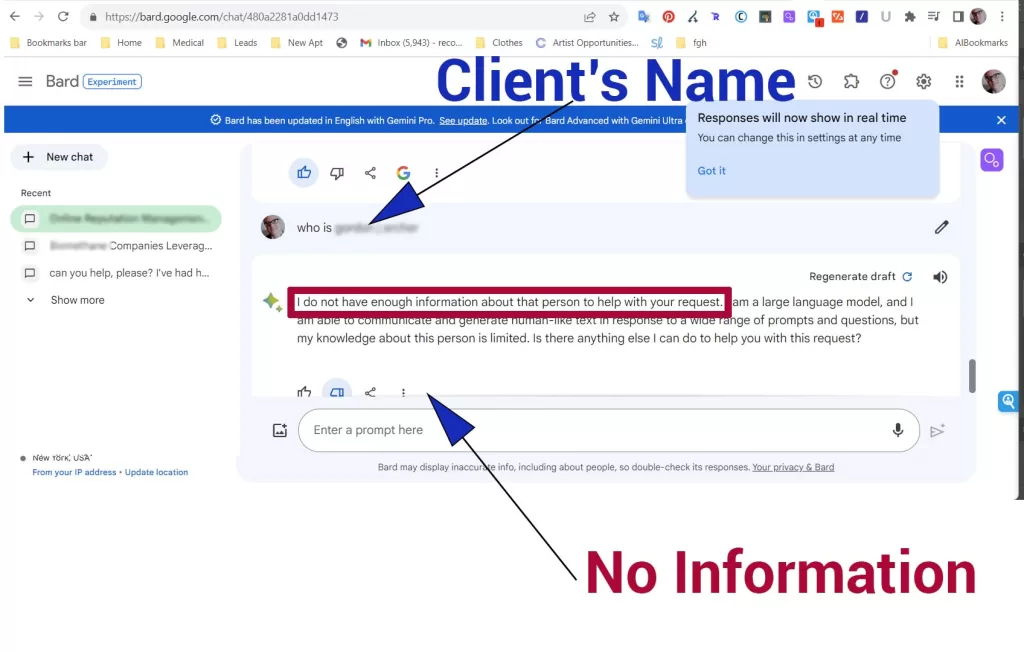
Executive Summary The way customers and stakeholders seek information has fundamentally changed. They are shifting from asking Google for a list of links to asking AI models like ChatGPT and Gemini for a single, definitive answer. This shift renders traditional Online Reputation Management (ORM) by itself incomplete and creates an urgent new C-suite imperative: Generative AI Reputation Management.  This is the strategic new discipline that ensures factual accuracy and positive sentiment appears within the answers of generative AI Lange Language Models (LLM) platforms.  This guide provides a proven, three-part framework for navigating this new reality of AI-driven misinformation, and shapes how new technology sees your brand. An Introduction to GenAI Reputation Management A company\’s reputation is no longer just a PR, online reputation management, or search engine optimization (SEO) concern; it is a technical output generated by AI algorithms.  As users increasingly turn to ChatGPT, Gemini, Perplexity for answers, brands are defined not by a page of search results, but by the single, authoritative answer AI provides. This creates a new category of strategic risk with immediate consequences for revenue, consumer trust, and market confidence.   The New Battlefield: From Search Results to AI Answers ORM is centered on building, boosting or suppressing links on the first page of Google results. However, the new field of GenAI Reputation Management addresses a fundamentally different challenge: when a user asks ChatGPT or Gemini about your company, what is the one response it provides and is it the correct one? Key AI and Internet Related Business Threats AI-Generated Misinformation: Malicious actors can now deploy believable falsehoods at a scale that overwhelms traditional moderation. These coordinated campaigns are designed to flood the information ecosystem, making it difficult for users to distinguish authentic from fabricated content. For example, a bot operation dubbed \’Overload,\’ active since late 2024, uses AI to generate thousands of fake articles and deepfake videos daily to disrupt public discourse. Deepfakes and Synthetic Media: The threat of hyper-realistic fake audio and video is growing, fundamentally eroding the trust we place in what we see and hear. This technology is no longer theoretical; it is being actively weaponized for large-scale financial fraud. For instance, in early 2025, the engineering firm Arup lost $25 million when an employee was tricked by a deepfake video conference impersonating the company\’s CFO. Hallucinations and Confidently Delivered Falsehoods: AI models can invent \”facts\” and present them with an authority that directly erodes brand credibility. This creates a unique challenge because the falsehoods are not just wrong—they are confidently and plausibly wrong. A well-known example of this risk is the case where a law firm submitted a legal brief citing six entirely non-existent cases generated by ChatGPT. Erosion of Organic Traffic: As AI Overviews provide direct answers, the value of traditional search rankings is collapsing. A July 2025 study found that the click-through rate for the top-ranking Google result has plummeted by 32% since the expansion of AI Overviews, directly threatening marketing visibility and lead generation.   The Unacceptable Cost of Inaction  Reacting after the fact is no longer a viable option. The financial and operational consequences are severe: Direct Financial Impact: Narrative attacks cost private firms an estimated $78 billion annually. This is a direct financial risk, manifesting as revenue loss, stock price volatility, and expensive litigation.   Investor and Stakeholder Confidence: A staggering 88% of investors now consider narrative attacks on corporations a severe issue. A single AI-related incident can shatter brand trust.   Regulatory and Legal Exposure: Biased AI outputs and misinformation campaigns can trigger intense regulatory scrutiny and costly compliance failures. Gartner predicts that by 2028, organizations with robust AI governance will experience 40% fewer AI-related ethical incidents.   The CEO\’s Playbook: The Synergistic Repair Framework for GenAI Reputation Management The shift to an AI-driven information ecosystem demands a proactive \”digital immune system\” that shapes your company\’s data reality before a crisis can take hold. This framework is built on three core principles that work together in a continuous feedback loop. Their synergy is the key to lasting success. The 3-Step Guide to Proactive Defense and Repair 1. Proactive Online Reputation Management (ORM): Building Your \”Wall of Truth\” This is the foundation. Large Language Models (LLMs) learn from the public internet. The first step is to build a \”wall of truth\” by creating and promoting accurate, high-quality content about your company on authoritative websites and platforms. This includes maintaining a meticulously sourced Wikipedia page, publishing high-quality thought leadership on platforms like LinkedIn, and earning third-party validation from trusted media. Reddit, Pinterest and specific business-related sites are vital. This becomes the factual source material AI learns from.   2. Direct Human Feedback Integration: The Repair Mechanism This is how to actively correct the AI. You must systematically use the feedback tools within platforms like ChatGPT and Gemini to report inaccuracies and update it with improvements. This direct feedback, especially when it references accurate online reputation content, is essential for correcting the model. This helps teach the AI to distinguish between fact and fiction, rewarding it for responses that align with your brand\’s reality.   3. Strategic Dataset Curation: The Long-Term Solution Frequently creating and publishing high-quality, factual datasets, such as white papers, detailed articles, or official biographies, etc., serve as clean, authoritative sources for future AI training. This involves establishing a corporate \”Single Source of Truth\” (SSoT)—a centralized, trusted repository of all your company\’s critical data—that serves as the foundational data layer for your public reputation.   Proof of Concept: The AI Repair Framework in Action (For more examples, see our online reputation management case studies.) Case Study 1: Reclaiming a CEO\’s Online and Gemini Reputation The Challenge: A hedge fund CEO faced a targeted smear campaign, resulting in malicious articles dominating their search results. AI models like Google\’s Gemini returned no information, creating an \”information vacuum\” that left the negative narrative unchecked. The Intervention: A six-month campaign was launched, applying the 3-step framework. A \”wall of truth\” was built with a personal website and optimized professional profiles. High-quality financial articles were published

The CEO\’s Playbook for a GenAI World: An Introduction to GenAI Reputation Management Read More »

combating generative ai misinformation: strategies to build trust and using online reputation management and llm updates

The CEO\’s Playbook for a GenAI World: An Introduction to GenAI Reputation Management

Executive Summary The way customers and stakeholders seek information has fundamentally changed. They are shifting from asking Google for a list of links to asking AI models like ChatGPT and Gemini for a single, definitive answer. This shift renders traditional Online Reputation Management (ORM) by itself incomplete and creates an urgent new C-suite imperative: Generative AI Reputation Management.  This is the strategic new discipline that ensures factual accuracy and positive sentiment appears within the answers of generative AI Lange Language Models (LLM) platforms.  This guide provides a proven, three-part framework for navigating this new reality of AI-driven misinformation, and shapes how new technology sees your brand. An Introduction to GenAI Reputation Management A company\’s reputation is no longer just a PR, online reputation management, or search engine optimization (SEO) concern; it is a technical output generated by AI algorithms.  As users increasingly turn to ChatGPT, Gemini, Perplexity for answers, brands are defined not by a page of search results, but by the single, authoritative answer AI provides. This creates a new category of strategic risk with immediate consequences for revenue, consumer trust, and market confidence.   The New Battlefield: From Search Results to AI Answers ORM is centered on building, boosting or suppressing links on the first page of Google results. However, the new field of GenAI Reputation Management addresses a fundamentally different challenge: when a user asks ChatGPT or Gemini about your company, what is the one response it provides and is it the correct one? Key AI and Internet Related Business Threats AI-Generated Misinformation: Malicious actors can now deploy believable falsehoods at a scale that overwhelms traditional moderation. These coordinated campaigns are designed to flood the information ecosystem, making it difficult for users to distinguish authentic from fabricated content. For example, a bot operation dubbed \’Overload,\’ active since late 2024, uses AI to generate thousands of fake articles and deepfake videos daily to disrupt public discourse. Deepfakes and Synthetic Media: The threat of hyper-realistic fake audio and video is growing, fundamentally eroding the trust we place in what we see and hear. This technology is no longer theoretical; it is being actively weaponized for large-scale financial fraud. For instance, in early 2025, the engineering firm Arup lost $25 million when an employee was tricked by a deepfake video conference impersonating the company\’s CFO. Hallucinations and Confidently Delivered Falsehoods: AI models can invent \”facts\” and present them with an authority that directly erodes brand credibility. This creates a unique challenge because the falsehoods are not just wrong—they are confidently and plausibly wrong. A well-known example of this risk is the case where a law firm submitted a legal brief citing six entirely non-existent cases generated by ChatGPT. Erosion of Organic Traffic: As AI Overviews provide direct answers, the value of traditional search rankings is collapsing. A July 2025 study found that the click-through rate for the top-ranking Google result has plummeted by 32% since the expansion of AI Overviews, directly threatening marketing visibility and lead generation.   The Unacceptable Cost of Inaction  Reacting after the fact is no longer a viable option. The financial and operational consequences are severe: Direct Financial Impact: Narrative attacks cost private firms an estimated $78 billion annually. This is a direct financial risk, manifesting as revenue loss, stock price volatility, and expensive litigation.   Investor and Stakeholder Confidence: A staggering 88% of investors now consider narrative attacks on corporations a severe issue. A single AI-related incident can shatter brand trust.   Regulatory and Legal Exposure: Biased AI outputs and misinformation campaigns can trigger intense regulatory scrutiny and costly compliance failures. Gartner predicts that by 2028, organizations with robust AI governance will experience 40% fewer AI-related ethical incidents.   The CEO\’s Playbook: The Synergistic Repair Framework for GenAI Reputation Management The shift to an AI-driven information ecosystem demands a proactive \”digital immune system\” that shapes your company\’s data reality before a crisis can take hold. This framework is built on three core principles that work together in a continuous feedback loop. Their synergy is the key to lasting success. The 3-Step Guide to Proactive Defense and Repair 1. Proactive Online Reputation Management (ORM): Building Your \”Wall of Truth\” This is the foundation. Large Language Models (LLMs) learn from the public internet. The first step is to build a \”wall of truth\” by creating and promoting accurate, high-quality content about your company on authoritative websites and platforms. This includes maintaining a meticulously sourced Wikipedia page, publishing high-quality thought leadership on platforms like LinkedIn, and earning third-party validation from trusted media. Reddit, Pinterest and specific business-related sites are vital. This becomes the factual source material AI learns from.   2. Direct Human Feedback Integration: The Repair Mechanism This is how to actively correct the AI. You must systematically use the feedback tools within platforms like ChatGPT and Gemini to report inaccuracies and update it with improvements. This direct feedback, especially when it references accurate online reputation content, is essential for correcting the model. This helps teach the AI to distinguish between fact and fiction, rewarding it for responses that align with your brand\’s reality.   3. Strategic Dataset Curation: The Long-Term Solution Frequently creating and publishing high-quality, factual datasets, such as white papers, detailed articles, or official biographies, etc., serve as clean, authoritative sources for future AI training. This involves establishing a corporate \”Single Source of Truth\” (SSoT)—a centralized, trusted repository of all your company\’s critical data—that serves as the foundational data layer for your public reputation.   Proof of Concept: The AI Repair Framework in Action (For more examples, see our online reputation management case studies.) Case Study 1: Reclaiming a CEO\’s Online and Gemini Reputation The Challenge: A hedge fund CEO faced a targeted smear campaign, resulting in malicious articles dominating their search results. AI models like Google\’s Gemini returned no information, creating an \”information vacuum\” that left the negative narrative unchecked. The Intervention: A six-month campaign was launched, applying the 3-step framework. A \”wall of truth\” was built with a personal website and optimized professional profiles. High-quality financial articles were published

The CEO\’s Playbook for a GenAI World: An Introduction to GenAI Reputation Management Read More »

what is ai reputation management: recent real world examples, urban street dystopian scene night, by recover reputation

Why Generative AI Reputation Management Is Important: Recent Real-World Examples

Internal Server Error The server encountered an internal error or misconfiguration and was unable to complete your request. Please contact the server administrator at webmaster@recoverreputation.stevegiovinco.com to inform them of the time this error occurred, and the actions you performed just before this error. More information about this error may be available in the server error log. Additionally, a 500 Internal Server Error error was encountered while trying to use an ErrorDocument to handle the request. What Is AI Reputation Management? The surge of deep fakes and misinformation–like Taylor Swift photos or inaccurate ChatGPT answers–underscores the need for guardrails in today’s digital “Wild West.” AI Reputation Management is the new field I developed to counteract and correct some of these abuses and issues.  The Impact of AI-Generated Misinformation: How Individuals and Businesses Can Protect Themselves from False AI Information  Strategies for Building a Positive AI Presence: Ways to Create Accurate ChatGPT and Gemini Representations of You or Your Brand Case Study Showcasing Success: A Real-World Case Study Describing Before-and-After Successful Results  Real World Recent Examples of AI Causing Reputation Damage Hundreds of businesses just killed their websites with AI https://blackbeanmarketing.com/insights/hundreds-of-businesses-just-killed-their-websites-with-aiBusinesses are increasingly using AI to generate website content, leading to poor quality and loss of brand identity. The No. 1 AI mistake job seekers make, from a career expert https://www.cnbc.com/2024/03/18/dont-use-chatgpt-to-write-your-resume.htmlMany job seekers use ChatGPT to write their resumes, which is the wrong way to utilize the AI tool. 6 harmful ways ChatGPT can be used by bad actors, according to a new study https://www.zdnet.com/article/6-major-risks-of-using-chatgpt-according-to-a-new-study/A study found that ChatGPT can be misused for plagiarism, misinformation, and other malicious purposes. Samsung bans use of A.I. like ChatGPT for employees after misuse of the chatbot https://www.cnbc.com/2023/05/02/samsung-bans-use-of-ai-like-chatgpt-for-staff-after-misuse-of-chatbot.htmlSamsung has banned the use of AI chatbots like ChatGPT for its employees due to concerns over misuse. ChatGPT’s unhelpful responses might be your fault https://www.sectionschool.com/blog/chatgpt-bad-responsesThe quality of ChatGPT\’s responses can be influenced by the prompts and instructions provided by the user. Key Points AI reputation management is a new field that counteracts and corrects misinformation presented in AI platforms.  It has become necessary because of the rise of deep fakes and misinformation.  Why Copywriting with AI is Bad Idea https://www.plena.io/blog-post/why-copywriting-with-ai-is-bad-ideaUsing AI for copywriting can lead to generic, unoriginal, and potentially harmful content. TurboTax and H&R Block now use AI for tax advice. It’s awful. https://www.washingtonpost.com/technology/2024/03/04/ai-taxes-turbotax-hrblock-chatbot/The use of AI for tax advice by popular tax preparation services has resulted in poor and unreliable recommendations. ChatGPT for SEO: 9 Best Use Cases (And 4 Suboptimal Ones) https://ahrefs.com/blog/chatgpt-for-seo/While ChatGPT can be useful for certain SEO tasks, it should be used cautiously and not as a replacement for human expertise. Researchers tested leading AI models for copyright infringement using popular books, and GPT-4 performed worst https://www.cnbc.com/2024/03/06/gpt-4-researchers-tested-leading-ai-models-for-copyright-infringement.htmlA study found that GPT-4 was the most prone to generating content that infringed on copyrights. Google\’s Gemini AI Vulnerable to Content Manipulation https://www.darkreading.com/cyber-risk/google-gemini-vulnerable-to-content-manipulation-researchers-sayResearchers have found that Google\’s Gemini AI chatbot can be manipulated to generate harmful or biased content. Google\’s Gemini firestorm shows the risks of the company\’s race to catch up with its AI rivals https://www.businessinsider.com/google-gemini-firestorm-big-tech-ai-arms-race-2024-3The issues with Google\’s Gemini chatbot highlight the risks of rushing to develop AI technologies to compete with other tech giants. In The Wake of Google Gemini’s Chatbot Debacle, An Object Lesson for Banks https://thefinancialbrand.com/news/data-analytics-banking/artificial-intelligence-banking/in-the-wake-of-google-geminis-chatbot-debacle-an-object-lesson-for-banks-175892/The problems with Google\’s Gemini chatbot serve as a cautionary tale for banks and other financial institutions considering the use of AI chatbots. 4 Of The Most Concerning Things In Google\’s Gemini AI Privacy Policy https://www.slashgear.com/1528329/google-gemini-ai-privacy-policy-concerns/The privacy policy for Google\’s Gemini AI chatbot raises several concerning issues regarding data collection and usage. ChatGPT\’s implementation of DALL-E is so dumb The integration of DALL-E image generation capabilities within ChatGPT is criticized as being poorly implemented. AI image generators often give racist and sexist results: can they be fixed? https://www.nature.com/articles/d41586-024-00674-9AI-generated images can often reflect societal biases and prejudices, and researchers are exploring ways to address this issue. Microsoft engineer warns company’s AI tool creates violent, sexual images, ignores copyrights https://www.cnbc.com/2024/03/06/microsoft-ai-engineer-says-copilot-designer-creates-disturbing-images.htmlA Microsoft engineer has raised concerns about the company\’s AI tool, Copilot, generating inappropriate and copyright-infringing content. How AI-generated disinformation might impact this year’s elections and how journalists should report on it https://reutersinstitute.politics.ox.ac.uk/news/how-ai-generated-disinformation-might-impact-years-elections-and-how-journalists-should-reportResearchers warn about the potential impact of AI-generated disinformation on upcoming elections and provide guidance for journalists on how to report on it. Midjourney bans prompts with Joe Biden and Donald Trump, heeding election misinformation concernshttps://mashable.com/article/midjourney-blocks-joe-biden-donald-trump-prompts-election The AI image generator Midjourney has banned the use of prompts involving US presidential candidates Joe Biden and Donald Trump to address concerns over election misinformation.

Why Generative AI Reputation Management Is Important: Recent Real-World Examples Read More »

ai reputation management solutions, process, & case study: chatgpt after screenshot

What is Generative AI Reputation Management and Why It\’s Important?

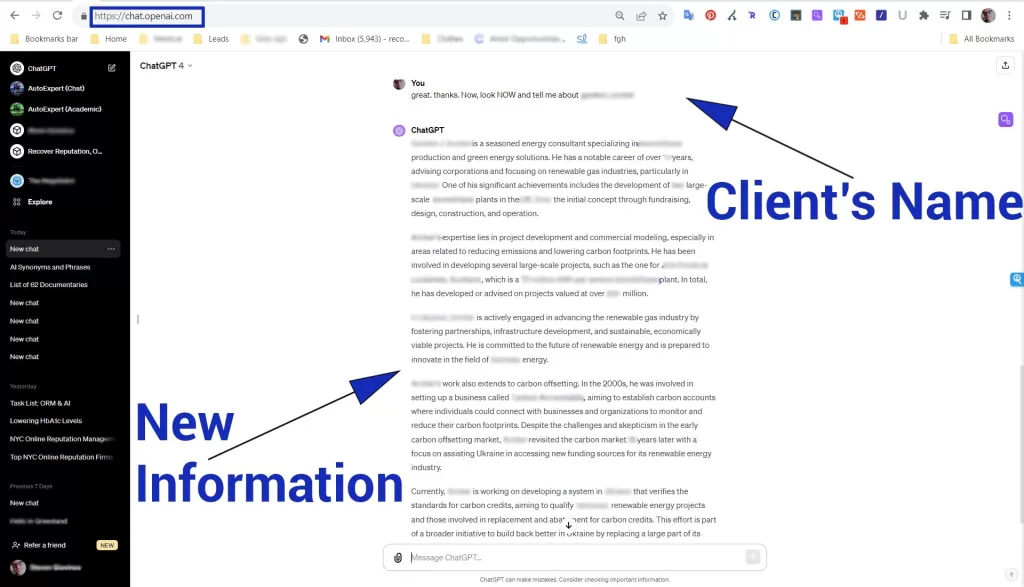
What is AI Reputation Management?  AI reputation management optimizes how people, businesses and brands appear in AI platforms such as ChatGPT and Gemini (Bard). The ultimate goal is to correct  generated answers or images in order to present you accurately and authentically. Since AI is rapidly becoming an alternative to traditional Google search results, it is essential to maintain a positive presence within these new platforms. Some questions:  Is your business, brand, or personal profile missing from AI results? Have you found inaccurate AI responses about you or your brand? Are you facing negative or false AI-generated answers? Unsure how to remove deep fake images associated with you? Key References Deep Fake Detection AI Help Cyber Civil Rights  Instagram Safety TikTok Safety Facebook Safety Snapchat Safety AI Reputation Solutions Build AI Presence: Establish your brand or self on pivotal platforms like ChatGPT, DALL-E, and Gemini (Bard), etc. ensuring you\’re represented authentically. Suppress Negative AI Answers: Systematically replace negative AI-generated content with factual, positive information, promoting your true narrative. Correct AI-Generated Responses: Proactively identify and remove deep fakes from DALL-E, Midjourney and the internet; repair poor AI-generated answers. Customize Tools and Consulting: Create custom GPTs, AI systems and strategies; offer AI education and marketing support; devise rapid responses to AI misinformation to protect and enhance your reputation. AI Reputation Process 1. Comprehensive Research and Strategic Planning: After an in-depth analysis/review of current web and AI presence, a customized strategy is crafted to align with your objectives and goals, emphasizing strengths. This strategy becomes the blueprint going forward. 2. Tool Optimization and Engagement: AI text and visual tools are reviewed to enhance any existing platforms and create new ones tailored to your industry trends and needs. This involves influencing, guiding and directing results as well as using some traditional SEO, ORM and engagement with key influencers. 3. Dynamic Content Development: Content creation and distribution of premium, impactful written and/or visual content across the network of platforms that have been optimized or established. This ensures your narrative remains authentic, engaging, and precisely what your clients are seeking. 4. Continuous Strategy Evolution: Constantly adapt, refine and improve strategies, making regular updates, engaging with key communities, and conducting ongoing research to stay successful. Case Studies and Client Success Real Before Screenshot: Bard (Gemini) Optimization Real Before Screenshot: Bard (Gemini) Optimization Situation: A sustainable energy entrepreneur faced a non-existent Gemini presence and a severely negative Google reputation due to false accusations, hindering business growth and investment opportunities. Outcome: Negative articles were quickly demoted within three months in two countries, and within six months for others. Achieved a positive Gemini presence rapidly. Why Choose Us? Education, Vision, Experience: Holding an MA from NYU\’s Interactive Telecommunications Program and an MFA from Yale University, Steven W. Giovinco blends technical and creative expertise. This educational foundation fuels our vision to provide innovative, ethical reputation management solutions across various industries. Direct experience spanning finance, law, medicine, arts, and more, reflecting a deep depth of industry knowledge. He is author of a comprehensive e-book, “Holistic Reputation Management,” and has ten years in boutique online reputation management. Contact Founder, Steven W. Giovinco Reach out and speak directly to CEO/Founder Steven W. Giovinco–no salespeople or chatbots here. Evaluations are always free. Recover Reputation +1-347-559-4952steve@recoverreputation.comwww.recoverreputation.com166 Second Avenue, Suite 11HNew York, NY 1ooo3

What is Generative AI Reputation Management and Why It\’s Important? Read More »

ai reputation management solutions, process, & case study: chatgpt after screenshot

What is Generative AI Reputation Management and Why It\’s Important?

What is AI Reputation Management?  AI reputation management optimizes how people, businesses and brands appear in AI platforms such as ChatGPT and Gemini (Bard). The ultimate goal is to correct  generated answers or images in order to present you accurately and authentically. Since AI is rapidly becoming an alternative to traditional Google search results, it is essential to maintain a positive presence within these new platforms. Some questions:  Is your business, brand, or personal profile missing from AI results? Have you found inaccurate AI responses about you or your brand? Are you facing negative or false AI-generated answers? Unsure how to remove deep fake images associated with you? Key References Deep Fake Detection AI Help Cyber Civil Rights  Instagram Safety TikTok Safety Facebook Safety Snapchat Safety AI Reputation Solutions Build AI Presence: Establish your brand or self on pivotal platforms like ChatGPT, DALL-E, and Gemini (Bard), etc. ensuring you\’re represented authentically. Suppress Negative AI Answers: Systematically replace negative AI-generated content with factual, positive information, promoting your true narrative. Correct AI-Generated Responses: Proactively identify and remove deep fakes from DALL-E, Midjourney and the internet; repair poor AI-generated answers. Customize Tools and Consulting: Create custom GPTs, AI systems and strategies; offer AI education and marketing support; devise rapid responses to AI misinformation to protect and enhance your reputation. AI Reputation Process 1. Comprehensive Research and Strategic Planning: After an in-depth analysis/review of current web and AI presence, a customized strategy is crafted to align with your objectives and goals, emphasizing strengths. This strategy becomes the blueprint going forward. 2. Tool Optimization and Engagement: AI text and visual tools are reviewed to enhance any existing platforms and create new ones tailored to your industry trends and needs. This involves influencing, guiding and directing results as well as using some traditional SEO, ORM and engagement with key influencers. 3. Dynamic Content Development: Content creation and distribution of premium, impactful written and/or visual content across the network of platforms that have been optimized or established. This ensures your narrative remains authentic, engaging, and precisely what your clients are seeking. 4. Continuous Strategy Evolution: Constantly adapt, refine and improve strategies, making regular updates, engaging with key communities, and conducting ongoing research to stay successful. Case Studies and Client Success Real Before Screenshot: Bard (Gemini) Optimization Real Before Screenshot: Bard (Gemini) Optimization Situation: A sustainable energy entrepreneur faced a non-existent Gemini presence and a severely negative Google reputation due to false accusations, hindering business growth and investment opportunities. Outcome: Negative articles were quickly demoted within three months in two countries, and within six months for others. Achieved a positive Gemini presence rapidly. Why Choose Us? Education, Vision, Experience: Holding an MA from NYU\’s Interactive Telecommunications Program and an MFA from Yale University, Steven W. Giovinco blends technical and creative expertise. This educational foundation fuels our vision to provide innovative, ethical reputation management solutions across various industries. Direct experience spanning finance, law, medicine, arts, and more, reflecting a deep depth of industry knowledge. He is author of a comprehensive e-book, “Holistic Reputation Management,” and has ten years in boutique online reputation management. Contact Founder, Steven W. Giovinco Reach out and speak directly to CEO/Founder Steven W. Giovinco–no salespeople or chatbots here. Evaluations are always free. Recover Reputation +1-347-559-4952steve@recoverreputation.comwww.recoverreputation.com166 Second Avenue, Suite 11HNew York, NY 1ooo3

What is Generative AI Reputation Management and Why It\’s Important? Read More »

the willy wonka debacle: a cautionary tale of ai misuse and reputation damage

The Willy Wonka Debacle: A Cautionary Tale of AI Misuse and Reputation Damage

The Willy Wonka Experience, organized by Billy Coull, has morphed from a poorly managed event into a case study of AI technology gone awry. What initially appeared as a simple case of mismanagement has unraveled to reveal a deeper issue: the irresponsible use of AI. AI-Fueled Mismatched Expectations Vibrant, AI-generated posters promised an immersive chocolate wonderland–albeit with strange misspellings. Indeed, children experienced a frightening sparse warehouse. This setting of unrealistic based on fantastical visions collided harshly with reality, resulting in disappointment and anger. AI Scripts Amplify the Chaos Further compounding the problem were AI-generated scripts written for the actors. These lacked coherence and strayed far from any kind of anticipated whimsical and fun narrative. Instead of engaging audiences, they contributed to the event\’s overall chaos and downfall. Beyond the Event: A Pattern of AI Reliance? Billy Coull\’s alleged use of AI to write books, just makes things worse. This pattern of overreliance on AI, without proper comprehension of the terrible results, is a recurring theme in his work. A Lesson Learned: Responsible AI Implementation So, what can we learn? The Willy Wonka Experience serves as a stark reminder of the importance of responsible usage of AI. While it holds major potential for creativity and efficiency, its misuse can lead to significant consequences, i.e, severely damaged reputations and worse, impacting venues, participants, and the organizer. The Willy Wonka Debacle: A Cautionary Tale of AI Misuse and Reputation Damage AI Reputation Management is a cutting-edge service addressing the need for visibility in this new era. Basically, it builds a presence on AI platforms, corrects inaccuracies, fixes negative answers, or undesirable results generated by ChatGPT, DALL-E, Bard, and other tools.

The Willy Wonka Debacle: A Cautionary Tale of AI Misuse and Reputation Damage Read More »

Get to the Point: What CEOs Need to Know About Online Reputation Management in 2024

Get Right to the Point Google\’s recent algorithm update is a significant change that could impact your online reputation. The bottom line is that your website traffic might decrease significantly. This article explores the implications for businesses and offers solutions. What is the Recent Google Update? You might have noticed a decline in website traffic. This is likely due to the Helpful Content Update (HCU), which Google concluded in late September 2023 (the March 2024 Update is mostly a continuation. This update aims to prioritize high-quality content that genuinely informs and assists users. Websites with content solely focused on search engine ranking are probably going to be penalized. How Does HCU Impact Your Online Reputation? HCU can negatively affect your online reputation in several ways. Reduced website traffic means fewer people see your brand or services, potentially leading to decreased sales and a suppressed online presence. This makes you vulnerable to negative articles with minimal positive links. CEOs and those managing SEO or online reputation need to address this right away. What is HCU? Complete in late September 2023, Google\’s HCU prioritizes high-quality, informative content that genuinely assists users. It rewards websites that create content with a user-centric approach, rather than solely focusing on search engine ranking. What Should You Do? Focusing solely on blog posts for traffic and sales is no longer effective. Here are some solutions: Utilize Forums: Google prioritizes user-generated content. Actively participate on forums like Reddit and Quora. Some of these rank higher than Forbes and related media sites. Create branded accounts: Establish accounts for your name and brand on relevant forums, including StackExchange, DigitalPoint, etc. Engage in discussions: Be active on subreddits and threads related to your business. Provide valuable insights and answer user queries genuinely. Avoid spamming or overt sales tactics; doing so could result in further reputation damage. Expand your reach: Consider platforms like Medium, LinkedIn Articles, and even Tumblr. Focus on quality: Write informative, well-written content free from spam and sales pitches. Target specific topics: Address specific issues relevant to your target audience. Prioritize user value: Rewrite website content with the goal of providing genuine value to users, not just attracting clicks. Focus on user intent: Conduct competitor research and identify unique approaches. Target long-tail keywords: Use long-tail search terms based on user queries. Be authentic: Don\’t shy away from expressing your opinions (excluding highly political topics) to build trust and relatability. Avoid unethical practices: Never buy links or overly use poor AI-written content. Engage with others: Actively read, like, share, and leave genuine comments on others\’ content. Go local: Build a local presence on Patch and other sites. Optimize Google Business Profile: Ensure your Google Business Profile (formerly Google My Business) is complete. Consider Bing Places as well. Engage with local communities: Utilize platforms like Yelp to leave reviews for other businesses and encourage genuine reviews for yours. The Bottom Line In the current search and reputation landscape, focusing solely on manipulation tactics can damage your online reputation. CEOs must prioritize providing genuine information, building trust through authentic engagement, and actively participating in online communities to maintain a positive online presence.

Get to the Point: What CEOs Need to Know About Online Reputation Management in 2024 Read More »

ai reputation management bing before recover reputation 1

Recover Reputation Introduces Groundbreaking AI Reputation Management Service [Press Release] 

Believing that AI platforms like ChatGPT are poised to become the new Google, Recover Reputation has developed a revolutionary AI Reputation Management service.   FOR IMMEDIATE RELEASE [NEW YORK, NY, February 27, 2024] – As AI-powered language models and image generators increasingly shape public perceptions, traditional reputation management strategies struggle to keep pace. Recover Reputation, a leader in online reputation management, tackles this challenge with the launch of its groundbreaking AI Reputation Management service. This innovative service empowers businesses, professionals, and individuals to proactively manage their AI presence. If they are missing AI search results, have inaccurate AI-generated responses, and suffer from negative AI-created images, AI Reputation Management ensures brands\’ appearances are positive, accurate and robust. New solutions include: Steven W. Giovinco, CEO and founder of Recover Reputation, states, \”As AI continues to become the new Google, it\’s vital that businesses and professionals are represented correctly and positively. Our AI Reputation Management service is designed to protect and enhance their presence on these emerging platforms.\” The launch of AI Reputation Management follows a successful case study where a sustainable energy entrepreneur, previously damaged by negative search results and an absent AI presence, achieved positive presence across multiple countries and platforms within months, thanks to Recover Reputation\’s strategic approach. ABOUT RECOVER REPUTATION Recover Reputation is a boutique firm specializing in online and AI reputation management. Founded by Steven W. Giovinco, with over thirty years of business and technology experience, the company is committed to repairing, building, and boosting the online and AI reputations of businesses, brands, and professionals worldwide. Steven’s Master’s degree from New York University’s Interactive Telecommunications Program has driven much of his innovative approaches. Recover Reputation employs a high-quality, hands-on approach, ensuring real results and ethical practices across various industries, including finance, law, healthcare, and the arts.   CONTACT INFORMATION Steven W. Giovinco, CEO/FounderRecover ReputationEmail: steve@recoverreputation.comPhone: +1-347-599-4942Website: www.recoverreputation.comAddress: 166 Second Avenue, Suite 11H, New York, NY 10003 [###]

Recover Reputation Introduces Groundbreaking AI Reputation Management Service [Press Release]  Read More »

Scroll to Top