Online Reputation Management

comprehensive 6 month plan for repairing a damaged online reputation 67 essential tasks by recover reputation

Comprehensive 6-month Plan for Repairing a Damaged Online Reputation: 67 Essential Tasks

The Comprehensive 6-month Plan for Repairing a Damaged Online Reputation 67 essential tasks that can be divided into step-by-step monthly actions.  The first month\’s tasks focus on creating and updating online profiles, optimizing search engine results, and generating content ideas.  The second-month tasks involve website optimization, content creation, and the addition of new online platforms.  The third to sixth-month tasks are geared towards creating more content and expanding online presence through additional platforms which are then used to share new articles, blogs, and videos.  The plan includes daily and weekly instructions for social media engagement and writing posts and sharing them to improve online visibility. Overall, the goal is to build, boost and repair online reputations by focusing on excellent content creation, social media engagement, and frequent updates. First Month Tasks General Bio Review, rank and prioritize key links to be used in all content Write bio information with appropriate links Rewrite bio into one paragraph version with appropriate links Generate possible keyword search terms Make possible hashtags Create content topics for blogs, white papers, etc. Select and organize all images/photos to be used online Update Social Media Platforms Update or create LinkedIn Profile with image, link and bio (same for below) Update or create Twitter Profile Update or create Crunchbase Profile Update or create Facebook Profile Update or create Medium Profile Update or create Youtube Profile Create a college alumni site Profile Wikipedia Try adding a reference to a Wikipedia article based accolades in the bio, or on alumni or business pages Second Month Tasks Website Rewrite and update Home Page content with image Rewrite and update Services or related Page content with image Review and update About content Review and update Contact content and links Review and select WordPress template Configure WordPress admin Add WordPress plugins to improve speed and security Create WordPress Pages Update WordPress Menu Update SEO Title and Description for Home Page Update SEO Title and Description for Services or related Page Update SEO Title and Description for About Page Update SEO Title and Description for Blog Page Update SEO Title and Description for Contact Page Run Smush to compress images Configure SSL Content Creation Write one blog text/article with image and appropriate hashtags based on the content topics Wikipedia Try adding another reference to a Wikipedia article based on the bio, such as an alumni or business post Third Month Tasks New Platforms Create Wikitree Profile with image, link and bio (same for below) Google My Business Site  Quora Academia Yelp About.me Reddit Account Tumblr Manta Content Creation Write two+ blog posts with image and appropriate hashtags from content topic  Write one Medium post with image and appropriate hashtags from content topic Write White Paper with image and appropriate hashtags from content topic Create a Presentation from one of the already-written articles/posts Social Media Make Google Alerts for key search terms, and share results on social media Search for key search terms and Follow key leaders, businesses or people on social media Daily Instructions for Twitter, LinkedIn, Facebook, etc.:  Share a follower’s post Post a link to a pertinent article Comment on someone else’s post Follow one influencer and one potential client Review and refine your list of current followers Share on a crucial topic of proven interest to prospects Research a key influencer’s followers and follow some of them Weekly instructions for Instagram, Youtube, Crunchbase, Slideshare, etc.:  Share a follower’s post. Post a link to a pertinent article Comment on someone else’s post Follow one influencer and one potential client Review and refine your list of current followers Share on a crucial topic of proven interest to prospects Research a key influencer’s followers and follow some of them Forth to Sixth Month Tasks New Platforms Create SoundCloud Profile with image, link and bio (same for below) Behance Flickr Imgur Piktochart Visual.ly DailyMotion Vimeo Content Creation Write two+ blog posts per month with image and appropriate hashtags from content topic Write one Medium post with image and appropriate hashtags from content topic Write White Paper with image and appropriate hashtags from content topic Create a Presentation from one of the already-written articles/posts Social Media Share Google Alerts results on social media Search for key search terms and Follow key leaders, businesses or people on social media Daily Instructions for Twitter, LinkedIn, Facebook, etc.:  Share a follower’s post Post a link to a pertinent article Comment on someone else’s post Follow one influencer and one potential client Review and refine your list of current followers Share on a crucial topic of proven interest to prospects Research a key influencer’s followers and follow some of them Weekly instructions for Instagram, Youtube, Crunchbase, Slideshare, etc.:  Share a follower’s post. Post a link to a pertinent article Comment on someone else’s post Follow one influencer and one potential client Review and refine your list of current followers Share on a crucial topic of proven interest to prospects Research a key influencer’s followers and follow some of them Write guest posts and share Bottom Line It is possible to repair a damaged online reputation through following these step-by-step tasks. However, it takes a few hours a day for at least six months. If you have questions, feel free to reach out to Recover Reputation.

Comprehensive 6-month Plan for Repairing a Damaged Online Reputation: 67 Essential Tasks Read More »


can ai chatgpt damage your online reputation yes here’s how

Can AI ChatGPT Damage Your Online Reputation? Yes. Here’s How

https://youtu.be/Ui1pNLJlse4 Small to Mid-Sized Businesses, Law Firms, Financial Advisors, CEOs, and Brands Could Be at Risk While pondering AI ChatGPT, here’s a “Domesday” scenario to consider: what if your carefully curated online presence–your website, social media platforms, and client engagement–is a risk of disappearing? Or what if you decided to use AI to save money to write blogs, generate images or create autorespond bots for your business but when the poor quality is detected by clients, this leads to online reputation damage? This might not be as far-fetched as you think. The advent of the plethora of AI tools can actually lead to a negative web presence, especially as AI gets deployed and integrated deeper into search engines and browsers. Note: that while there are many text-based AI-tools, for simplicity, we\’ll mostly focus on ChatGPT. Other AI Tools ChatGPT DALL-E 2 Jasper AI Repurpose IO Jenni AI Murf AI Writing Checker Tome  Informational Links What is ChatGPT and why does it matter? A New Chat Bot Is a ‘Code Red’ for Google’s Search Business  JPMorgan restricts employee use of ChatGPT Vanderbilt University apologizes after using ChatGPT to console students  How Is This Applicable to You? AI tools like ChatGPT, DALL-E, Jasper AI, Midjourney, Repurpose IO, Jenni AI, Murf, AI Content Checker, and Tome (and many more) are transforming the business and online landscapes. Understanding their implications is crucial for everyone, regardless of your interest, usage or experience with AI. Even if you\’re skeptical or indifferent to AI tools, it\’s essential to recognize the potential impact of the content they generate. In fact, you\’re likely already using AI in some capacity—spellcheck and auto-correct are just a few examples that have been around for years. As AI continues to shape the future of online search, staying informed about these tools and their potential consequences is critical, particularly for those who may be unaware of the risks and opportunities associated with generated content. Embracing this new era of AI-driven answers requires both caution and adaptability to safeguard your online presence and reputation. Is Online Search Changing? Online search will drastically change in the future, and with it, your online reputation. Also, there are ways your web presence can actually be damaged by ChatGPT, such as using poorly written unedited AI content or not being found in AI answers by would-be clients. This is especially crucial for mid-sized brands, small businesses, financial advisors, law firms, physicians, CEOs, and professionals, i.e., any business that is not literally at the very top in its industry. What is ChatGPT? First, what is it? By now, you\’ve come across AI and ChatGPT, an exponentially expanding platform that has garnered approximately 5 million users within just a few months and currently has about 180 million users. Individuals and businesses alike are utilizing it for answering technical questions, crafting articles, and even composing poetry in iambic pentameter. Though still somewhat in its early stages, AI, and ChatGPT in particular, are poised to revolutionize how we make and access information. Experience it for yourself: visit the ChatGPT site, ask a question about your business or personal life, and see what emerges. Two immediate observations are: one, conducting a search, similar to one used for Google, yields results that rarely mention a a specific brand, and two, almost never provide a website hyperlink. These are immediate problems for businesses. How Does ChatGPT Work? ChatGPT gathers information from billions of words across sources such as Wikipedia, books, news articles, and scientific journals. Developed by OpenAI, this language model employs ways to generate human-like text.   I asked ChatGPT itself how it worked, but the answer to me personally was unhelpful and slightly baffling: ChatGPT is a type of language model developed by OpenAI, which is based on the Transformer architecture and uses deep learning techniques to generate text. Here\’s a high-level overview of how it works: Data Preparation: The model is trained on a massive dataset of text, which is preprocessed and cleaned to remove any irrelevant or duplicate information. Tokenization: The text data is then split into individual tokens, such as words or subwords, and these tokens are then assigned unique numerical IDs. Model Training: The model is trained on the tokenized data, where it learns to predict the next word in a sequence based on the context of the surrounding words. The model is trained using a variant of the transformer architecture, which allows it to learn relationships between tokens across large distances in the input sequence. Inference: When the model is used for inference or generating text, it takes an initial seed of text, such as a prompt or question, and generates subsequent text tokens one at a time, using the probabilities generated by the model during training. The process continues until the model reaches a stopping criterion, such as a maximum length for the generated sequence or a specific end-of-sequence token. Text Generation: The generated tokens are then decoded back into human-readable text, and the final generated text is returned as the output. Overall, the ChatGPT model is designed to generate text that is contextually relevant and coherent, given an input prompt. The training process allows the model to learn patterns and relationships in the text data, and use that knowledge to generate text that is similar in style and content. After this example, you might think that AI-written text will never work or is too technical–but we’ll see other examples below.  To get a comparison, I went to Google, and asked the same question, but ended up with hundreds of links and a still unclear answer. This exercise itself seems to be emblematic of the ChatGPT vs traditional online search experience: one concise answer or many spammy links. What is the Near Future of AI and ChatGPT? ChatGPT is offered as a standalone application, premium paid versions, and integrated into Bing\’s search engine and Microsoft\’s Edge browser. It\’s not hard to imagine that these developments could significantly impact online reputation management for businesses. Seamless integration into internet searches

Can AI ChatGPT Damage Your Online Reputation? Yes. Here’s How Read More »

5 actionable tips for building a positive online reputation 

5 Actionable Tips For Building A Positive Online Reputation

Introduction When you hear the phrase “reputation management,” you might think of it as something that only big businesses or celebrities have to worry about. But the truth is, your online reputation can have a big impact on your professional and personal life–as well as your brand, especially if you are a business owner. In today’s digital world, it’s more important than ever to be proactive about managing your online reputation. Here are five actionable tips for building a positive reputation online: Be aware of what’s being said about you online. Google yourself regularly and set up Google Alerts. Build up your presence on social media. Get involved in online conversations. Manage your digital footprint. 1. Start with a Positive Mindset It’s important to remember that building a positive online reputation starts with having a positive mindset. Before you start making any changes to your online presence, you need to be sure that you’re viewing everything through a positive lens and not letting negative thoughts about yourself or your brand take over.  Take time to reflect on your past successes and accomplishments and focus on the positive aspects of who you are and what you do. This will help you keep your focus on building a good reputation, rather than trying to fight negative or outdated perceptions.  2. Consistency is Key Once you’ve gotten yourself into the right headspace, it’s time to start showing up consistently and building your brand. This means staying active on social media, blogging regularly, and engaging with your audience/clients. Consistency is key when it comes to managing your online reputation. Your online presence should reflect the values and message that you want to convey to the world, and it should be maintained regularly, no matter how small the task. Try for ten minutes a day and expand to longer. 3. Be Proactive When it comes to managing your online web presence, you can’t just sit back and wait for things to happen. You have to be proactive in building and maintaining your brand, creating meaningful content, and engaging with your audience. This means not only creating content but also interacting with other people and businesses, sharing your opinion, and staying up-to-date with the latest news and trends in your industry. Being proactive about your online presence will help you create a positive reputation and strengthen your brand.  4. Be Responsive No matter how much proactive effort you put into managing your online reputation, things can still go wrong. When this happens, it’s important to remember to respond immediately and address it quickly and honestly. Show your audience that you are open to feedback and genuinely engaged with your audience.  5. Take the High Road When it comes to managing your online reputation, it’s important to remember that there is no room for nastiness or personal attacks. You should always take the high road and approach difficult situations with a positive attitude and respect. No matter the situation, it’s important to remember to be professional and be prepared to admit mistakes and apologize when it’s warranted. Focusing on respect and positivity will help you build a good reputation and create relationships that will benefit your business for years to come.  Conclusion Building a good reputation online takes a lot of hard work but it is impossible. By following these five actionable tips and staying consistent, you can create a positive image and build trust with your audience. With a little bit of effort, you can improve your online reputation and create a strong, lasting impression.  Feel free to reach out to Steven W. Giovinco at Recover Reputation with questions.

5 Actionable Tips For Building A Positive Online Reputation Read More »

recover reputation’s plans for 2023: give away more information and offer pro bono services, golden afternoon sky

Recover Reputation’s Plans for 2023: Give Away More Information and Offer Pro Bono Services

Given it’s 2023, I thought I would share some upcoming goals for Recover Reputation. Basically, we plan to: Publish a printed version of the ebook, “Holistic Reputation Management.” Give more information away through talks, presentations, and seminars. Provide pro bono services to those in need, including persons of color, disabled, or those impacted by revenge porn. Recover Reputation Highlights Recover Reputation is a boutique online reputation management firm that builds, boosts, and repairs the web presence of businesses, brands, and professionals.    With a 90% success rate in moving down negative links, I only take on projects I feel that can be successfully completed, and my approach is focused on high-quality hands-on work.  Current Services Repair: Suppress negative links off the first page of Google search results through excellent content, and relentless engagement. Building: Create positive information that appears on the first page of Google search results for the brand or business. Removal: Delete images, videos, blog posts, comments, sites, and articles, if possible.   Most projects take about eight months to complete; the average fee is $5,000 per month.  Why I Started in Online Reputation Management  I was working as a search engine optimization (SEO) consultant for a client, but it seemed difficult to really quantify successful results. One day, she asked if I could remove an extremely damaging post appearing prominently at the top of Google search for her brand. Although at the time I had little experience in online reputation management, and spent days conducting research, and found a way to delete the negative post.  Light Bulb Moment When I saw the immediate positive impact this had on her business, I had a profound “light bulb” moment: I can really make a difference in people’s lives by removing or suppressing bad information written by disgruntled ex-clients or untrue articles made by fired employees.   I immediately learned as much as I could and shifted all my efforts to online reputation management. In 2017, I launched Recover Reputation formally by creating an LLC.  To Help and Be of Service What I found especially meaningful in repairing damaged reputations was seeing the direct impact my work had on restoring people’s lives, which is extremely important to me as a small business owner. Additionally, I love to work directly with clients–rather than have layers of salespeople, project managers, etc.–and feel this is the most effective way to provide quality results to those I serve. In other words, I feel like I am making a difference in people’s lives. Giving Back to the Community I support the community by giving individuals a second chance, helping innocent people get their lives back, hiring the disadvantaged, and giving away free services to those who need them.    The core of my business is giving brands, CEOs, executives, and others who have admittedly made mistakes a second chance. I work with people who, if they did something wrong, now realize their past errors. I also help clients who erroneously had their reputation inadvertently hurt because of circumstances or a tangential connection to someone else. Helping Non-Profits For example, one of my first clients was a non-profit group that helped families impacted by 9/11, who mistakenly got embroiled in a series of incorrect negative press articles. Since I live in Downtown New York, I was able to offer a severe discount to the organization because I felt the strong need to be of service.  Help the Community Another way I plan to help the community is to hire employees with disabilities, people of color or are from disadvantaged neighborhoods. Since I identify as someone who has a disability (psoriatic arthritis) and might be considered older, I want to help those who might not be normally associated with technology firms and people here in New York. Pro Bono Services Finally, I want to give my services away for free. This could be in the form of lectures, my book, presentations, or online reputation repair to those that can not afford it such as the underprivileged, young women suffering revenge porn issues, or the unemployed. Accomplishments I Am Most Proud of My biggest accomplishment is my extremely high success rate in solving clients’ problems. While most online reputation management firms don’t seem to be focused on achieving positive results for their clients, I am obsessed with it.  90% Success Rate As a result, I have documented a 90% success rate. Out of about 40 cases, only a few times have I been unable to suppress negative articles off the first page of Google search results. The success is partially due to my work ethic as well as my policy of not taking on a client I don’t think I can be successful with. Being honest and transparent is a core tenant of my business, and that, unfortunately, makes me unique in my field: there are many distributable online reputation management firms, and I aim to be the highly trustworthy exception. Revenge Porn Help Briefly, another accomplishment is my being able to help young women with revenge porn problems. For example, one of my clients was recorded partially nude–possibly due to being drugged at a club–and posted to YouTube without her consent. When employers and others searched Google for her name, several variations of this video and photos prominently appeared, causing extreme reputation damage. I was able to remove them; soon after, she immediately found new employment.

Recover Reputation’s Plans for 2023: Give Away More Information and Offer Pro Bono Services Read More »

Use Online Reputation Management to Gain and Retain Clients [White Paper]

Use Online Reputation Management to Gain and Retain Clients Download Free White Paper Use reputation management tactics to convert prospective clients into paying ones. Craft a web presence that conveys trust/expertise to attract better business naturally. Develop a strategy to continually highlight your expertise across platforms and media. Suppress “negative links” off the first pages of, in particular, Google searches (i.e., any tied to competitors, content posted by a disgruntled employee, unfounded complaints). Powered By EmbedPress

Use Online Reputation Management to Gain and Retain Clients [White Paper] Read More »

how to get new clients using leads and reputation management

How to Get New Clients Using Leads and Reputation Management

Thinking it might be helpful for new entrepreneurs, small business owners, or those starting a practice or service, here are some ways I try to get clients. It can be a hard road, especially at the beginning, but try crafting a great online reputation as a building block for developing clients. First, Prepare Your Reputation Breathe. While not really directly about reputation building, start by trying to get out of fear–the fear could be about anything: lack of money, anxiety, not knowing what\’s going to happen. Personally, this has taken me a long time to not be afraid of what might or might not happen. Being in an anxious state shuts you down, and clients can sense this. Write. Create excellent content such as blogs, white papers, presentations, etc. that provide excellent solutions to problems your clients actually need. This is part of online reputation management development–showing that you are the expert in your field. Give Talks. Give away some key information for free as a talk or presentation. This could be at the local library, at an industry event or via a Zoom gathering. Then, Share and Connect Contact Leads. Email everyone who has contacted you about your service, and offer something that will help them. It could be the two items above, a related article, or a free brief evaluation. Also, see if they or someone they know are looking for your services. Feel free to ask directly for leads if you know them; approach them with more tact if they are \”lukewarm\” contacts. Contact Past Clients. Do the same as above, but since you\’ve worked with them in the past, you could be more casual and friendly. Try to schedule a coffee or lunch in person, if possible, soon (in the next two weeks). Remember that they could be looking for a new service you are offering or they might know someone–a friend, family member, their accountant, etc.–who needs what you do. Cold Contact. Find new people and reach out to them, even if you don’t know them. It could be an author of an article or an expert in your field. Honestly, this can produce limited results, but if done with a specific and well-thought-out reason, it could work. Examples might be asking a business in a related field to speak at a Zoom panel or offering a free ebook you authored. Do your research! Mutual Synergies. Seek out other businesses that are related but not direct competitors. If you know them, meet in person, and pitch ways you can work together. Connect with Competitors. Look at competitors and see how you differ. Maybe they are too big–or too small–for a project, which might be perfect for you. Meet in Person. Nothing beats an in-person meeting. It might not be possible or appropriate for some potential clients or related businesses but schedule a coffee, lunch, or gathering. Pick up the phone too.  Follow up. Repeat the above steps several times. Reach out to your list with news, new services, helpful tips, articles, meetings and more once at least once or twice a year. These are just some brief ideas. I am probably missing several tasks, so feel free to add your own in the comments. Importantly, keep at it, continue to reach out to leads, and always build a positive online reputation. How Long Does Online Reputation Management Take? Each repair or brand building project is different and unique. Most projects average about six months to complete, although it could be a little less or more. In most cases, you can start to see an impact within a month. Why Does it Take So Long? Repairing your online presence is complex and requires analysis, site set up and time to take effect. For example, Google does not rank recently made sites highly, so it can take months for changes to be found properly by Google. Also, it takes months to create a genuine and trustworthy online presence where sites link back to you or treat you as an industry leader. Generally, an average project takes about six months to complete. What Can I Do If Someone Posts Negative Comments? You might not be able to stop the attacks, especially if they’re anonymous. In fact, you might not want to: if they don’t show up on the first page of your search results, it might be best to leave it alone; attempting to contact the poster could cause them to add additional negative posts.There are steps you can take steps to limit the potential damage they could cause, however. For example, maintaining an active presence on websites like Twitter, LinkedIn, Facebook, and YouTube can help give you a layer of protection from online attacks and also give you the tools to promote positive, truthful information about you and your business. Can You Stop Slander on Social Networking Sites? The Internet has made it easy for people–including competitors–to share opinions, and sometimes these opinions are slanderous or harmful. On many of these sites, if the comments violate the terms of service you can report the post as abuse at Facebook and YouTube. We also advise customers to engage in a management service to take control of your online presence. Being proactive and creating a positive profile helps prevent future negative content from appearing online. Engaging with a lawyer to take legal action, however, is very costly and might not be effective. What is Online Brand Building? Google has recently changed its algorithm so just search engine optimization is not enough to get your site visible. Online brand building includes SEO as well as social media and content creation, such as article writing and blogging and is the post effective way to generate traffic that lead to sales. Can Recover Reputation Make the Negative Results Disappear Forever? Sometimes we can completely remove negative posts, especially if it includes personal information such as social security numbers, bank accounts, and your home address, for example. However, the best plan is

How to Get New Clients Using Leads and Reputation Management Read More »

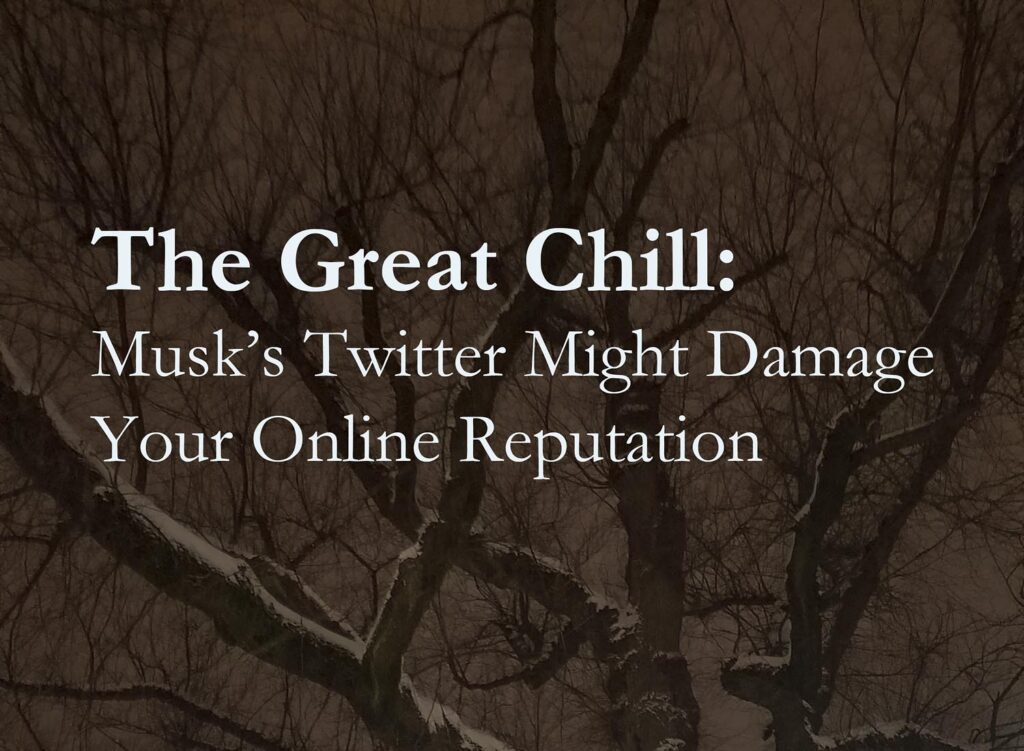
5 ways twitter can damage your online reputation

5 Ways Twitter Can Damage Your Online Reputation

Before Elon Musk\’s takeover, Twitter was a key online reputation management tool. Now, using it might actually harm your web presence. Why?  Twitter under owner Elon Musk might quickly morph into the wild-west of content where “anything goes”, leaving regular users, business owners, students, newshounds, etc. in the crossfire, ultimately leading to a weakened online reputation. But more on this in a moment. Sure, we don\’t know what will happen in the end, and yes some might conclude that Twitter is already toxic.  But will it get better or worse?  This Tweet from Musk the day after his takeover should give you all you need to know.  (Screenshot courtesy of https://www.mediaite.com/news/elon-musk-deletes-conspiracy-theory-on-paul-pelosi-attack-after-hours-of-outrage/) After much backlash, it was deleted the same day.  It indicates to me the \’New\’ Twitter is less filtered and more adversarial–things that are probably not good for your online reputation, which I’ll explore further below. What seems abundantly clear is that the platform will shift from being neutrally based–as imperfect as that is–towards an even louder megaphone. This could be fine for some, but it’s no place for business and casual discourse. It’s a shame because it is so widely integrated into many other platforms and is very popular. Personally, I’ve loved it and used Twitter many times throughout the day. Let\’s take a moment to review Twitter and its role in reputation management. Brief Review: What Is Twitter? Think of Twitter as sharing a short headline with an attached link. This makes for lightning-fast communication; if you want more depth, this is not the right source for you. Because Twitter is so widely used, it can represent a nearly real-time pulse or opinion on topics, business, or politics. Can 280 Characters Help Your Online Reputation, Really? Twitter has been an essential online reputation management tool for years. Briefly, here are four reasons why. First, having an active and engaging Twitter account can quickly rise to the first page of Google searches. This is incredibly important to those with a damaged or minimal reputation because a positive link means a negative site or comment will get suppressed and pushed down. This is the essence of online reputation management. Second, tweets may appear in Google searches. This further expands a positive web presence. Third, as a result of good information flooding the web, potential clients see you as an expert in your field, making it easier for them to choose you over a competitor. Lastly, it is a platform you control, minimizing problems that might result from someone else’s post. 5 Ways Musk’s Twitter Can Damage Your Web Presence 1. Association With Controversy Being active on the platform might be misconstrued that you condone and approve of new owner Elon Musk\’s approaches and beliefs. No matter how you feel about Mr. Musk and his past and present businesses, there are many who are turned off by him. Unfair this appraisal might be, people, clients, and new business partners might link you to Twitterverse controversies of its chief. 2. It’s Personal–Not Business Speaking of controversies….Musk is certainly a larger-than-life public figure, who might be interested in serving a different agenda rather than enhancing a safe user experience. Also, due to his wealth, he might not be as beholden to board members as others might be, and this independence could be a blessing or curse. 3. Bad Content Competition New users to the platform, previously banned ones, or current Twitter users might feel free to post even more inappropriate or harmful messages, which could drown out your content. Moderate brand posts could get easily lost in the scrum. Do you want to compete in screaming matches? 4. Political/Free-Speech Centric Twitter seems to be going for free-speech-centric political discussion. A newly formed Content Committee is reviewing who will be reinstated to the platform, and it’s expected some controversial politicians and social media stars will return. This shift could further damage your online reputation because it means less room for business-related discussions, resulting in less traction for your Twitter account, leading to a drop in Google searches for your brand. 5. Direct Reputation Damage What if one of your posts generates negative comments, which could result in direct reputation damage? The whole point of being active on a social media platform, as mentioned above, is to build an excellent web presence and draw in new clients by showcasing your expertise. “New” Twitter might lead to more problems. What To Do? Find Other Platforms Develop a presence on other platforms. This could include spending more time on sites you already work with and seeking out new ones. Start by reviewing what others in your industry are doing to get a feel for what to be successful, and actively post. Here are some recommendations, many of which are familiar, as well as new platforms which are being developed. Reddit: Popular posting site, with many specialized “subreddits” or groups where comments can be minimally moderated. However, Reddit can be a bit of a “free-for-all” depending on the Subreddit LinkedIn: Business-oriented sharing and posting site, but is becoming more spammy. Learn how to remove a fake Linkedin account. Instagram: Image/video only, with comments Pinterest: general interest images, but can leave comments Medium: Blogging site for range of topics; great for online reputation management SlideShare: Business presentation; used to be more popular Mastodon: Smaller social media site which has grown since the Twitter announcement of Musk’s takeover Substack: Blogging and podcasting Bumble for Friends: Known as a dating site but section focused on making friends Friender: Find new friends Clubhouse: Audio-only group discussion Neighbors from Ring: Local community sharing Counter Social: Focus on troll-free and safe environment  Aether: self-governing communities Plurk: Social media platform Micro.blog: Blogging platform Cohost: Social media platform Minds: Social media platform Hivesocial: Social media platform Know When It’s Enough Get ready to pull the plug on Twitter. What will it take for you to quit? Will it be a comment made directly to you, your business, a colleague, or something you value? Have

5 Ways Twitter Can Damage Your Online Reputation Read More »

want to gain and retain clients? build an excellent online reputation

Want to Gain and Retain Clients? Build an Excellent Online Reputation

Aim for Consistent Reputation Building Gaining new business is rarely easy, especially when you’re just starting out. However, having a robust online presence can help substantially. That’s because a positive online reputation attracts clients naturally. Google search results filled with positive links draw in prospective buyers. People aren’t just concerned about credibility either. They seek answers when they search online for information tied to you and your business. In particular, they want to know: Can I trust them? If they then notice that articles, blog posts, interviews, social media profiles and videos linked back to you fill the first page of their search results, they’re more likely to hire you over a competitor. This is why online reputation management has to be a priority. If minimal or scant results appear in return, potential clients may wonder whether you and/or your business are inactive, uncaring or negligent when it comes to maintaining both a web presence and close business connections.  A Poor Reputation Drives People Away Worse still? If their search results yield negative links or poor reviews, that potential client will swiftly move on and find someone else to help them. In all cases, the best “in person” recommendations a prospect may have received—perhaps from a friend or a colleague of yours—become immaterial. The reason is simple, though it may not seem obvious: The essence of any good working relationship (and, therefore, online reputation) is trust. In the end: Can they trust you? When it comes to any online reputation, the bad always outweighs the good. You can fix “the bad” and get others to fixate more on “the good” by constantly and consistently building a better reputation online.  Common Questions People Ask Before Working with You It helps by addressing a series of questions potential clients typically ask themselves when they’re entering business partnerships. Questions people usually ask are questions I ask myself when I’m approaching a new venture. I encourage you to do the same: Are these people trustworthy? Who else have they worked with? Do they offer a guarantee of any sort? Have they been in business for very long? Where do I find examples of their successes? Can they solve my problems and will I see results? Is what they offer a good value or will they overcharge me? Do they understand my issue well enough to give me sound advice? Your online reputation needs to address and answer each of these questions thoroughly. What Is Online Reputation Management? Let’s explore what online reputation management is and why it’s important. Everything that appears in Google and similar search engine or inquiry platform results (i.e., blogs, articles, videos, reviews) works together to comprise your web reputation. Since this is what online consumers see first, it’s crucial to get this right. Keep in mind that, as was cited in this book’s introduction, Statista research from 2024 showed that Google alone holds about 82% of the global search-market share. Focus on Being Trustworthy Reputation management also involves tracking your social media posts or activity and tangential but related areas such as search engine optimization (SEO), various forms of media and print products. As you can see, this encompasses much more than simply customer reviews. Trust is a key concept here. A well-crafted online presence needs to convey a tone that helps confirm that you’re the right person to work with. It needs to reassure others that: You’re friendly. You’re professional. -&- You’re experienced. On the whole? It needs to convince them that you’re trustworthy. Compelling online content is what substantiates confidence. Everything attributed or attributable to you—from articles and presentations to white papers and videos (not to mention your business website)—needs to drive this point home. 

Want to Gain and Retain Clients? Build an Excellent Online Reputation Read More »

ethics of online reputation management

Ethics of Online Reputation Management

What Are the Ethics of Reputation Management? Be transparent and honest when crafting an online reputation. Appearing at the top of Google searches can make or break a business, making a stellar web presence paramount. Yet some cut corners on reputation management practices–or worse, engage in unethical methods.  I firmly believe moral integrity is crucial to reputation building. If a firm knowingly repeats problems or is systematically harmful, then they rightly deserve their negative notoriety. When this appears prominently in Google searches, the activities become highly visible for all to see.  However, what if a wrong business decision deserves a second chance? I sometimes suggest owners or professionals apologize for the poor business practice and move on by correcting the problem. In these cases, adequately implemented online reputation management is the best way to salvage a career or wrong decision. Also, reputation management should never be used to hurt another business. I’ve seen disgruntled ex-partners, revenge porn, angry clients, or competitors purposely create an online smear campaign to inflict online damage. Never do this. Not only is it wrong when discovered, but your reputation will also be ruined as well.  In desperation, some will do almost anything to fix problems in Google search results. Since a lousy reputation means lost business, firms might be tempted to buy reviews, use “Black Hat” tactics, or hack sites. But, of course, itis is all illegal and never should be attempted. Finally, an online reputation firm must do honest work. They need to follow proper guidelines, be scrupulously fair, and not cut corners–whether asked by clients or their own. Also, it is wrong for a firm to charge $3,000 for a solution and not deliver it or know that it really will take $20,000. Knowingly overpromising and under-delivering is unethical too.  Second Chances An online repair can mend damaged search results. Everyone makes mistakes in life and business, and a web presence can be rebuilt through excellent content and dedicated hard work. In these cases, especially when there is contrition, reputation reconstruction is the best option. For example, I had a case where a business executive misbehaved at a holiday party nineteen years ago. When a competitor leaked this to the New York Times, he could not get a new job years later, resulting in hundreds of thousands of dollars in lost wages. However, since he was apologetic, I felt comfortable given his career a second chance. Eventually, six months later, he got a new high-paying position. Honestly Address Issues Use online reputation management only when necessary. It is not a method to cover systemic business problems or to hide poor customer complaints. While neither are pleasant, real issues need to be thoroughly resolved, and savvy business owners use these problems as an opportunity to improve. Bad People  To be honest, not everyone deserves a second chance. There are instances in which reputation management cannot and should not be used. This may sound harsh, but some issues do not warrant repair. In my opinion, some include clear proof of sexual harassment and related conviction, swindling seniors, discovering purposeful online smear campaigns, and other ways that exact online revenge. Fake Reviews Do not write false or fake reviews. It may seem tempting to write your own for Yelp, Google My Business, TripAdvisor, Avvo, and others, but it’s unethical and most likely illegal. IP addresses can be traced, and when the natural source is uncovered–you or someone you hired–it results in extreme reputation devastation. Contrived comments on blog posts are not a good idea too. Blackhat Never use “Blackhat” techniques or things that do not follow platforms’ rules and policies. This includes using link farms, software bots that artificially click on good articles, impersonation of others, plagiarism, article spinning, spam, and the like. Hacking In no circumstances engage in hacking. Surprisingly, at least to me, I’ve gotten requests to hack a site or platform to remove harmful content, stop a problematic link or delete a review. Never try this, and run immediately if someone offers hacking as a service.  Ethical Reputation Firms Work with ethical online reputation management firms. Since your reputation is an extension of theirs, pick one that is honest and transparent. Unfortunately, I’ve known companies that buy reviews, make fake accounts, steal online identities, create false problems to generate business, assign tasks to low-cost and unskilled overseas workers, and worse (I feel online reputation management needs their reputation management overhaul). When the scam is discovered, your reputation will be ruined as collateral damage. Also, shoddy quality work reflects poorly on your reputation.  Undercharge Be aware of reputation pricing. Fees can be woefully low or outrageously high. Reprepital pricing is based on careful custom analysis–not on what someone thinks a client can pay. For example, let’s say two negative links towards the top of the first page in Google search results. A company quotes an initial price of $3,000, which might seem like a bargain. But in almost all cases, the actual cost to repair this issue might cost about ten times more. Some also claim to do work but never complete it.

Ethics of Online Reputation Management Read More »

online reputation management trends for 2022: zoom, good content, nfts and metaverse @recovreputation interior

Online Reputation Management Trends for 2022: Zoom, Good Content, NFTs and Metaverse @RecovReputation [Update: Covid]

Online reputation management trends for 2022 represent a partial rehash of last years’ as well as a pivot to new and uncharted directions, in my view. On the one hand, Zoom calls and unthoughtful posts will continue to wreak havoc to online reputations resulting in poor web presence. On the other hand, fresh mediums on the rise such as NFTs (Non-Fungible Tokens) and the metaverse could bring unexpected challenges. The antidote for poor reputation management, however, remains the same. Focus on excellent content, be personal, connect in meaningful ways, and always keep in mind what is of paramount interest for your readers or clients. Here are four or so predictions for 2022. 1. Online Employees Meetings Can Cause Problems It feels like we’ve been living on Zoom and other related platforms for a year and a half, and this trend looks like it will continue unabated into 2022–and maybe even forever. Given this ongoing development, it opens up many online reputation management challenges (which you might have experienced yourself).  Things ranging from embarrassing moments to trade secrets can inadvertently–or purposely–be shared via screenshots, audio/video capture, or just through regular written posts, all of which damage a business\’s brand and reputation. Also, executives are not immune from these problems: remember Better.com’s CEO who fired 900 people via teleconference? Wherever possible, lockdown sharing credentials and have a reputation management policy in place that stresses positive but well-crafted postings made at all levels in a company, from interns to upper management and all in-between. 2. Honesty and Authenticity Continue to Be Paramount Both honest and authentic interactions will continue to be the main drivers of positive online reputation building for the foreseeable future. Attempts to “game” the system with poorly written content or posts made on unrelated platforms still don’t/won’t work, and Google’s unrelenting algorithm tweaks continue to try to deliver the best search results for readers.  What this means is to be your true self and have your brand connect with clients in meaningful ways. Be personal, helpful, engaging and thoughtfully give away information. This should be part of an ongoing and sustained reputation strategy.  Examples are to write a targeted white paper aimed at solving clients’ problems; make meaningful comments on key industry influencers\’ Tweets; post presentations; get constantly active on local or industry-specific sites; share videos, or add anything else that provides real-world solutions. 3. NFTs and Crypto Currencies Non-fungible Tokens or NFTs along with cryptocurrencies such as Bitcoin and Ethereum could lead to reputation damage. As they start to enter the mainstream business world, more people will jump in, and as a result, lead to reputation issues. Damage could be due to buying/selling a controversial NFT, not understanding the market, or having your work posted without your knowledge. Negative issues, if they occur, don’t just stay solely on NFT platforms. Rather, they can appear quickly in Google searches as clients look for you or your business. As always, behave as you would in real life: connect with people in an earnest way and share good information, but always be especially cautious when developing a presence using new technology.  4. Metaverse This might be a stretch for 2022, but my hunch is that the metaverse, or virtual worlds, could start to impact online reputations in unexpected ways. If you’re not familiar with the metaverse, it’s an online platform where people can buy or otherwise interact in a 3-D environment. As with any “gold-rush” opportunity, problems invariably occur, which could quickly flood traditional online platforms leading to negative articles, comments or posts. Note, by the way, that even if you have no interest in the metaverse (and don/t want to know more), your online reputation can still be damaged. Someone could impersonate you, use your name/identify, make false claims about your business, etc. Also, if you choose to jump in and make a presence there, you might misunderstand the new needs of the metaverse client, which–just like in the “brick-and-mortar” world–could result in dissatisfaction and complaints.  Bottom Line What will really happen in 2022? Who knows.  But there will always be new ways an online reputation can be ruined. A good idea is to always keep the focus on creating and sharing excellent work on the right platforms. This is an online reputation management strategy that never goes out of style. Update: Covid Covid, and its variants, continue into 2022. Besides the obvious health issues (be safe!), there are some related online reputation management issues as well. These could be from people being infected at your location; the discovery of false vaccine cards linked to your company; covid-related social media posts by employees or clients that mention your business; covid comments that are political; and the distraction and drain on resources all of this may cause. Remember too that because of less in-person meetings or ‘brick-and-mortar’ buying, a positive web presence is ever more important as clients turn more and more to Google searches. During covid, take time to continually build, boost and monitor your online reputation.

Online Reputation Management Trends for 2022: Zoom, Good Content, NFTs and Metaverse @RecovReputation [Update: Covid] Read More »

Scroll to Top