Steven W. Giovinco

ai reputation management solutions, process, & case study: chatgpt after screenshot

What is Generative AI Reputation Management and Why It\’s Important?

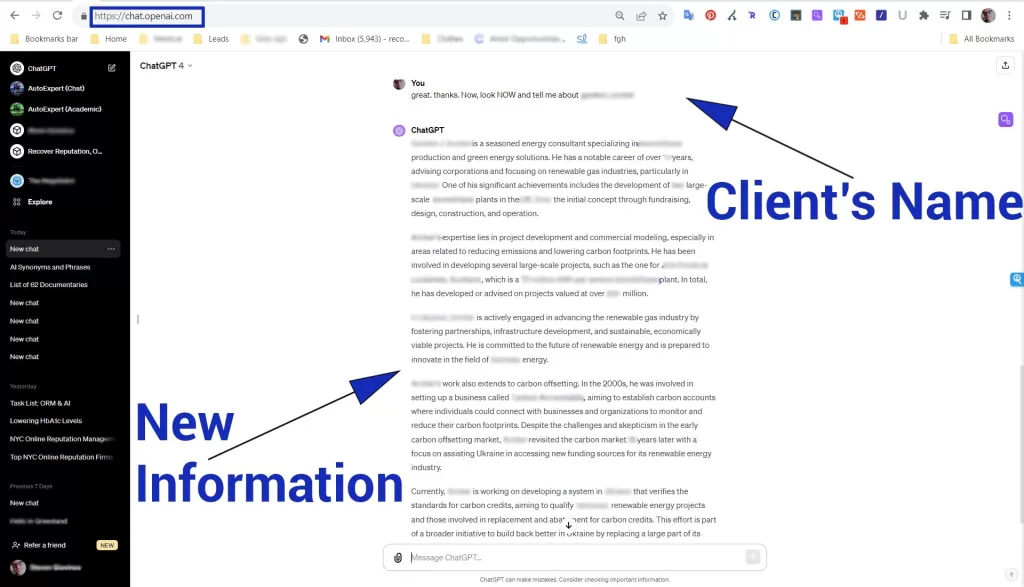
What is AI Reputation Management?  AI reputation management optimizes how people, businesses and brands appear in AI platforms such as ChatGPT and Gemini (Bard). The ultimate goal is to correct  generated answers or images in order to present you accurately and authentically. Since AI is rapidly becoming an alternative to traditional Google search results, it is essential to maintain a positive presence within these new platforms. Some questions:  Is your business, brand, or personal profile missing from AI results? Have you found inaccurate AI responses about you or your brand? Are you facing negative or false AI-generated answers? Unsure how to remove deep fake images associated with you? Key References Deep Fake Detection AI Help Cyber Civil Rights  Instagram Safety TikTok Safety Facebook Safety Snapchat Safety AI Reputation Solutions Build AI Presence: Establish your brand or self on pivotal platforms like ChatGPT, DALL-E, and Gemini (Bard), etc. ensuring you\’re represented authentically. Suppress Negative AI Answers: Systematically replace negative AI-generated content with factual, positive information, promoting your true narrative. Correct AI-Generated Responses: Proactively identify and remove deep fakes from DALL-E, Midjourney and the internet; repair poor AI-generated answers. Customize Tools and Consulting: Create custom GPTs, AI systems and strategies; offer AI education and marketing support; devise rapid responses to AI misinformation to protect and enhance your reputation. AI Reputation Process 1. Comprehensive Research and Strategic Planning: After an in-depth analysis/review of current web and AI presence, a customized strategy is crafted to align with your objectives and goals, emphasizing strengths. This strategy becomes the blueprint going forward. 2. Tool Optimization and Engagement: AI text and visual tools are reviewed to enhance any existing platforms and create new ones tailored to your industry trends and needs. This involves influencing, guiding and directing results as well as using some traditional SEO, ORM and engagement with key influencers. 3. Dynamic Content Development: Content creation and distribution of premium, impactful written and/or visual content across the network of platforms that have been optimized or established. This ensures your narrative remains authentic, engaging, and precisely what your clients are seeking. 4. Continuous Strategy Evolution: Constantly adapt, refine and improve strategies, making regular updates, engaging with key communities, and conducting ongoing research to stay successful. Case Studies and Client Success Real Before Screenshot: Bard (Gemini) Optimization Real Before Screenshot: Bard (Gemini) Optimization Situation: A sustainable energy entrepreneur faced a non-existent Gemini presence and a severely negative Google reputation due to false accusations, hindering business growth and investment opportunities. Outcome: Negative articles were quickly demoted within three months in two countries, and within six months for others. Achieved a positive Gemini presence rapidly. Why Choose Us? Education, Vision, Experience: Holding an MA from NYU\’s Interactive Telecommunications Program and an MFA from Yale University, Steven W. Giovinco blends technical and creative expertise. This educational foundation fuels our vision to provide innovative, ethical reputation management solutions across various industries. Direct experience spanning finance, law, medicine, arts, and more, reflecting a deep depth of industry knowledge. He is author of a comprehensive e-book, “Holistic Reputation Management,” and has ten years in boutique online reputation management. Contact Founder, Steven W. Giovinco Reach out and speak directly to CEO/Founder Steven W. Giovinco–no salespeople or chatbots here. Evaluations are always free. Recover Reputation +1-347-559-4952steve@recoverreputation.comwww.recoverreputation.com166 Second Avenue, Suite 11HNew York, NY 1ooo3

What is Generative AI Reputation Management and Why It\’s Important? Read More »
ai reputation management solutions, process, & case study: chatgpt after screenshot

What is Generative AI Reputation Management and Why It\’s Important?

What is AI Reputation Management?  AI reputation management optimizes how people, businesses and brands appear in AI platforms such as ChatGPT and Gemini (Bard). The ultimate goal is to correct  generated answers or images in order to present you accurately and authentically. Since AI is rapidly becoming an alternative to traditional Google search results, it is essential to maintain a positive presence within these new platforms. Some questions:  Is your business, brand, or personal profile missing from AI results? Have you found inaccurate AI responses about you or your brand? Are you facing negative or false AI-generated answers? Unsure how to remove deep fake images associated with you? Key References Deep Fake Detection AI Help Cyber Civil Rights  Instagram Safety TikTok Safety Facebook Safety Snapchat Safety AI Reputation Solutions Build AI Presence: Establish your brand or self on pivotal platforms like ChatGPT, DALL-E, and Gemini (Bard), etc. ensuring you\’re represented authentically. Suppress Negative AI Answers: Systematically replace negative AI-generated content with factual, positive information, promoting your true narrative. Correct AI-Generated Responses: Proactively identify and remove deep fakes from DALL-E, Midjourney and the internet; repair poor AI-generated answers. Customize Tools and Consulting: Create custom GPTs, AI systems and strategies; offer AI education and marketing support; devise rapid responses to AI misinformation to protect and enhance your reputation. AI Reputation Process 1. Comprehensive Research and Strategic Planning: After an in-depth analysis/review of current web and AI presence, a customized strategy is crafted to align with your objectives and goals, emphasizing strengths. This strategy becomes the blueprint going forward. 2. Tool Optimization and Engagement: AI text and visual tools are reviewed to enhance any existing platforms and create new ones tailored to your industry trends and needs. This involves influencing, guiding and directing results as well as using some traditional SEO, ORM and engagement with key influencers. 3. Dynamic Content Development: Content creation and distribution of premium, impactful written and/or visual content across the network of platforms that have been optimized or established. This ensures your narrative remains authentic, engaging, and precisely what your clients are seeking. 4. Continuous Strategy Evolution: Constantly adapt, refine and improve strategies, making regular updates, engaging with key communities, and conducting ongoing research to stay successful. Case Studies and Client Success Real Before Screenshot: Bard (Gemini) Optimization Real Before Screenshot: Bard (Gemini) Optimization Situation: A sustainable energy entrepreneur faced a non-existent Gemini presence and a severely negative Google reputation due to false accusations, hindering business growth and investment opportunities. Outcome: Negative articles were quickly demoted within three months in two countries, and within six months for others. Achieved a positive Gemini presence rapidly. Why Choose Us? Education, Vision, Experience: Holding an MA from NYU\’s Interactive Telecommunications Program and an MFA from Yale University, Steven W. Giovinco blends technical and creative expertise. This educational foundation fuels our vision to provide innovative, ethical reputation management solutions across various industries. Direct experience spanning finance, law, medicine, arts, and more, reflecting a deep depth of industry knowledge. He is author of a comprehensive e-book, “Holistic Reputation Management,” and has ten years in boutique online reputation management. Contact Founder, Steven W. Giovinco Reach out and speak directly to CEO/Founder Steven W. Giovinco–no salespeople or chatbots here. Evaluations are always free. Recover Reputation +1-347-559-4952steve@recoverreputation.comwww.recoverreputation.com166 Second Avenue, Suite 11HNew York, NY 1ooo3

What is Generative AI Reputation Management and Why It\’s Important? Read More »
5 ways twitter can damage your online reputation

5 Ways Twitter Can Damage Your Online Reputation

Before Elon Musk\’s takeover, Twitter was a key online reputation management tool. Now, using it might actually harm your web presence. Why?  Twitter under owner Elon Musk might quickly morph into the wild-west of content where “anything goes”, leaving regular users, business owners, students, newshounds, etc. in the crossfire, ultimately leading to a weakened online reputation. But more on this in a moment. Sure, we don\’t know what will happen in the end, and yes some might conclude that Twitter is already toxic.  But will it get better or worse?  This Tweet from Musk the day after his takeover should give you all you need to know.  (Screenshot courtesy of https://www.mediaite.com/news/elon-musk-deletes-conspiracy-theory-on-paul-pelosi-attack-after-hours-of-outrage/) After much backlash, it was deleted the same day.  It indicates to me the \’New\’ Twitter is less filtered and more adversarial–things that are probably not good for your online reputation, which I’ll explore further below. What seems abundantly clear is that the platform will shift from being neutrally based–as imperfect as that is–towards an even louder megaphone. This could be fine for some, but it’s no place for business and casual discourse. It’s a shame because it is so widely integrated into many other platforms and is very popular. Personally, I’ve loved it and used Twitter many times throughout the day. Let\’s take a moment to review Twitter and its role in reputation management. Brief Review: What Is Twitter? Think of Twitter as sharing a short headline with an attached link. This makes for lightning-fast communication; if you want more depth, this is not the right source for you. Because Twitter is so widely used, it can represent a nearly real-time pulse or opinion on topics, business, or politics. Can 280 Characters Help Your Online Reputation, Really? Twitter has been an essential online reputation management tool for years. Briefly, here are four reasons why. First, having an active and engaging Twitter account can quickly rise to the first page of Google searches. This is incredibly important to those with a damaged or minimal reputation because a positive link means a negative site or comment will get suppressed and pushed down. This is the essence of online reputation management. Second, tweets may appear in Google searches. This further expands a positive web presence. Third, as a result of good information flooding the web, potential clients see you as an expert in your field, making it easier for them to choose you over a competitor. Lastly, it is a platform you control, minimizing problems that might result from someone else’s post. 5 Ways Musk’s Twitter Can Damage Your Web Presence 1. Association With Controversy Being active on the platform might be misconstrued that you condone and approve of new owner Elon Musk\’s approaches and beliefs. No matter how you feel about Mr. Musk and his past and present businesses, there are many who are turned off by him. Unfair this appraisal might be, people, clients, and new business partners might link you to Twitterverse controversies of its chief. 2. It’s Personal–Not Business Speaking of controversies….Musk is certainly a larger-than-life public figure, who might be interested in serving a different agenda rather than enhancing a safe user experience. Also, due to his wealth, he might not be as beholden to board members as others might be, and this independence could be a blessing or curse. 3. Bad Content Competition New users to the platform, previously banned ones, or current Twitter users might feel free to post even more inappropriate or harmful messages, which could drown out your content. Moderate brand posts could get easily lost in the scrum. Do you want to compete in screaming matches? 4. Political/Free-Speech Centric Twitter seems to be going for free-speech-centric political discussion. A newly formed Content Committee is reviewing who will be reinstated to the platform, and it’s expected some controversial politicians and social media stars will return. This shift could further damage your online reputation because it means less room for business-related discussions, resulting in less traction for your Twitter account, leading to a drop in Google searches for your brand. 5. Direct Reputation Damage What if one of your posts generates negative comments, which could result in direct reputation damage? The whole point of being active on a social media platform, as mentioned above, is to build an excellent web presence and draw in new clients by showcasing your expertise. “New” Twitter might lead to more problems. What To Do? Find Other Platforms Develop a presence on other platforms. This could include spending more time on sites you already work with and seeking out new ones. Start by reviewing what others in your industry are doing to get a feel for what to be successful, and actively post. Here are some recommendations, many of which are familiar, as well as new platforms which are being developed. Reddit: Popular posting site, with many specialized “subreddits” or groups where comments can be minimally moderated. However, Reddit can be a bit of a “free-for-all” depending on the Subreddit LinkedIn: Business-oriented sharing and posting site, but is becoming more spammy. Learn how to remove a fake Linkedin account. Instagram: Image/video only, with comments Pinterest: general interest images, but can leave comments Medium: Blogging site for range of topics; great for online reputation management SlideShare: Business presentation; used to be more popular Mastodon: Smaller social media site which has grown since the Twitter announcement of Musk’s takeover Substack: Blogging and podcasting Bumble for Friends: Known as a dating site but section focused on making friends Friender: Find new friends Clubhouse: Audio-only group discussion Neighbors from Ring: Local community sharing Counter Social: Focus on troll-free and safe environment  Aether: self-governing communities Plurk: Social media platform Micro.blog: Blogging platform Cohost: Social media platform Minds: Social media platform Hivesocial: Social media platform Know When It’s Enough Get ready to pull the plug on Twitter. What will it take for you to quit? Will it be a comment made directly to you, your business, a colleague, or something you value? Have

5 Ways Twitter Can Damage Your Online Reputation Read More »

11 questions to ask when looking for a reputable online reputation management firm

11 Questions to Ask When Looking for a Reputable Online Reputation Management Firm

How to Find a Reputation Business You Can Trust How can you find the right firm to help repair or build your online reputation? More importantly, who is trustworthy and can deliver a legitimate solution at a realistic price?  The choice and selection can be daunting. Unfortunately, unscrupulous online reputation management firms have proliferated, so finding the right firm is paramount and can mean the difference between success or failure.  Some unethical companies buy reviews, overcharge, engage in hacking or follow “black hat” techniques. It seems the industry could use a reputation management overhaul itself. Working with the wrong firm can actually lead to additional reputation damage.  Here are some key questions to ask when searching for a reputable online reputation management firm. 1. What Is the First Contact Like? What is the first contact like with the reputation firm? If via email, does it seem formulaic or a hard sell with an urgent time to respond? If on the phone, do they seem distracted, disinterested or unable to answer technical or procedural questions?  Get a sense of the reputation management firm through your introductory contact.  A good web reputation analyst should listen intently to your specific issue, offer a detailed solution, and be well versed in web reputation and repair issues. Since some large firms use quota or commission-based salespeople, try talking with someone who will actually be doing the work. 2. Is the Pricing Realistic or Change Quickly? Do they offer a set price and then drastically reduce it? Some reputation firms quote an initial fee but quickly lower it. Beware: this could indicate that the firm is overcharging,  is providing substandard work or is basing their fee on what they think you can afford.  Also, is the proposed amount realistic? Some companies might offer a woefully inadequate fee that should be ten times larger to be successful. A price quote should be based on how many hours it takes to solve the issue. 3. Quick Solution Within Weeks? Are they promising a fast solution in weeks? Although total removal or suppression in less than a month might be possible depending on the severity, an average online reputation repair case takes six months or more. People that promise a nearly immediate result are over-promising or are purposely deceptive. 4. Are They Using Bad or Blackhat Techniques? Does the reputation firm use shady or “black-hat” techniques? Disreputable firms engage in bad practices ranging from buying followers, falsifying reviews, and even hacking. Most egregiously, I’ve heard of reputation businesses purposely damaging a random person and then contacting them to offer a solution!  Also, be aware of the term “proprietary solutions”. This often refers to things such as  “link-farms” or a series of fake websites made which that link back to each other. Options such as these have no or minimal reputation value, and can actually incur additional reputation damage.  Reputable firms focus on analysis, research, excellent content creation and constant reviews. 5. Do they Guarantee Removal? Do they guarantee outright removal? While images or videos which violate copyright rules are possible to delete, most items are not. If a firm says they can remove any type of content, they are probably engaging lawyers who submit dubious take-down requests, which is often not effective with Google search results. In reality, suppression is often the only option. (Recover Reputation never takes on a case unless I think it can be solved).  6. Do They Have Relevant–and Real–Case Studies? Do they have real case studies? If the company has no or minimal examples of their solutions, move on to someone else. Also, since testimonials or case studies could be fabricated, review them carefully for veracity.   7. Do They Have a Real Location? Where is the business located—and are they really there? Believe it or not, this is an issue. I’ve seen companies claiming to be in the US but are actually in Russia. Since nearly all reputable firms post their location, phone number, email and other pertinent information, not having a street address could mean the company is not legitimate or is located overseas. (Some sole proprietorships prefer to use P.O. box offices.)   A simple way to check the validity of an address is to search using Google Maps. Results that show a mail drop-off center, a house (when it should be an office building), vacant land, a shed, factory or run-down building indicate a false place of business and should be avoided. 8. Is Their Proposal Simplistic? What do their proposals look like? Poorly worded, simplistic, and unprofessional assessments of your issue are problematic. So too are ones that are filled with too many deliverables. For example, offering one-hundred blog posts may sound impressive, but if they are badly crafted or on the wrong topic, they will have little impact. A customized hands-on approach is most effective, and the proposal should reflect this. 9. Do They Have a Poor Online Reputation? What does their own reputation look like? Search for negative reviews, bad comments, poorly made content, sloppy work, typos, etc., across various platforms and websites. If you see any red flags, immediately move on and work with someone else. A good firm should provide excellent information that is easily accessible through a simple online search. 10. Are They a Large Corporation? How large and accessible is the organization? Giant firms can not only feel impersonal but often follow a set of route solutions that can be quickly outdated and ineffective. A good reputation firm should be nimble, and be able to quickly adjust to Google’s constantly shifting algorithm updates.  11. Can You Trust Your Gut Instinct? How does it feel? After reviewing all these criteria, check your gut instinct. Does it seem like a good fit, or is there something opaque about their process? Can they understand your issues or does it feel like a sales pitch? Always, call around and compare online reputation solutions. Bottom Line Picking the right online reputation firm can be complex and is full of

11 Questions to Ask When Looking for a Reputable Online Reputation Management Firm Read More »

how to use online reputation management to gain and retain clients

How to Use Online Reputation Management to Gain and Retain Clients

Gathering new customers is one of the hardest parts of running a business (especially when starting out), but one way to gain clients is by having a strong online presence built on trust–not fake reviews or inflated followers.  Appearing authoritative in Google search results attracts prospective buyers who see positive links and articles as a sign of credibility, making reputation management a priority.  At its essence is trust. Personal Referrals and Reputation Management Initial business referrals could come from a variety of sources: a hearty personal endorsement from a friend or family member; through a strong business recommendation; via a convincing ad, email introduction, cold call, or networking event–or yes, even through a Google search.  Often, the next step for prospective clients is verifying your talents through an online review of your reputation where they assess and confirm your talents through Google searches.  Trust and Authenticity Prospects seek authenticity, trust, and believability, and if this is not found online, the best recommendation from a close friend could be negligible.  Substantially worse, however, is if nothing appears or if there is a negative link, which turns the potential client swiftly to move on to someone else. Before hiring you, prospective clients usually ask a bunch of questions–either out loud or to themselves before hiring or engaging a new business partnership: Your web presence should focus on answering these questions.  What Is Online Reputation Management Online reputation management is built around the premise that information found in searches is sometimes a primary- or certainly a secondary-consideration in deciding to hire someone. It is a place to confirm that you are the right person to work with, showing that you are professional, friendly, experienced, and truly helpful. Compelling online content is a central component to substantiate this. Articles, blogs, videos, presentations, social media platforms and your website need to drive this point home. The work here should always be focused on what the potential client wants, showing you as the definitive and dependable source that solves their problems.  When clients see your positive web presence, they feel more comfortable in choosing you to work with over a competitor. Don’t be afraid to give away information; in fact, I strongly encourage it, because this signals to clients that you are helpful, and thus, the right person to work with. Poor or Negative Online Reputation On the other hand, if there is no online appearance or a minimal one in Google search results, potential customers ask themselves, “Are they still in business?”, “Are they unprofessional?”,  “Do they even care?” or, “Is this the kind of firm I want to work with?” A poorly defined online reputation is seen as untrustworthy, so clients just move on. The most damaging case is if something negative appears in the few pages of Google searches. Competitors, “trolls”, ex-partners, disgruntled employees, and of course, unhappy buyers, can write negative posts, and even if it’s not truly condemning, new and existing clients will quickly move on to someone else without even investigating the problem.  So, to gain new clients, establish an accomplished online reputation. Reputation Building Strategy Develop a carefully considered reputation strategy. Before building a reputation, draft an initial strategy built around knowing who do you want to work with, where will you reach them, and how will you connect. It’s usually a work in progress requiring continual tweaking, but always create original content, share meaningful information and be helpful. To formulate this, start by asking some basic but crucial questions: Who are you trying to connect with? How will you build trust? What kind of content will you create? How and when will you share it? Each reputation strategy needs to be customized for the customer’s industry, their geographic location, company size, challenges and specific goals. As a result, no two solutions are probably alike. The key is creativity, excellent content, constant updates and ceaseless adjustments.  For example, building a reputation for a financial advisor differs substantially from that of a grad student; an entrepreneur who received initial funding investment needs a different service than an established CEO professional working at a large firm; a biomass firm in Brazil is different still from an international divorce lawyer in Paris. Not getting this right could mean failure. Define Clear Goals  Now that there is a basic framework, lay out specifically what you want. Clearly define outcomes and milestones before building your reputation; by the way, the same goes for working with someone new or connecting with a prospect too. Although it might seem obvious, it is important to get very specific with your online goals, such as: Each intention has a slightly different approach. Once you have a straightforward vision mapped out, define exactly how you will achieve each step with measurable, time-bound and specific tasks. Why does this matter to your reputation? Identifying key objectives keeps the process on track, and, importantly, prevents disappointed clients, which avoids potential tarnishing your own online reputation later. Set Your Online Persona Set your voice and online persona. Do you want to appear to be neutral but very informed, sound like an academic, casually breezy, or snarky/sarcastic? Since your online reputation reflects your identity, the easiest approach is to just be who you are in real life. This too is an on-going process that should be reviewed and revised frequently.  Part of the strategy includes systematically generating content on appropriate platforms such as LinkedIn, Twitter, Instagram, etc.These sites are also a place to post informative articles, videos and links made by other experts. Being active and engaging builds your web profile. This in turn, draws in prospective clients who see you as the trusted professional that solves their problem.   Understand Your Client’s Business Process Understand where your prospective clients are in their buying stage. Are they just starting out, still getting research? Are they comparison shopping to get more information after already receiving a proposal from a competitor? Or are they ready to sign-up now? Each phase has its own reputation process,

How to Use Online Reputation Management to Gain and Retain Clients Read More »

Scroll to Top