Google’s AI Search Overhaul: Why Traditional Online Reputation Management (ORM) is Dead
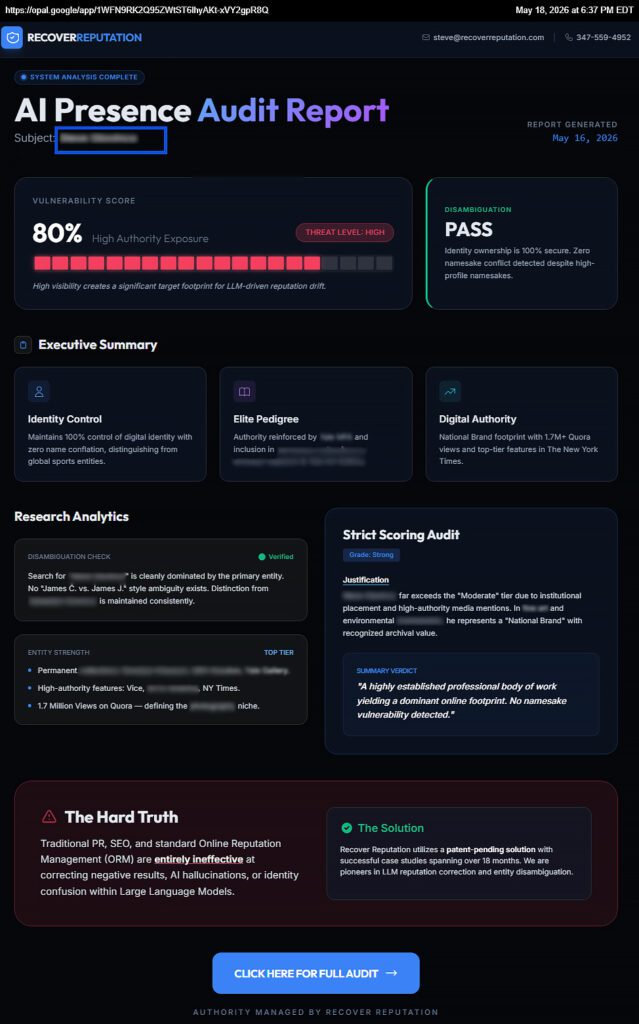
By Steven W. Giovinco Search encourages paragraph-long, complex queries rather than two-word names AI summaries can answer follow-up questions right on the search page without clicking external links Assistants search in the background for topics, shifting people away from websearches Photographs and videos can be directly into the search bar, making metadata more important In its most massive overhaul since 2001, Google announced it is fundamentally changing how search works. Driven by their new Gemini 3.5 Flash AI model, the search box is expanding. It is no longer just a place for short keywords; instead, it is dynamic, designed for long questions, uploaded photos, and multi-turn conversations with AI. If you are an executive or a brand relying on online reputation management to “bury bad links,” you are exposed to this new search reality. Here is a breakdown of what Google just changed, the severe implications for online reputations, and how Generative Reputation Management (GRM) is the only solution. Google Search Updates: The Shift to AI Overviews and Gemini Google is aggressively transforming from a search engine into an answer engine. Here are the critical updates: Expanded, Conversational: The search box is now significantly larger, made to encourage paragraph-long, complex queries rather than two-word names. “AI Mode” and Follow-Up: Google is merging AI Overviews with an interactive chatbot mode. Now, when a user gets an AI summary, they can ask follow-up questions right on the search page without clicking an external link. Research Agents: Google is deploying digital assistants for complex research for the user behind the scenes. It summarizes topics, and delivers it directly. Other Input: You can upload photographs and videos directly into the search bar, or use smart glasses to look at a product or a person and ask AI for an immediate background check. The Impact of AI Search on Online Reputation Management (ORM) These updates represent the end for standard SEO and traditional ORM. Standard Content Suppression is Dead With AI agents synthesizing information directly at the top of the search page, users no longer need to click through to your website. Thus, the concept of “Page Two” suppression is dead. If an old lawsuit, a negative article, or an embarrassing social media post exists anywhere online, AI will most likely find it and include it into your summary. Past Damaging Links Appear In the past, someone would Google your name, review the top links, and move on. Now, because the search bar encourages complex queries and follow-us, AI reviews search deeper for answers. If a prospect asks the chatbot, “What are the main criticisms of this executive?” the AI will actively seek for legacy issues to satisfy the prompt. If there is an “information vacuum” about your current successes, AI will fill it with negative sources or will make it up (hallucinate). Visual Reputation is Crucial Because users can now initiate searches using uploaded images or videos (and manipulate them using tools like Gemini Omni), visual reputation is just as vulnerable as text. If AI cannot correctly identify the context of a photo of you, it creates a dangerous void in or could confuse you with someone else. Generative Reputation Management (GRM): Solutions for the AI Era You cannot “spin” an AI agent. Google openly admits it is reducing websites to “raw data providers,” so suppressing links is now unnecessary. Instead, it is necessary to engineer core data AI relies on. To combat these updates, it is necessary to transition to Generative Reputation Management (GRM). Here are the specific solutions we deploy to protect our clients in this new ecosystem: Combat Longer Searches with Conversational Key Phrases Because users are now typing complex, paragraph-long questions, short-tail keywords are useless. Content strategy must anticipate longer prompts and build high-authority whitepapers, executive essays, and FAQ architectures based on these. If a user might ask, “What were the major challenges [Executive Name] faced in 2024?”, publish premium content that uses that exact phrase as a key target, forcing AI to use our content as its ground truth. Feed the AI “Raw Data” via Structured Entity Mapping AI agents like Gemini Spark do not read PR spin; they read structured, machine-readable data. Aggressively manage your “Data Provenance,” by utilizing complex schema markup, Wikidata optimizations, and elite institutional profiles. When Google’s agents are looking for answers, we ensure they bypass old negative content and use unified, positive sources. Optimize Visual Metadata to Control Multimodal Search To prepare for visual search, every high-quality image and video associated with your brand must be optimized. Inject EXIF metadata and rich Alt-Text into visual assets across the web, ensuring that when AI “sees” your face, it instantly connects you to your current, positive ventures. The Hard Truth: Securing Your Digital Identity from AI Google’s redesign shows traditional SEO and ORM are over. The future of search is LLMs that (confidently) tell you exactly who you are based on data it finds. If you are not actively structuring your narrative for AI ingestion, ChatGPT and Gemini will structure it for you–with disastrous, inaccurate results. Before launching new ventures, seeking investment, or moving past negative articles, know how these new AI agents are summarizing your life’s work. Are you prepared for the new Google search? Enter your brand or name and Recover Reputation will run a deep-dive simulation through ChatGPT and Gemini and email your customized audit. Learn more here.
Google’s AI Search Overhaul: Why Traditional Online Reputation Management (ORM) is Dead Read More »