Uncategorized

Google’s AI Search Overhaul: Why Traditional Online Reputation Management (ORM) is Dead

By Steven W. Giovinco Search encourages paragraph-long, complex queries rather than two-word names AI summaries can answer follow-up questions right on the search page without clicking external links Assistants search in the background for topics, shifting people away from websearches Photographs and videos can be directly into the search bar, making metadata more important In its most massive overhaul since 2001, Google announced it is fundamentally changing how search works.  Driven by their new Gemini 3.5 Flash AI model, the search box is expanding. It is no longer just a place for short keywords; instead, it is dynamic, designed for long questions, uploaded photos, and multi-turn conversations with AI. If you are an executive or a brand relying on online reputation management to “bury bad links,” you are exposed to this new search reality.  Here is a breakdown of what Google just changed, the severe implications for online reputations, and how Generative Reputation Management (GRM) is the only solution. Google Search Updates: The Shift to AI Overviews and Gemini Google is aggressively transforming from a search engine into an answer engine. Here are the critical updates: Expanded, Conversational: The search box is now significantly larger, made to encourage paragraph-long, complex queries rather than two-word names. “AI Mode” and Follow-Up: Google is merging AI Overviews with an interactive chatbot mode. Now, when a user gets an AI summary, they can ask follow-up questions right on the search page without clicking an external link. Research Agents: Google is deploying digital assistants for complex research for the user behind the scenes. It summarizes topics, and delivers it directly. Other Input: You can upload photographs and videos directly into the search bar, or use smart glasses to look at a product or a person and ask AI for an immediate background check. The Impact of AI Search on Online Reputation Management (ORM) These updates represent the end for standard SEO and traditional ORM. Standard Content Suppression is Dead With AI agents synthesizing information directly at the top of the search page, users no longer need to click through to your website. Thus, the concept of “Page Two” suppression is dead.  If an old lawsuit, a negative article, or an embarrassing social media post exists anywhere online, AI will most likely find it and include it into your summary.   Past Damaging Links Appear In the past, someone would Google your name, review the top links, and move on.  Now, because the search bar encourages complex queries and follow-us, AI reviews search deeper for answers. If a prospect asks the chatbot, “What are the main criticisms of this executive?” the AI will actively seek for legacy issues to satisfy the prompt. If there is an “information vacuum” about your current successes, AI will fill it with negative sources or will make it up (hallucinate). Visual Reputation is Crucial Because users can now initiate searches using uploaded images or videos (and manipulate them using tools like Gemini Omni), visual reputation is just as vulnerable as text. If AI cannot correctly identify the context of a photo of you, it creates a dangerous void in or could confuse you with someone else. Generative Reputation Management (GRM): Solutions for the AI Era You cannot “spin” an AI agent. Google openly admits it is reducing websites to “raw data providers,” so suppressing links is now unnecessary. Instead, it is necessary to engineer core data AI relies on. To combat these updates, it is necessary to transition to Generative Reputation Management (GRM). Here are the specific solutions we deploy to protect our clients in this new ecosystem: Combat Longer Searches with Conversational Key Phrases Because users are now typing complex, paragraph-long questions, short-tail keywords are useless.  Content strategy must anticipate longer prompts and build high-authority whitepapers, executive essays, and FAQ architectures based on these. If a user might ask, “What were the major challenges [Executive Name] faced in 2024?”, publish premium content that uses that exact phrase as a key target, forcing AI to use our content as its ground truth. Feed the AI “Raw Data” via Structured Entity Mapping AI agents like Gemini Spark do not read PR spin; they read structured, machine-readable data. Aggressively manage your “Data Provenance,” by utilizing complex schema markup, Wikidata optimizations, and elite institutional profiles. When Google’s agents are looking for answers, we ensure they bypass old negative content and use unified, positive sources. Optimize Visual Metadata to Control Multimodal Search To prepare for visual search, every high-quality image and video associated with your brand must be optimized. Inject EXIF metadata and rich Alt-Text into visual assets across the web, ensuring that when AI “sees” your face, it instantly connects you to your current, positive ventures. The Hard Truth: Securing Your Digital Identity from AI Google’s redesign shows traditional SEO and ORM are over. The future of search is LLMs that (confidently) tell you exactly who you are based on data it finds. If you are not actively structuring your narrative for AI ingestion, ChatGPT and Gemini will structure it for you–with disastrous, inaccurate results. Before launching new ventures, seeking investment, or moving past negative articles, know how these new AI agents are summarizing your life’s work. Are you prepared for the new Google search?   Enter your brand or name and Recover Reputation will run a deep-dive simulation through ChatGPT and Gemini and email your customized audit. Learn more here.

Google’s AI Search Overhaul: Why Traditional Online Reputation Management (ORM) is Dead Read More »

AI Reputation Management: How Algorithms Actually “See” Your Brand 

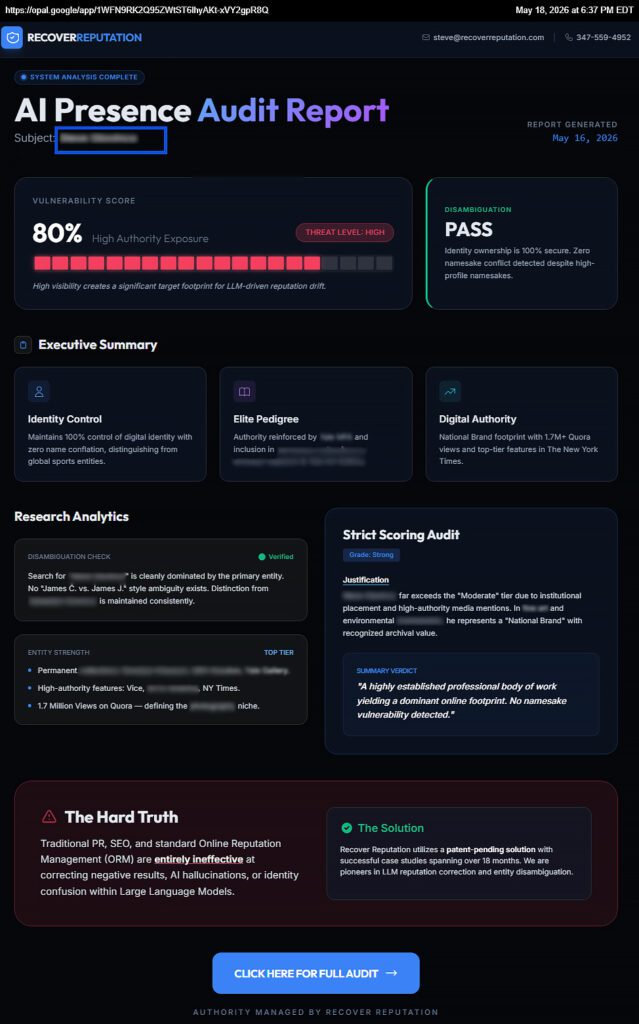
Why Traditional Online Reputation Management (ORM) is Failing  For the last twenty years, online reputation management meant appearing on page one of Google. If a negative article appeared, traditional ORM would publish targeted content to push it down to page two or further.  Today, that strategy is obsolete. With the rapid integration of Large Language Models (LLMs) like ChatGPT, Gemini, and Claude into search engines–or replacing them entirely–the concept of “Page Two” no longer exists. AI models don’t give you a list of blue links; they synthesize the entire internet into a single, confident-sounding narrative. If your online reputation has gaps, overlapping identities, or negative data, the AI will hallucinate an inaccurate summary of your career or brand. To fix an algorithmic problem, you need an initial algorithmic diagnosis. We realized that executives and brands cannot fix their AI narrative until they understand exactly how LLM sees them. So we engineered the AI Presence Audit Report, a proprietary, diagnostic tool that analyzes AI results the exact way an LLM does. Here is a detailed how our AI Presence Audit breaks down digital vulnerabilities, using a real analysis of a high-authority entity. The AI Vulnerability Score: Are You at Risk for AI Hallucinations?  The foundation of our report is the Vulnerability Score. Most executives assume that if they have “good PR” and a clean search history, they are safe from AI hallucinations. Our algorithm often proves otherwise. In this section, the audit flagged an 80% Vulnerability Score (High Authority Exposure). High visibility is a double-edged sword: it means the LLM has a lot of data to pull from, but it also creates a massive surface area for algorithmic mischaracterization if that information isn’t properly structured. As the report notes, “High visibility creates a significant broad footprint for LLM-driven reputation shifts.” Next to the score, we evaluate the immediate Threat Level. In this example, the entity achieved a “PASS” for Identity Control. If you share a name with a controversial figure, a politician, or a criminal, this is where the AI will flag a Critical Threat of “Entity Conflation.” Mapping Your Knowledge Graph: How LLMs Evaluate Your Identity  When an AI model generates a brand or personal summary, it isn’t “thinking”, it is connecting nodes in a knowledge graph. Our Executive Summary breaks down the three pillars that LLMs look for when deciding if you are a credible entity: Identity Control: Do you own your narrative? We analyze if your primary digital assets are verified and clearly disambiguated from old firms, past lawsuits, or namesakes. In this case, the subject maintains 100% control of their digital identity. Elite Pedigree (Trust Anchors): AI models weigh certain institutions heavier than others. Having verifiable ties to Tier-1 institutions acts as an “anchor” that prevents the AI from generating low-tier hallucinations. Digital Authority: We measure your footprint’s reach. A massive footprint across mainstream publications (like The New York Times) proves to the AI that you are a recognized national brand, not an obscure entity it needs to guess about. Entity Disambiguation: Stopping AI from Confusing Your Brand  Traditional reputation management measures success by looking at search volume, i.e., the number of entries on the front page of Google. For AI, however, we measure success by looking at Algorithmic Weight and Disambiguation. One of the most dangerous, yet overlooked, threats in Generative Search is when an AI confuses you with someone else. Our audit performs a Disambiguation Check. In the dashboard above, the engine verifies that the subject has cleanly dominated their primary entity status. In this case, distinctly separating someone with the same last name (a global sports entity) with the target subject. Our Strict Scoring Audit bypasses less authoritative references. We test if the AI recognizes your brand based on institutional placement rather than generic search keywords. For example, here AI ultimately concluded that this subject possesses “recognized archival value.” If AI cannot connect your name to your highest achievements, it creates an “Information Vacuum” that competitors or negative press will easily fill. The Hard Truth: Why You Need Generative Reputation Management (GenRM)  The foundation of our report is the Vulnerability Score. Most executives assume that if they have “good PR” and a clean search history, they are safe from AI hallucinations. Our algorithm often proves otherwise. In this section, the audit flagged an 80% Vulnerability Score (High Authority Exposure). High visibility is a double-edged sword: it means the LLM has a lot of data to pull from, but it also creates a massive surface area for algorithmic mischaracterization if that information isn’t properly structured. As the report notes, “High visibility creates a significant broad footprint for LLM-driven reputation shifts.” Next to the score, we evaluate the immediate Threat Level. In this example, the entity achieved a “PASS” for Identity Control. If you share a name with a controversial figure, a politician, or a criminal, this is where the AI will flag a Critical Threat of “Entity Conflation.” The most important takeaway from our AI Presence Audit is the reality check it provides to clients. Traditional PR, SEO, and standard Online Reputation Management are ineffective at correcting negative results, AI hallucinations, or identity confusion within LLMs. You cannot “spin” an algorithm. To securely overwrite AI training data, establish a verifiable ground truth, and fix these vulnerabilities at the root code level, you require Generative Reputation Management (GenRM). We have developed a patent-pending solution that doesn’t just push bad links down; it restructures the semantic architecture of digital identities so that AI engines have the correct data to output the truth. Ready to See How AI Views You? Request Your Custom AI Presence Audit  Before you launch a new venture, seek investment, or attempt to bury a past crisis, you need to know exactly what the algorithm is telling your prospects behind closed doors. Click here to request your custom AI Presence Audit and secure your digital identity today. https://www.recoverreputation.com/contact/

AI Reputation Management: How Algorithms Actually “See” Your Brand  Read More »

The Chroma-Key Crisis: What a Viral AI Art Scam Teaches Us About Generative Reputation Management (GenRM)

By Steven W. Giovinco | Founder, Recover Reputation Recently, I watched a brilliant investigative video essay by YouTube creator Mujun. On the surface, the video documents a massive scandal within the digital illustration community. A popular creator named “Asami Arts” was exposed for generating synthetic AI images, secretly tracing over them, and selling them to unsuspecting clients as 100% human-made art. https://youtu.be/HWO9g4Shnpc But watching a breakdown like this, I do not just see internet drama. Since I focus on Online Reputation Management (ORM) and Generative Reputation Management (GenRM), I see a real-time preview of the algorithmic warfare happening now or about to happen that will be waged against regular people, brands and firms. The most alarming part of this scandal was not the mere use of AI, but was the sophisticated, highly engineered methods the bad actor used to synthesize the illusion of authenticity, and how easily it fooled most people. This should be a massive red flag. We have officially entered an era where “proof” can be manufactured. Here is what this scandal teaches us about the future of reputation management, why legacy PR is entirely unequipped to handle it and that nearly anything can be spoofed. 1. The Weaponization of “LoRAs” (Synthetic Identity Theft) One of the most fascinating parts of Mujun’s video is the discussion of LoRAs (Low-Rank Adaptations). These are small, highly specific machine-learning models trained on a hyper-niche set of data. In this scandal, the creator scraped the copyrighted portfolios of veteran artists without their consent. They fed this data into a LoRA, teaching the AI to perfectly clone that specific artist’s unique style. The scammer could then instantly generate infinite fakes that perfectly mimicked real professionals. The Tactic The Art World Scam (The Catalyst) The GenRM Corporate Reality (The Threat) Synthetic Cloning (LoRAs) Scammers trained AI models on stolen portfolios to perfectly mimic an artist’s unique brushstrokes. Bad actors train LLMs on synthetic articles to deepfake executive voices and clone corporate communications. Manufactured Proof (Chroma-Key) The scammer used green-screen video editing to hide the AI layer, faking a flawless “live drawing” video. Saboteurs synthesize flawless, fake digital footprints (documents, reviews, whistleblowers) to launch smear campaigns. The Target Audience Fooling paying clients who only look at the surface-level “Presentation Layer” (the finished drawing). Fooling investors, stakeholders, and journalists who rely on the AI “Presentation Layer” (ChatGPT or Gemini summaries). The GenRM Connection: This is the exact technology that should keep people awake at night. Large Language Models (LLMs) like ChatGPT and Google Gemini are constantly scraping the internet. But scammers are using these exact open-source AI tools to clone other things, including corporate communications, deepfake executive voices, and generate highly convincing, fabricated evidence of brand misconduct. Just as an AI was trained to perfectly create an artist’s brushstroke to steal their business, an AI can be trained by a few synthetic articles to perfectly mimic a toxic narrative about brands or people. 2. The “Chroma-Key” Deception: When Proof is Faked When confronted with accusations of using AI, the scammer escalated the deception. They released a 7-minute “time-lapse” video showing their drawing process from scratch to prove their innocence. In reality, it was a flawless optical illusion that successfully fooled many. It was only when technical experts analyzed the video frame-by-frame that they realized the imposter had used video-editing software to chroma-key (green-screen) the underlying AI layer out of the recording. The GenRM Connection: Legacy Public Relations relies on a simple assumption: If we just show the public the truth, we will win. But what happens when the attacker manufactures flawless, fake proof? The “Presentation Layer” of the internet (what the public sees) is now hopelessly compromised. If a solo actor can manipulate digital layers to fake authenticity and fool thousands of paying customers, imagine what well-funded corporate saboteurs, short-sellers, or coordinated smear campaigns can do to a Fortune 500 brand. You are bringing a PR knife to an “algorithmic gunfight”. 3. The Death of Legacy PR and the Rise of GenRM How was the art fraudster finally caught? They were not defeated by PR spin, apologies, or public debate. They were uncovered by deep forensic data audit by a Teru. Teru bypassed the manipulated video and reviewed the underlying data. They tracked upload timestamps of the LoRA models, identified visual artifacts (like backwards gun muzzles and looping hair strands) and noticed that the color green was entirely missing from the fraudster’s digital RGB color wheel, proving a hidden layer had been keyed out. The GenRM Connection: You cannot fight an algorithmic crisis like this with a press release or traditional online reputation management. When an identity is ingested and manipulated inside the parametric memory of a Generative AI model, traditional crisis or reputation management is useless. A PR firm cannot “spin” an algorithm. To detect falsehood, you have to operate like the forensic experts in the video. It’s best not to waste time arguing on the surface level. Instead, attack the underlying data (the Knowledge Layer) by mapping authoritative, positive entity data directly into the LLMs using custom schema and content architecture, and overwrite the poisoned training data at the source. Strategic Feature Legacy Public Relations Generative Reputation Mgmt (GenRM) The Battlefield The “Presentation Layer” (News articles, SERPs, Social Media) The “Knowledge Layer” (LLM Parametric Memory & Training Data) Core Assumption “If we show the public the truth, we win.” “Truth is whatever the algorithm has been trained to output.” Primary Weapon Press releases, public apologies, and SEO spin. Custom schema, entity mapping, and authoritative data architecture. Pace of Action Reactive: Responds to a crisis after the damage is done. Proactive: Inoculates the algorithm before hallucinations occur. Control Your Narrative, or AI Will I think the ultimate lesson of the Asami Arts scandal is that in the era of Generative AI, truth is no longer what actually happened; “truth”, unfortunately, is whatever the algorithm has been trained to output. The artists in the video lost control of their digital footprint, and their data was

The Chroma-Key Crisis: What a Viral AI Art Scam Teaches Us About Generative Reputation Management (GenRM) Read More »

repair holiday online reputation genai ceo damage

The Holiday Party Trap: How One CEO Ruined His Reputation (And Why GenAI Makes It Risky for You Today)

The Holiday Party Trap: How One CEO Ruined His Reputation (And Why GenAI Makes It Risky for You Today) By Steven W. Giovinco Picture a highly successful 55-year-old New York media executive with a stellar track record (someone at the forefront of innovation) found himself “untouchable” in the job market. He wasn’t losing opportunities because of his skills or his resume. He was losing them because of a single holiday party that happened 19 years ago. Admittedly, his behavior at that staff event was embarrassing but not abusive or illegal. But in the age of Google, that one night haunted him for nearly two decades, dominating page one of his search results and costing him a signed contract for a high-level position. If a pre-smartphone incident could cause that much damage, imagine the stakes today.  As we head into another holiday season, the risks have evolved. It’s no longer just about someone snapping a photo; it’s about how Generative AI (GenAI) can amplify, distort, and permanently encode those moments into your digital footprint. Here is how we repaired his reputation then, and how you must protect yours now in the age of ChatGPT and Gemini. The New Ghost of Christmas Past: GenAI and Viral Velocity In the original case study, the damage was negative search results that sat on Google that was fairly stable. Today, reputation damage is dynamic and algorithmic. The “Hallucination” Risk: AI search engines like ChatGPT, Gemini, and Perplexity don’t just index links; they synthesize narratives from diverse sources. If a holiday party blunder goes viral today, AI models might ingest that data and “learn” it as a defining fact about your career. Worse, they can hallucinate additional details, turning a minor embarrassing moment into a factually incorrect, career-ending controversy that is incredibly difficult to correct. Deepfakes and Context Stripping: The photo of you holding a drink can be (mostly) harmless. But GenAI tools can now be used by bad actors to alter that image or strip it of context, creating “evidence” of behavior that never happened. A harmless dance floor video can be manipulated into something compromising in minutes. How We Repaired the CEO’s Online Reputation (And How the Strategy Has Changed) To fix the CEO’s web reputation, we used a strategy that suppressed the negative results. While the core principles remain, the toolkit has expanded to address AI. Step 1: The Foundation (Human Intelligence) The process always starts with talking and listening. We needed to identify his true business goals—was it cable TV? Digital ad sales? We had to build a narrative that was authentic, not just “clean.” Old Way: Write a bio to push down bad links. New Way: Craft a narrative that “trains” the algorithms on who you are now, making it harder for AI to associate you with past mistakes. Step 2: Strategic Platforming We focused on high-authority platforms that Google (and now LLMs) trust. Then: We built profiles on IMDb, Crunchbase, and LinkedIn to flood the first page of Google. Now: We still use those platforms, but we optimize them for Data Provenance. We ensure that the data on LinkedIn and Crunchbase is structured in a way that AI scrapers can easily read and verify, establishing a “source of truth” that contradicts negative hallucinations. Step 3: The Wikipedia Factor We helped facilitate a neutral, well-sourced Wikipedia article. Warning: Wikipedia is a primary training source for almost all Large Language Models (LLMs). Having a clean, factual Wikipedia presence is one of the strongest defenses against AI chatbots spreading misinformation about you. The GenAI Reputation Pivot: Using the Tool That Can Hurt You We don’t just fight AI; we use it. Tone and Research: In the original case, we had to try to understand the tone or voice of the CEO based on interviews and online research. Additionally, further deep review of buried positive content took time to find. Today, we use GenAI to help assess sentiment and uncover unintended potential risks of strategy deployment. This helps to identify industry-specific thought leadership topics (edited by humans), making it quicker to deploy positive context faster than ever before. Synergistic Algorithmic Repair™: We now look beyond just “suppressing links.” We look at correcting the AI itself. By feeding positive, verified data into the ecosystem, we can influence how GenAI answer questions about you. The Happy Reputation Result After months of diligent work, which included moving positive articles from page 12 to page 1—the CEO landed a mid-to-high six-figure job. The negative story was suppressed, and his expertise took center stage. Your Holiday Survival Guide (GenAI Edition) If you are an executive attending a party this season, the rules have changed: Assume Everything is Content: There is no “off the record” when everyone has a 4K camera and an internet connection. Monitor the AI: Don’t just Google yourself. Ask ChatGPT, “Who is [Your Name]?” If it brings up a holiday blunder or a hallucinated error, you need a repair strategy immediately. Flood the Zone Early: Don’t wait for a crisis. creating a strong, positive digital footprint now acts as an “immunization” against future reputation attacks. Reputation is fragile. It used to take years to ruin it; now it takes seconds. But with the right strategy, we can repair it.

The Holiday Party Trap: How One CEO Ruined His Reputation (And Why GenAI Makes It Risky for You Today) Read More »

gemini generated image uh3hnmuh3hnmuh3h

Why ORM Fails AI: A New Framework for GenAI “Algorithmic Repair” and Corporate Reputation Risk

Generative AI platforms like ChatGPT and Gemini have fundamentally disrupted the landscape for C-Suite executives. LLMs have replaced Google as the new gatekeeper of brand perception and online reputation management but they introduce a distinct enterprise risk: “hallucinations.”  Models frequently invent disparaging facts, amplify outdated controversies, or fabricate negative narratives when they lack sufficient data. For CEOs, PR firms, and Online Reputation Management (ORM) agencies, this presents a critical strategic problem: Traditional ORM tactics are structurally incapable of fixing these errors. In the past, ORM focused on the “Presentation Layer” (Google search results), aiming to push negative links to page two or three. My research proves this approach is obsolete in the AI era. LLMs operate on the “Knowledge Layer”; they do not just index the web, they synthesize it based on trained data. If a negative narrative exists in the model’s memory, suppressing a link on Google will not stop AI from generating it. After a year of original research and development, I established the Synergistic Algorithmic Repair Framework. This guide outlines the methodology for agencies and business leaders to move from “search suppression” to “knowledge correction.” The Protocol: A 3-Pillar Framework for Brand Resilience My research demonstrates that effective Generative AI reputation management requires a “synergistic” loop that integrates the digital ecosystem with the model’s internal feedback mechanisms. This offers a roadmap to evolve services beyond simple ORM/SEO. Pillar 1: Digital Ecosystem Curation (Establishing Corporate Ground Truth) An AI model can create hallucinations when it encounters an “information vacuum”. To prevent this, it is important to establish a machine-readable “Ground Truth”. The Strategy: Develop a corpus of high-authority assets, i.e., corporate wikis, schema-optimized executive bios, and white papers, optimized specifically for AI ingestion, comprehension, and validation. The Business Impact: Unlike traditional ORM content designed for human readers, this content fills the “voids” in the model’s knowledge base, forcing the system to rely on verified data rather than speculation. Pillar 2: Verifiable Human Feedback (Direct Algorithmic Intervention) Passive monitoring is insufficient. We must utilize the feedback loops inherent in these models (Reinforcement Learning from Human Feedback, or RLHF) to surgically repair errors or information gaps. The Strategy: Implement a protocol of Verifiable Feedback. When an LLM outputs an inaccuracy, we submit a correction that is explicitly cited against the authoritative “Ground Truth” assets created in Pillar 1. The Business Impact: This creates a traceable link between the correction and the evidence, effectively “training” the specific instance of the model to align with factual reality rather than subjective opinion. Pillar 3: Strategic Dataset Curation (Long-Term Inoculation) To ensure the durability of the repair, we must prevent the model from regressing during training cycles. The Strategy: Aggregate the verified content into structured, high-quality datasets that can be used for fine-tuning or provided to crawler bots. The Business Impact: This “inoculates” the model against future errors, ensuring that subsequent versions of the AI are trained on a factual representation of the entity from the outset. ROI and Validation: Case Studies This framework has been validated through real-world commercial applications, proving its efficacy over traditional methods. Case A: The “Information Vacuum” (Hedge Fund CEO) The Risk: A CEO faced a targeted smear campaign. Google Gemini had no data on him (“Information Vacuum”), causing it to hallucinate and default to the negative narratives found in the previous smear campaign. The Intervention: We deployed a six-month campaign to build an authoritative digital ecosystem and fed this data directly into Gemini’s feedback loop. The Result: The “vacuum” was filled. The AI output transformed from non-existent/negative to a positive, factual summary of the CEO’s career, drawing directly from the newly created content. Case B: Corporate Disinformation (Sustainable Energy Group) The Risk: A global energy firm was fighting a disinformation campaign that was being amplified by ChatGPT. The Intervention: A multilingual strategy was used to seed verified content across high-authority platforms, coupled with systematic, evidence-based feedback reports to OpenAI’s system. The Result: 100% of negative search results were suppressed, and ChatGPT’s narrative shifted to a detailed, positive summary of the leadership’s expertise. Conclusion: A New Governance Model The era of relying solely on ORM tactics for reputation management is over. As Generative AI becomes the primary interface for information retrieval, accurate representation in these systems is now a necessary part of corporate governance and brand equity. For ORM firms, PR agencies, and corporate CEOs, this represents a necessary evolution of the business model. It is necessary to move from being “Google optimizers” to “Knowledge Curators.”

Why ORM Fails AI: A New Framework for GenAI “Algorithmic Repair” and Corporate Reputation Risk Read More »

gemini generated image qy8t8oqy8t8oqy8t

When AI Invents Harm: What the NYT Story Means for Business Risk

I’m Steven W. Giovinco of Recover Reputation. The recent New York Times story, “Who Pays When A.I. Is Wrong?” by Ken Bensinger, highlights a broad operational risk that every organization should treat as a strategic potential issue. The Problem: LLM Reputation Damage Generative AI can fabricate damaging claims when it encounters sparse or low-quality data about a person or company. Attempts to alter results in ChatGPT and Gemini through lawsuits and takedown notices don’t fix the underlying cause of AI’s knowledge base. Mapping the Crisis The Times piece effectively maps the scope of this crisis. It’s not isolated; it’s systemic: An energy contractor lost massive sales after a search platform’s AI falsely accused them of deceptive practices. A political commentator sued a major AI developer after its chatbot accused him of embezzlement. The case was dismissed, highlighting the high cost and low success rate of litigation. An Irish broadcaster had to sue a global tech publisher when an AI-generated news article falsely accused him of serious misconduct. These victims are trapped in crisis mode, spending vast resources on public legal battles that often do not result in the actual harm being repaired. Why the usual response fails The instinctive responses of litigation and traditional PR attempt to attack the problem that appears to users. However, those actions rarely change the model’s internal knowledge or the datasets that inform its outputs. The result is that falsehoods often persist, resurfacing in search, chatbots, and other consumer-facing systems. How this plays out (real-world patterns) Businesses lose customers after an AI-generated claim circulates on search or news platforms. Public legal battles are costly, slow, and often unsuccessful at correcting the record inside the systems that created the harm. Even reputable publishers and platforms can propagate and preserve these errors, because the fixes applied are often superficial. The Core Vulnerability: AI Information Vacuum When AIs lack reliable data about an entity, they tend to “hallucinate” to fill the gap. That means low visibility,  thin web footprint, few authoritative references, or inconsistent public records, becomes a liability. A Pragmatic Alternative: Fix Online Reputation Stopping the harm requires changing the inputs the AI uses, not only disputing its outputs. Below is a concise, operational framework for doing that. Framework for Algorithmic Repair Digital Ecosystem Curation (Build verifiable sources)Create a structured, public body of high-quality, AI-readable content using online reputation management. Creating authoritative pages, primary documents, and consistent metadata that establishes the factual record. This is the evidence the model should rely on. Verifiable Human Feedback (Tie corrections to evidence)When using platform feedback channels, attach auditable, source-linked corrections rather than simple “this is wrong” flags. The feedback must point to the exact pieces of evidence created in step 1 so platforms and downstream systems can trace and evaluate the claim. Strategic Dataset Curation (Inoculate future models)Collect and format the verified evidence into datasets suitable for model training and fine-tuning. Make this corpus available to platforms and legal as-needed so future training cycles incorporate the corrected record. What Businesses Should Do Now Treat AI-generated defamation as a strategic operational risk — map exposures, especially where online visibility is thin. Prioritize building authoritative, machine-readable records for your key brands, executives, and products. Use evidence-linked feedback when requesting corrections from platforms. Demand auditable traces of action. Work with technical and legal advisors to combine practical remediation with any necessary legal remedies. Bottom line The NYT story exposes a new class of risk: algorithmic misinformation that litigation and traditional PR alone cannot reliably fix. The durable remedy is methodological: repair the knowledge layer with verifiable evidence, evidence-linked feedback, and datasets designed for long-term model correction. That shift — from “sue or suppress” to “repair and inoculate” — is how organizations will regain control over their digital reputations in an AI-dependent landscape. Lorem ipsum dolor sit amet, consectetur adipiscing elit. Ut elit tellus, luctus nec ullamcorper mattis, pulvinar dapibus leo.

When AI Invents Harm: What the NYT Story Means for Business Risk Read More »

Anatomy of a Crisis: What Emiru and TwitchCon Teaches Us About Reputation Management in 2025

Image courtesy by Knut – YouTube: https://www.youtube.com/watch?v=w7Wsr2WzSVU – View/save archived versions on archive.org and archive.today (8:26), CC BY 3.0, Link The events at TwitchCon 2025 are a case study in public relations failure and real-time reputation damage. At the moment, just searching for “Twtich” show many multiple negative results.  At the crux was an alleged assault on a globally recognized streamer, Emiru. Despite promises of increased security, this seemingly became a breaking point in a pattern of safety failures that have plagued the convention, from the infamous foam pit injuries of 2022 to persistent, unaddressed concerns about alleged creator stalking. This is more than a PR nightmare. It is a huge failure that has inflicted deep and potential lasting damage on Twitch’s most valuable asset: the trust of its creators and massive online community. Emiru and TwitchCon: The Key Players For those outside the streaming world–as many of you might be–it’s important to understand the context. Twitch is an American live-streaming service and a subsidiary of Amazon. It is the largest video game streaming platform in the world, with an average of 31 million daily visitors who watch creators play games, create art, broadcast music, or just chat in in real life (IRL) streams. TwitchCon is the platform’s massive annual convention where thousands of fans and creators gather for panels, “meet-and-greets”, and community events. Emiru, whose real name is Emily-Beth Schunk, is one of the platform’s most popular creators. A 27-year-old streamer, YouTuber, and cosplayer, she is known for her “League of Legends” gameplay and has amassed a following of nearly two million on Twitch alone. As a co-owner of the gaming organization One True King, she is a significant and influential figure in the streaming community. Anatomy of a Crisis: A Pattern of Failed Promises The core of the crisis is essentially a breach of trust. Twitch CEO Dan Clancy had previously emphasized that the company was strengthening safety and security measures in response to previous incidents. Yet, at TwitchCon 2025, the opposite seemingly occurred. During a scheduled meet-and-greet, Emiru was allegedly assaulted when a male attendee bypassed several security barriers, grabbed her, and attempted to kiss her. The incident, captured on video, went viral and sparked immediate outrage. The situation was compounded by reports that Emiru’s own bodyguard was the one who intervened—not TwitchCon’s security. No one from the event reportedly aided her immediately afterward, and the assailant was simply escorted away before being banned. Twitch’s official response—a statement condemning the behavior and banning the individual—was immediately contradicted by Emiru herself, who called their account a “blatant lie” and detailed how event staff failed to react appropriately. This public refutation from a top-tier creator transformed a security failure into a full-blown credibility and trust crisis. Confidential Discussion with CEO Take Control of Your Algorithmic Reputation Stop letting AI define you. Discover your vulnerabilities and learn how our Synergistic Reputation Repair™ service can restore factual accuracy and build digital equity for your brand. Request Your Algorithmic Audit The Flawed Response: Why Traditional PR is Not Enough Twitch’s reaction is a textbook example of a traditional, siloed approach to reputation management. It involves isolated actions—official CEO statements, online posts, a ban—that fail to address the root cause of the problem. This approach is designed for limited, temporary impact. It treats the symptoms (bad press) without curing the disease (a fundamental loss of trust). The public and creator backlash, including calls to shut down TwitchCon entirely or avoid it in the future, is proof of its failure. The Deeper Damage: A Permanent Algorithmic Stain The immediate PR crisis is only the beginning. The real, lasting damage is now being included into AI models such as ChatGPT and Gemini, which have become the new “front page” for every brand’s reputation. When potential advertisers, creators, or parents ask, “Is TwitchCon safe?”, AI models will now generate a negative narrative of alleged assault, security failures, and official statements being called “blatant lies” by the victims themselves. This results in a long-term, algorithmically reinforced erosion of trust that statements and press releases cannot fix alone. A Two-Front Solution for Reputation Repair First and foremost, the issue of security must be seriously and transparently fixed. This cannot be a PR move; it must be a genuine, verifiable overhaul of safety protocols, made in collaboration with creators. Only after real and foundational changes are made can the negative digital narrative be effectively repaired. Once that real-world commitment is underway, a two-front approach is needed, which combines online reputation management with the new discipline of algorithmic or LLM reputation repair. Front 1: Traditional Online Reputation Management (ORM) Solutions The first step is to regain control of links and content appearing in Google’s search results, which is the foundation of the repair process. Content Suppression: A strategic ORM campaign needs to create and promote high-quality, authoritative content that ethically pushes negative articles and videos off the first page of search results. Although this takes months, it’s important to start as soon as possible. Digital Asset Building: This involves creating a robust network of positive and authentic content across websites, professional profiles, and other platforms to rebuild credibility and convey a commitment to change. Front 2: Algorithmic Repair for ChatGPT & Gemini This is where traditional methods fail. You cannot “bury” an AI’s answer. You must correct it at the source in the LLM itself. To solve this, I developed Synergistic Algorithmic Repair™, the first patent-pending framework engineered for this purpose. It is a systematic, synergistic process to repair answers on platforms like ChatGPT and Gemini.   Digital Ecosystem Curation: This process begins by building a verifiable “corpus of canonical data” on the public internet. This includes official statements, new safety protocols, third-party audits, and testimonials from creators who are part of the new solution. This becomes the “ground truth.”   Verifiable Human Feedback: Once established, we interact directly with the AI platforms. Using the AI’s own feedback mechanisms, we systematically flag inaccuracies and reinforce the correct information, citing the canonical

Anatomy of a Crisis: What Emiru and TwitchCon Teaches Us About Reputation Management in 2025 Read More »

Who Does AI Trust? The Ultimate List of Websites Cited by ChatGPT and Gemini

Building a presence on these platforms are crucial to having an AI presence Generative AI platforms like ChatGPT and Google’s Gemini are no longer novelties; they are the new information gatekeepers. When asking a question, unlike Google results, they don’t list links—they provide a single answer synthesized from sources they deem credible.  For businesses, content creators, or individuals concerned with online reputation, this raises a critical question: where exactly are they getting this information? And how can I use this to build an AI presence? Understanding which websites these AI models trust and cite is the first step in a new digital strategy of Generative AI Optimization (GAIO) and GenAI Reputation Management. To be visible in the AI-driven answers, you need to know which sources are shaping deep learning models.  Recover Reputation analyzed multiple large-scale studies and conducted direct research to deconstruct the information ecosystems of the two biggest Large Language Models. Knowing these platforms are crucial to building an AI presence. Here are the definitive lists of the websites that ChatGPT and Gemini rely on the most. The ChatGPT Canon: Authority and Community Rule ChatGPT’s sourcing strategy is built on a core “canon” of trusted domains. It has a clear preference for two types of content: authoritative, encyclopedic knowledge and vast, community-vetted conversations. This is supplemented by established media outlets and specialized review sites for consumer-related questions. Across the board, two giants stand out: Wikipedia for factual information (cited in 7.8% to 15% of cases) and Reddit for real-world experience (cited anywhere from 1.8% to a staggering 29.4% of the time, depending on the query type). This reliance is so significant that it’s clear these two platforms form the foundational pillars of ChatGPT’s knowledge base.   Here is a consolidated ranking of the top 20 domains most frequently cited by ChatGPT, along with their share of citations as found in major studies. Rank Domain Primary Category Share of Citations (%) Source Study 1 reddit.com Conversational UGC 1.8% – 29.4% Ahrefs, Profound 2 wikipedia.org Encyclopedic UGC 7.8% – 15.0% Ahrefs, Profound 3 forbes.com News / Media 1.1% – 6.7% Ahrefs, Profound, Wellows 4 businessinsider.com News / Media 0.8% – 1.3% Ahrefs, Profound 5 techradar.com Tech Review 0.9% – 11.8% Profound, Wellows 6 amazon.com E-commerce ~3.4% Ahrefs 7 nypost.com News / Media 0.7% – 1.0% Ahrefs, Profound 8 g2.com Software Review ~1.1% Profound 9 nerdwallet.com Finance ~0.8% Profound 10 thespruce.com Lifestyle / Home ~1.3% Ahrefs 11 cnet.com Tech Review ~8.8% Wellows 12 pcmag.com Tech Review ~7.0% Wellows 13 wired.com Tech / Media ~1.0% Ahrefs 14 reuters.com News / Media ~0.6% Profound 15 tomsguide.com Tech Review ~4.6% Wellows 16 bhg.com Lifestyle / Home ~1.0% Ahrefs 17 people.com Entertainment / Media ~1.0% Ahrefs 18 techcrunch.com Tech / Media ~4.0% Wellows 19 hbr.org Business / Media ~2.8% Wellows 20 openai.com Corporate / Tech ~2.8% Wellows Gemini’s Playbook: Context is Everything Google’s Gemini operates slightly differently. Instead of relying on a fixed set of top domains, it acts as a “balanced synthesizer,” dynamically choosing its sources based on the specific topic of the query. This makes its citation patterns more diverse and highly specialized.   One of Gemini’s biggest advantages is its deep integration with its own ecosystem, especially YouTube, which accounts for approximately 3% of its citations in some studies. For health queries, it shows a unique preference for government and NGO sources, citing them nearly 25% of the time.   Because Gemini’s sources change dramatically depending on the topic, we’ve broken down the top domains by category. Top 20 Cited Domains for General Queries (Google AI Mode) For broad, everyday questions, Gemini (powering Google’s AI Mode) pulls from a wide range of user-generated content, reference sites, and major online platforms.   en.wikipedia.org (12.0% share)   www.youtube.com (1.8% – 10% share)   blog.google www.reddit.com (2.2% – 14% share)   www.google.com (7.4% share)   www.amazon.com www.quora.com (1.5% share)   www.facebook.com m.yelp.com www.instagram.com www.imdb.com www.tripadvisor.com www.linkedin.com (1.3% share)   www.mapquest.com www.walmart.com www.britannica.com www.healthline.com www.yahoo.com www.ebay.com my.clevelandclinic.org Top Cited Domains for Health & Medicine When it comes to health, Gemini shows a strong preference for official, institutional, and highly authoritative medical sources over general media.   pmc.ncbi.nlm.nih.gov (PubMed Central) (~7.0% share) my.clevelandclinic.org (~3.2% share) www.mayoclinic.org (~3.0% share) www.ncbi.nlm.nih.gov (National Center for Biotechnology Information) (~2.7% share) www.sciencedirect.com (~1.7% share) www.healthline.com www.webmd.com www.medicalnewstoday.com www.verywellhealth.com www.goodrx.com medlineplus.gov www.drugs.com www.cdc.gov (Centers for Disease Control and Prevention) Top Cited Domains for Automotive For car and auto insurance queries, Gemini leans on a mix of specialized review sites, industry authorities, and major media outlets. bankrate.com (6.7% share) thezebra.com (7.2% share) nerdwallet.com edmunds.com kbb.com (Kelley Blue Book) caranddriver.com cars.usnews.com www.cars.com forbes.com en.wikipedia.org reddit.com youtube.com Top 20 Cited Domains for B2B Tech For business-to-business technology questions, Gemini shifts its focus to company blogs, niche industry publications, and professional platforms.   Company Websites/Blogs (~17% share) Niche B2B Publications (e.g., TechTarget) Mainstream News (~10% share) linkedin.com (~2% share) Analyst Reports (e.g., Gartner) forbes.com businessinsider.com pcmag.com cnet.com techradar.com tomsguide.com techcrunch.com hbr.org (Harvard Business Review) zapier.com (Blog) medium.com www.nytimes.com www.cnbc.com play.google.com apps.apple.com www.investopedia.com What Does This Mean for You? These lists reveal a clear roadmap for anyone looking to build authority, visibility and a reputation in the age of AI. The models are designed to prioritize signals of trust and expertise.   Authority is Paramount: High-authority domains like Wikipedia, Forbes, and major health institutions are consistently favored. Building genuine credibility in your niche is more important than ever. User-Generated Content is King: Platforms like Reddit and YouTube are not just social networks; they are massive repositories of human experience that AI models rely on heavily. Authentic participation in these communities is extremely crucial. Content Must Be Contextual: For Gemini, in particular, the best source depends on the topic. Your content strategy must be tailored to your specific industry, whether that means creating in-depth health guides, authoritative financial reviews, or engaging B2B tech videos. As AI continues to evolve, the websites it trusts will shape what the world knows. By understanding these preferences, you can position your content to be a source of truth for both humans and the machines that guide

Who Does AI Trust? The Ultimate List of Websites Cited by ChatGPT and Gemini Read More »

Recover Reputation Announces First-of-its-Kind Solution for Correcting AI Chatbot Errors

Firm’s Patent-Pending Synergistic Reputation Repair™ is the First Reputation Management Solution for the New Problem of AI Misinformation. NEW YORK, NY – September 4, 2025 – Recover Reputation, an online reputation management firm, today announced its patent-pending Synergistic Reputation Repair™, a new solution designed specifically to correct inaccurate and damaging answers about businesses and professionals appearing in AI chatbots like OpenAI’s ChatGPT and Google’s Gemini. The launch provides a direct answer to the new and urgent problem of AI-generated misinformation, where incorrect answers from chatbots can damage a company’s brand, mislead customers, and create significant business risks.  Synergistic Reputation Repair™ is the first systematic framework designed to repair AI-generated misinformation at its source. It moves beyond outdated online reputation management and SEO tactics, which are ineffective against the synthesized, authoritative-sounding narratives produced by Large Language Models (LLMs). “AI has become the new front page for everyone—from businesses and professionals to underrepresented groups who are often disproportionately harmed by algorithmic bias. But it frequently gets the facts wrong, and until now, there hasn’t been a clear way to fix it,” said Steven W. Giovinco, founder of Recover Reputation. “Our solution provides the first direct, systematic process for correcting the record. We are committed to ensuring that everyone has the right to a fair and accurate digital representation in the age of AI.” The proprietary, three-part system works synergistically to deliver durable results: Proactive Content Strategy: Creates and promotes a portfolio of accurate, authoritative content across the web. This provides AI models like ChatGPT and Gemini with a reliable foundation of factual information to draw from when generating answers about a person, business or group. Direct AI Correction: Engages directly with AI platforms to correct false and misleading statements. Using AI’s feedback systems, this process systematically flags inaccuracies and reinforces the correct information, making the corrections more effective and durable. Long-Term Reputational Shielding: Develops a structured, high-quality dataset of verified information. This serves as a long-term asset to fortify their reputation and protect against future AI-generated inaccuracies. Recover Reputation is one of the first firms to tackle this emerging threat and the only one with a patent-pending, integrated system designed for the unique challenges of the AI era. Based on documented case studies, comprehensive campaigns are designed to achieve significant and lasting transformations within a six-month timeframe.   About Recover Reputation Recover Reputation is a New York-based online reputation management firm specializing in correcting complex misinformation in AI platforms. Founded by 30-year technology veteran Steven W. Giovinco, the company is the inventor of the patent-pending Synergistic Reputation Repair™ framework, the only solution engineered to combat the new and complex threats of the AI era and promote digital equity.   Media Contact: Steven W. Giovinco Founder, Recover Reputation steve@recoverreputation.com +1 347-559-4952 www.recoverreputation.com ###

Recover Reputation Announces First-of-its-Kind Solution for Correcting AI Chatbot Errors Read More »

i ask a lot of questions when repairing a damaged online reputation. here\'s why @recovreputation

I Ask A lot of Questions When Repairing a Damaged Online Reputation. Here\’s Why

7 Key Topics to Know the Answer to for Online Reputation Management I ask a lot of questions when starting a new online reputation management repair project. Beyond \”What happened?” and “How can I help\”, I pose probing questions for a business or individual client, such as: It might seem somewhat odd and perhaps too personal to delve into someone’s background, future aspirations, and current personal interests–after all, this is about suppressing damaging content from appearing prominently in Google search results. But knowing as much as possible about a reputation client’s business and personal background is crucial to success. The goal is not to ‘game the system’ by stuffing the web with fluff or false achievements but to have a thorough and true understanding in order to build an authentic online reputation that real people find appealing. After an initial deep web search where all positive and negative links are carefully identified, I then follow up with in-depth discussions focused around several central categories such as where they worked, lived, went to school, etc. Here are key categories below to understand. 1. Business and Personal Goals Do they want to expand their business, sell it, retire, move to Australia? Knowing answers to these questions drives the whole reputation strategy since it informs nearly everything, including the bio statement, key search terms, blog topics, influencers to follow, platforms to be active on, site development, etc. 2. Previous Positions Knowing all previous jobs (through a CV/resume and follow-up discussion) importantly gives a detailed career summary. This becomes invaluable when crafting a biographical statement for websites or platform profiles. It also fills in gaps in their LinkedIn profile (remember: a complete account with a headshot photo ranks extremely highly by Google, as does being active there) and further fleshes out key search terms.  3. University, College, High School Education Identifying an online reputation client’s education, college major, interests, years attended, clubs, curriculum–even teachers or famous fellow classmates–is useful for developing a presence on high-ranking alumni sites. 4. Volunteering, Charity If they are active in a charity, be sure to know the details to be able to share about it. Being on a non-profit board, volunteering, or being active in helping others leads to positive links and is usually easy to promote. It can also result in inclusion in Wikipedia articles, another powerful tool. 5. Hobbies Seemingly innocuous or unimportant, I always ask what a client likes to do in their spare time. Besides showing they are a genuine, real person which helps foster trust, it can lead to a series of articles, reviews or personal engagement with other like-minded people. 6. Location Where they live and work engages with other locals in their town or neighborhood and can generate topics for content creation. Reviewing a favorite lunch spot or posting images about a new development in the area helps build a positive online reputation. Reddit, Yelp, Patch and other similar sites are good to be active on. 7. Sensitive Topics to Avoid Just as important is to know what shouldn’t be highlighted. I always ask many questions to thoroughly understand any sensitive information, bad business relationships, or other issues that can inflame reputation damage and make things worse. Having a list of “no-go” topics, people, positions, careers or old links is extremely important to identify.  Answers Lead to Reputation Strategy After asking many questions, I carefully compile the resulting information into a spreadsheet for quick access. I then digest this material to develop a customized reputation repair strategy. Acting as the project’s blueprint, this drives actions for the next six to ten months. Missing key information, not realizing that a previous firm or person should NOT be mentioned, or presenting the wrong tone on social media posts could lead to failure.  Example: Lawyer to Contemporary Art in Five Months For one client, I quickly discovered through initial discussions that they actually had no interest in their legal career and instead wanted to shift towards working with contemporary art. As a result, she gained a new web reputation, suppressed the negative link posted by an ex-partner and found a new position she was passionate about within five months. Example: Annuities Expert Gains Web Presence and Clients Or during a conversation with a financial advisor, I learned that he traveled hundreds of miles daily to personally meet with clients, where he would then spend hours learning their needs and discussing his specialty, annuities. This became a central tenet of his online reputation presence driving content and social media sharing. Not only was his reputation repaired, but he also gained new business clients. So, asking questions is key to developing a successful online reputation solution. I tend to ask a lot–nothing personal, it’s just good business.

I Ask A lot of Questions When Repairing a Damaged Online Reputation. Here\’s Why Read More »

Scroll to Top