STEVENGIOVINCO

The Executive\’s Playbook for Digital Invisibility: A Step-by-Step Guide to Erasing Personal Data

Summary Your data is sold by brokers, which causes it to reappear. Audit your digital footprint by searching your name and accounts. Use automated services and manual requests to remove data. Build a positive online reputation to control Google results. Key References Understanding Data Brokers: Detailed explanations of how the data broker industry functions can be found from sources like Proton.me and McAfee.   Data Removal Service Comparisons: In-depth reviews and comparisons of automated services like Incogni, DeleteMe, and Optery are available from outlets such as Cybernews and Security.org.   Google\’s Removal Tools: Step-by-step guides on using Google\’s \”Results about you\” tool and the \”Remove Outdated Content\” tool are provided by Google\’s official support pages.   Proactive Reputation Management: Strategies for building a positive personal brand and creating content are outlined in guides from Shopify and various reputation management blogs.   Leveraging Legal Rights: Information on using your legal rights for data removal, including templates for GDPR and CCPA requests, can be found on the websites of regulatory bodies like the UK\’s Information Commissioner\’s Office (ICO) and privacy advocates like the Electronic Privacy Information Center (EPIC).   Personal information appearing online leads to spam calls but it could make you a target for cybercrime, scams, identity theft, AI deep fakes and financial fraud. This exposure can also lead to real-world dangers like stalking and harassment by seeking to find and contact you. This is risky for anyone but could be especially challenging for C-Suite, business owners and high networth individuals. Information often found includes: Home address Home phone number Age Relatives Old addresses, etc. For example, I just got a request from a client to remove their personal information from Google searches. They tried, but the data kept reappearing on sketchy sites, making them frustrated, powerless, and possibly in danger. I thought it would be helpful to share how to reclaim online privacy.  Most attempts at data removal fail because they fight symptoms, not the cause. The internet\’s data-sharing economy is a multi-billion dollar industry designed to find, package, and sell personal information. Its persistence is not a bug; it\’s a built-in feature.   This guide will not just give a list of links but to craft a systematic strategy to audit your digital footprint, execute a comprehensive removal campaign, and build a proactive defense to keep personal information private for good. Note: Although this might be implemented on your own, it might require additional resources and assistance to fully implement. The Data Broker Ecosystem: Why Information Always Reappears Start with understanding the “enemy” or source of the problem: personal information as the raw material for a massive, obscure industry. The system has two main players: Primary Data Aggregators (The \”Wholesalers\”): Firms like Acxiom, Experian, and Oracle collect vast amounts of data from public records including: Voter registrations Property deeds Commercial sources Website cookies, app permissions They package this data into detailed profiles and sell them to other businesses for marketing and risk assessment.   People-Finder Sites (The \”Retailers\”): These websites, such as Whitepages, Spokeo, BeenVerified, and hundreds of others, are the public-facing storefronts. They buy data from the wholesalers or scrape it themselves from public records, then sell individual reports.   The Never Ending Problem: How Personal Data Reappears This two-tiered structure is why information keeps coming back and is difficult to delete.  For example, when you buy a house, and that public record is collected by a wholesaler like Acxiom. Acxiom then sells or licenses that data to dozens of retailers like Spokeo. When you go to Spokeo and successfully request a removal, you\’ve only deleted their retail copy. The original wholesale record at Acxiom remains untouched. The next time Spokeo runs its scheduled data update, its system sees a \”missing\” record from its source (Acxiom) and automatically repopulates your profile.   The result is an endless cycle of removal and repopulation, which is what created the entire market for paid removal services. This means a one-time, superficial cleanup will usually reappear. You aren\’t just cleaning up a mess; you are fighting an active, ongoing system that requires a strategic, recurring approach. The 3-Step Framework for Digital Privacy: Audit, Remove, and Defend A professional campaign to reclaim privacy needs to be methodical. It should follow a clear, three-step framework that moves from reactive cleanup to proactive defense. Audit – Know Your Enemy: Before removing anything, conduct a thorough audit online digital footprint to understand the full extent of your exposure. This is a deep investigation, not just a quick Google search.   Remove – The Cleanup Campaign: Systematically request removal of data from each source identified, using a combination of tools and manual requests. Monitor & Defend – Ongoing: Removing data is not a one-time event. It must continuously monitored for new exposures and to build a positive online presence that acts as a defensive wall against future unwanted information being displayed.   Step 1: Comprehensive Digital Footprint Audit The first step is to develop a comprehensive audit to identify every place where personal data is exposed.   Master Advanced Google Searching Use Search Variations: Go beyond your name. Search your full name in quotes (e.g., \”Jane Doe\”), common nicknames, middle name, middle initial and combinations like \”Jane Doe\” + city, \”Jane Doe\” + employer, or \”Jane Doe\” + phone number.   Use a Private Browser: Open an \”Incognito\” or \”Private\” window for searches. This prevents personal search history from influencing the results, showing what a stranger would see.   Dig Deep: Don\’t stop at page one. Examine at least the first five to ten pages of search results for any mentions.   Search for Images and Videos: Use Google\’s \”Images\” and \”Videos\” tabs to see what visual information about you exists online.   Uncover Data Broker Profiles Check the Big Retailers: Systematically search for your name on the major people-finder sites, and document every profile you find:  Whitepages Spokeo BeenVerified Intelius PeopleFinders Radaris   Use State Registries: For a truly comprehensive list, consult official state-level data broker registries. States like California, Texas, Oregon, and Vermont require data brokers to register, providing a public

The Executive\’s Playbook for Digital Invisibility: A Step-by-Step Guide to Erasing Personal Data Read More »

I Looked at the Pulse of SEO: What a Year on Reddit Revealed About AI\’s Unfolding Impact

Summary AI in SEO: Sentiment is mixed—fearful of AI\’s impact on search rankings and content quality, but positive about its use for technical tasks. SEO Careers: Rising anxiety about job security and the value of current skills. Reputation Management: Shift needed from traditional ORM to \”Generative AI Reputation Management\” to influence AI outputs. Overall: SEO community moving from AI hype to skepticism; adaptation and focus on human value are key. A Glimpse into the Shifting Tides: SEO & AI on Reddit My year-long exploration of Reddit\’s SEO forums reveals a critical turning point: AI is reshaping the search paradigm. This sentiment analysis, powered by Gemini, highlights the challenges and opportunities, confirming why effective online reputation management must now embrace strategies beyond Google. I always scroll through SEO (and many other) subreddits to see what people are actually talking about–it’s the zeitgeist of the moment.  Around May 2024, SEO Reddit posts were starting to talk about AI/ChatGPT. People were excited, nervous, curious. However, fast forward to May 2025, when the sentiment is totally different. Hype has died down, and with a new reality sinking in, the feeling is complicated. People are using AI, and it’s not always what they expected, AND they now see ranking in ChatGPT, Gemini and Perplexity as the near future. This got me wondering what actually changed in a year. I wanted to see the shift in opinions for myself, so I decided to create a small project. I used Gemini to analyze the sentiment on the biggest SEO subreddits to understand how it really changed. Although I work in online reputation management, not SEO, there is much overlap, and I see sentiment and solutions for both are nearly the same. Since online reputation sub Reddit groups are infinitesimally smaller than the search ones, I centered on those to gather more opinions and thus more data points. Also, anticipating this, I have shifted focus to generative AI reputation management which combines traditional reputation management with new approaches, and found this small study to confirm the future: things are moving away from traditional search engines swiftly. Schedule Your Free 15-Min Consult Schedule Your Free 15-Min Consult My Method: How I Tracked Reddit\’s Sentiment with Gemini I didn\’t try to scan all of Reddit. I just picked the big SEO subreddits where mostly pros hang out and post questions and concerns (r/SEO, r/bigseo, r/TechSEO). My goal was to get the pulse of the communities where people in the trenches are talking about how AI–both as a tool and new paradigm–actually affects their work. I pulled several hundred distinct threads and many thousands of top-level comments from May 1, 2024, to May 30, 2025, to get a full year’s worth of conversations. This let me compare the mood and spot trends. I looked for threads about AI\’s effect on things like content, technical SEO, rankings, tools and the future of SEO jobs. After gathering a bunch of posts, I had Gemini analyze the sentiment. It sorted the opinions into \’Positive,\’ \’Negative,\’ or \’Neutral\’ for each topic. Using Gemini saved a ton of time; doing it by hand would have been impossible. Just to be clear, this was my own project, not some huge academic study, and was conducted by analyzing publicly available discussions in a way that respects user privacy and platform terms. It’s a snapshot of what real people are saying. The Unveiling: What a Year of AI in SEO Looks Like on Reddit After crunching the numbers, the mood swing was pretty real. Some people are leaning into AI, but many traditional SEO firms are nervous. Generally, they are struggling with AI being both a helpful tool and something that could change everything–including maybe putting them out of business. People are not just talking about it; they\’re judging it based on real results. Here\’s a breakdown of the sentiment shifts for key aspects. AI for Content Generation  Notable Change & Observations: -15% Positive, +20% Negative. People are way more skeptical. The initial hype about creating content fast has been replaced by worries about quality and getting penalized for AI spam. AI for Technical SEO Notable Change & Observations: +15% Positive. This is a clear winner. The community loves using AI for the complicated, boring data stuff. It helps them focus on bigger picture strategy. AI\’s Impact on Search Rankings Notable Change & Observations: -10% Positive, +25% Negative. This is where the panic is setting in. AI messing with search results is a huge concern and people feel like they\’re losing control. AI Tools & Automation (General)  Notable Change & Observations: -10% Positive, +15% Negative. The excitement has cooled off. I think people are being more realistic now, weighing the benefits against the costs and hassles of using the tools. Future of SEO Professionals Notable Change & Observations: -10% Positive, +20% Negative. Job security anxiety is up. There\’s a growing fear that skills are becoming outdated and that SEOs need to adapt fast to stay relevant. To summarize the data in one place, here’s a table showing what I found: Table: AI in SEO Tracking the Tremors in Sentiment (May 2024 – May 2025) Key Aspect of AI in SEO Sentiment May 2024 (% P, N, Neg) Sentiment May 2025 (% P, N, Neg) Notable Change & Observations AI for Content Generation 40% P, 30% N, 30% Neg 25% P, 25% N, 50% Neg -15% Positive, +20% Negative. People are way more skeptical. The initial hype about creating content fast has been replaced by worries about quality and getting penalized for AI spam. AI for Technical SEO 60% P, 30% N, 10% Neg 75% P, 15% N, 10% Neg 15% Positive. This is a clear winner. The community loves using AI for the complicated, boring data stuff. It helps them focus on bigger picture strategy. AI\’s Impact on Search Rankings 20% P, 40% N, 40% Neg 10% P, 25% N, 65% Neg -10% Positive, +25% Negative. This is where the panic is setting in. AI messing with search

I Looked at the Pulse of SEO: What a Year on Reddit Revealed About AI\’s Unfolding Impact Read More »

combating generative ai misinformation: strategies to build trust and using online reputation management and llm updates

The CEO\’s Playbook for a GenAI World: An Introduction to GenAI Reputation Management

Executive Summary The way customers and stakeholders seek information has fundamentally changed. They are shifting from asking Google for a list of links to asking AI models like ChatGPT and Gemini for a single, definitive answer. This shift renders traditional Online Reputation Management (ORM) by itself incomplete and creates an urgent new C-suite imperative: Generative AI Reputation Management.  This is the strategic new discipline that ensures factual accuracy and positive sentiment appears within the answers of generative AI Lange Language Models (LLM) platforms.  This guide provides a proven, three-part framework for navigating this new reality of AI-driven misinformation, and shapes how new technology sees your brand. An Introduction to GenAI Reputation Management A company\’s reputation is no longer just a PR, online reputation management, or search engine optimization (SEO) concern; it is a technical output generated by AI algorithms.  As users increasingly turn to ChatGPT, Gemini, Perplexity for answers, brands are defined not by a page of search results, but by the single, authoritative answer AI provides. This creates a new category of strategic risk with immediate consequences for revenue, consumer trust, and market confidence.   The New Battlefield: From Search Results to AI Answers ORM is centered on building, boosting or suppressing links on the first page of Google results. However, the new field of GenAI Reputation Management addresses a fundamentally different challenge: when a user asks ChatGPT or Gemini about your company, what is the one response it provides and is it the correct one? Key AI and Internet Related Business Threats AI-Generated Misinformation: Malicious actors can now deploy believable falsehoods at a scale that overwhelms traditional moderation. These coordinated campaigns are designed to flood the information ecosystem, making it difficult for users to distinguish authentic from fabricated content. For example, a bot operation dubbed \’Overload,\’ active since late 2024, uses AI to generate thousands of fake articles and deepfake videos daily to disrupt public discourse. Deepfakes and Synthetic Media: The threat of hyper-realistic fake audio and video is growing, fundamentally eroding the trust we place in what we see and hear. This technology is no longer theoretical; it is being actively weaponized for large-scale financial fraud. For instance, in early 2025, the engineering firm Arup lost $25 million when an employee was tricked by a deepfake video conference impersonating the company\’s CFO. Hallucinations and Confidently Delivered Falsehoods: AI models can invent \”facts\” and present them with an authority that directly erodes brand credibility. This creates a unique challenge because the falsehoods are not just wrong—they are confidently and plausibly wrong. A well-known example of this risk is the case where a law firm submitted a legal brief citing six entirely non-existent cases generated by ChatGPT. Erosion of Organic Traffic: As AI Overviews provide direct answers, the value of traditional search rankings is collapsing. A July 2025 study found that the click-through rate for the top-ranking Google result has plummeted by 32% since the expansion of AI Overviews, directly threatening marketing visibility and lead generation.   The Unacceptable Cost of Inaction  Reacting after the fact is no longer a viable option. The financial and operational consequences are severe: Direct Financial Impact: Narrative attacks cost private firms an estimated $78 billion annually. This is a direct financial risk, manifesting as revenue loss, stock price volatility, and expensive litigation.   Investor and Stakeholder Confidence: A staggering 88% of investors now consider narrative attacks on corporations a severe issue. A single AI-related incident can shatter brand trust.   Regulatory and Legal Exposure: Biased AI outputs and misinformation campaigns can trigger intense regulatory scrutiny and costly compliance failures. Gartner predicts that by 2028, organizations with robust AI governance will experience 40% fewer AI-related ethical incidents.   The CEO\’s Playbook: The Synergistic Repair Framework for GenAI Reputation Management The shift to an AI-driven information ecosystem demands a proactive \”digital immune system\” that shapes your company\’s data reality before a crisis can take hold. This framework is built on three core principles that work together in a continuous feedback loop. Their synergy is the key to lasting success. The 3-Step Guide to Proactive Defense and Repair 1. Proactive Online Reputation Management (ORM): Building Your \”Wall of Truth\” This is the foundation. Large Language Models (LLMs) learn from the public internet. The first step is to build a \”wall of truth\” by creating and promoting accurate, high-quality content about your company on authoritative websites and platforms. This includes maintaining a meticulously sourced Wikipedia page, publishing high-quality thought leadership on platforms like LinkedIn, and earning third-party validation from trusted media. Reddit, Pinterest and specific business-related sites are vital. This becomes the factual source material AI learns from.   2. Direct Human Feedback Integration: The Repair Mechanism This is how to actively correct the AI. You must systematically use the feedback tools within platforms like ChatGPT and Gemini to report inaccuracies and update it with improvements. This direct feedback, especially when it references accurate online reputation content, is essential for correcting the model. This helps teach the AI to distinguish between fact and fiction, rewarding it for responses that align with your brand\’s reality.   3. Strategic Dataset Curation: The Long-Term Solution Frequently creating and publishing high-quality, factual datasets, such as white papers, detailed articles, or official biographies, etc., serve as clean, authoritative sources for future AI training. This involves establishing a corporate \”Single Source of Truth\” (SSoT)—a centralized, trusted repository of all your company\’s critical data—that serves as the foundational data layer for your public reputation.   Proof of Concept: The AI Repair Framework in Action (For more examples, see our online reputation management case studies.) Case Study 1: Reclaiming a CEO\’s Online and Gemini Reputation The Challenge: A hedge fund CEO faced a targeted smear campaign, resulting in malicious articles dominating their search results. AI models like Google\’s Gemini returned no information, creating an \”information vacuum\” that left the negative narrative unchecked. The Intervention: A six-month campaign was launched, applying the 3-step framework. A \”wall of truth\” was built with a personal website and optimized professional profiles. High-quality financial articles were published

The CEO\’s Playbook for a GenAI World: An Introduction to GenAI Reputation Management Read More »

ai reputation management solutions, process, & case study: chatgpt after screenshot

What is Generative AI Reputation Management and Why It\’s Important?

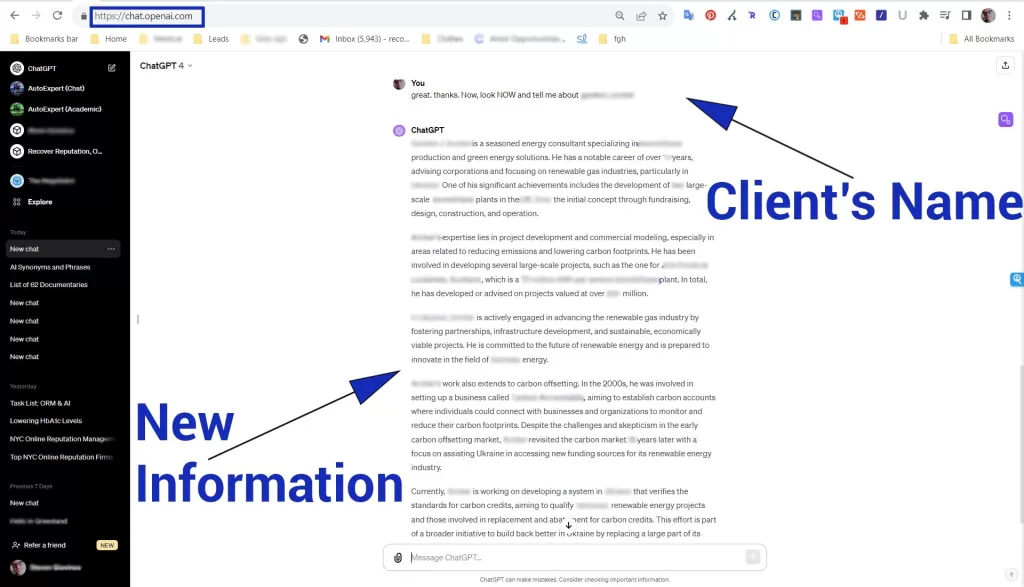
What is AI Reputation Management?  AI reputation management optimizes how people, businesses and brands appear in AI platforms such as ChatGPT and Gemini (Bard). The ultimate goal is to correct  generated answers or images in order to present you accurately and authentically. Since AI is rapidly becoming an alternative to traditional Google search results, it is essential to maintain a positive presence within these new platforms. Some questions:  Is your business, brand, or personal profile missing from AI results? Have you found inaccurate AI responses about you or your brand? Are you facing negative or false AI-generated answers? Unsure how to remove deep fake images associated with you? Key References Deep Fake Detection AI Help Cyber Civil Rights  Instagram Safety TikTok Safety Facebook Safety Snapchat Safety AI Reputation Solutions Build AI Presence: Establish your brand or self on pivotal platforms like ChatGPT, DALL-E, and Gemini (Bard), etc. ensuring you\’re represented authentically. Suppress Negative AI Answers: Systematically replace negative AI-generated content with factual, positive information, promoting your true narrative. Correct AI-Generated Responses: Proactively identify and remove deep fakes from DALL-E, Midjourney and the internet; repair poor AI-generated answers. Customize Tools and Consulting: Create custom GPTs, AI systems and strategies; offer AI education and marketing support; devise rapid responses to AI misinformation to protect and enhance your reputation. AI Reputation Process 1. Comprehensive Research and Strategic Planning: After an in-depth analysis/review of current web and AI presence, a customized strategy is crafted to align with your objectives and goals, emphasizing strengths. This strategy becomes the blueprint going forward. 2. Tool Optimization and Engagement: AI text and visual tools are reviewed to enhance any existing platforms and create new ones tailored to your industry trends and needs. This involves influencing, guiding and directing results as well as using some traditional SEO, ORM and engagement with key influencers. 3. Dynamic Content Development: Content creation and distribution of premium, impactful written and/or visual content across the network of platforms that have been optimized or established. This ensures your narrative remains authentic, engaging, and precisely what your clients are seeking. 4. Continuous Strategy Evolution: Constantly adapt, refine and improve strategies, making regular updates, engaging with key communities, and conducting ongoing research to stay successful. Case Studies and Client Success Real Before Screenshot: Bard (Gemini) Optimization Real Before Screenshot: Bard (Gemini) Optimization Situation: A sustainable energy entrepreneur faced a non-existent Gemini presence and a severely negative Google reputation due to false accusations, hindering business growth and investment opportunities. Outcome: Negative articles were quickly demoted within three months in two countries, and within six months for others. Achieved a positive Gemini presence rapidly. Why Choose Us? Education, Vision, Experience: Holding an MA from NYU\’s Interactive Telecommunications Program and an MFA from Yale University, Steven W. Giovinco blends technical and creative expertise. This educational foundation fuels our vision to provide innovative, ethical reputation management solutions across various industries. Direct experience spanning finance, law, medicine, arts, and more, reflecting a deep depth of industry knowledge. He is author of a comprehensive e-book, “Holistic Reputation Management,” and has ten years in boutique online reputation management. Contact Founder, Steven W. Giovinco Reach out and speak directly to CEO/Founder Steven W. Giovinco–no salespeople or chatbots here. Evaluations are always free. Recover Reputation +1-347-559-4952steve@recoverreputation.comwww.recoverreputation.com166 Second Avenue, Suite 11HNew York, NY 1ooo3

What is Generative AI Reputation Management and Why It\’s Important? Read More »

game over for reputation: the completionist's charity scandal and lessons in online reputation management

Game Over for Reputation: The Completionist\’s Charity Scandal and Lessons in Online Reputation Management

In the corner of the internet, a fast-brewing scandal you might not have heard of is unfolding. It\’s an example of self-inflicted online reputation management damage involving $600,000, games, and a charity for dementia. The Completionist\’s Controversy More specifically, it\’s about a YouTube star with a previously stellar reputation, \”The Completionist,\” aka Jirard Khalil. He occupies a narrow but extremely popular niche of online gaming. With over a million subscribers, thousands watch him literally complete every game he plays—sometimes taking many, many hours. Recently, Jirard found himself facing a real-life battle—a controversy surrounding his charity, Open Hands Foundation, and its alleged handling of funds. Why This Matters So, why should you care? Because this story isn\’t just about one gamer. The controversy surrounding \”The Completionist\” provides a critical lesson in online reputation management, representing a cautionary tale for anyone with an online presence. Public figures, brands, content creators, and creative businesses should see this as a harsh reminder that trust is earned, transparency is key, and even those with an excellent online reputation can face an unexpected “game over”. Background of the Controversy Jirard Khalil, known as \”The Completionist\” on YouTube, faced allegations concerning funds in his charity, Open Hands Foundation. Allegations arose that significant sums had been raised but remained unused for a prolonged period of almost ten years. Jirard himself claimed he was unaware of the foundation’s lack of fund distribution until 2021 or 2022 (he gave conflicting answers) and had intentions to donate the money. This was discovered by well-known YouTubers, SomeOrginaryGamers, aka Mutahar \”Muta\” Anas, and Karl Jobst, who raised serious questions and allegations after reviewing Open Hands’ public tax filings.Seemingly in a response, soon after funds were disbursed. However, the lack of concrete proof of such donations or clear transparency in the charity’s operations led to public skepticism. The fund’s website also removed information regarding the funding. Public Reaction and Impact on Online Reputation The gaming/YouTube community\’s reaction was harsh. Some found humor in the juxtaposition between Jirard\’s gaming persona and the allegations, while others expressed extreme disappointment or worse. This highlights the fragile nature of online reputation, especially for public figures whose actions are scrutinized by a niche but extremely reactive and vocal audience. 8 Lessons in Online Reputation Management 1. Transparency Is Key Transparency and communication are non-negotiable in these situations. Whether running a charity or a business, clear and open communication about operations and finances is crucial. While Jirard did post an apology response, it seemed insincere and threatened legal action against those that uncovered the discrepancy. Ultimately, this led to further distrust and reputational damage. 2. Prompt and Clear Response to Allegations When issues come up, be prompt and clear when crafting a response. Naturally, it’s important to discuss any legal implications, but get in front of the issue swiftly. Addressing concerns directly and openly can mitigate potential harm to your reputation. Delayed or vague responses exacerbate the situation. 3. Maintaining Consistency Between Persona and Actions For public figures, creatives, and brands, maintaining a consistent online persona and real-world actions is crucial. Discrepancies lead to a loss of trust among followers. 4. Regular Auditing and Reporting Regular auditing and transparent reporting, especially in matters involving public funds or donations, are essential. This ensures accountability and maintains public trust. 5. Being Prepared for Crisis Management Having a crisis management plan is crucial. Being unprepared can lead to mishandling of the situation, further damaging your reputation. 6. Use Online Reputation Management Part of the long-term strategy is to effectively build and maintain a positive online reputation. This can act as a defensive wall or at least mitigate problems if they appear. DON’T delete comments on posts. DON’T remove information from websites or platforms. 7. Engage with Audience Concerns Engage with audience concerns sincerely and respectfully to help maintain a positive relationship with the audience. Ignoring or trivializing such concerns can lead to a negative backlash. In Jirard’s case, it could be impossible to return. 8. Learning from Mistakes When mistakes are made, acknowledging them quickly and learning from them can sometimes salvage and even enhance a reputation. People often value growth and accountability. Bottom Line The situation faced by \”The Completionist\” serves as a reminder of the importance of ethical practices and transparency in maintaining a positive online reputation. It underscores the need for individuals and organizations to be mindful of their actions and communications—not doing so can leave a severely damaged reputation.   Ready to Regain Control of Your Online Reputation? Get in touch with us today for a free consultation. Let\’s work together to restore your online reputation and get your life back on track. Please enable JavaScript in your browser to complete this form.Name *Phone Number *Email *MessageName Submit

Game Over for Reputation: The Completionist\’s Charity Scandal and Lessons in Online Reputation Management Read More »

navigating the ripple effects: how openai's leadership shakeup impacts online reputation management, recover reputation

Navigating the Ripple Effects: How OpenAI\’s Leadership Shakeup Impacts Online Reputation Management

What is the fallout? And how will this impact your online reputation? If you are not a ChatGPT user, you might shrug your shoulders at the news of the ouster of Sam Altman and wonder what the fuss is all about. The answer might be a surprising yes, this could impact you—whether you use ChatGPT or not. Key References How AI ChatGPT Can Damage Your Online Reputation Microsoft hires former OpenAI CEO Sam Altman OpenAI board faces growing revolt over Sam Altman’s ousting OpenAI employees threaten to quit en masse after former CEO Sam Altman joins Microsoft Sam Altman joins Microsoft as OpenAI names its third CEO in 3 days   Background: What Happened?   OpenAI, the firm behind the disruptive ChatGPT, at the time of this writing, cryptically fired the CEO and founder, Sam Altman (Greg Brockman resigned too, among others). Without warning, this changed everything. Headline news and shock across the tech and business world was immediate. At the moment, we don\’t really know what happened, except that there was a “deliberative review process by the board, which concluded that he was not consistently candid in his communications with them, hindering its ability to exercise its responsibilities.” Maybe we will never know. How Is ChatGPT Helpful as a Reputation Tool? ChatGPT can be an online reputation repair tool (among other things, of course). It suggests content topics, assists in writing blogs, and summarizes white papers to be submitted elsewhere. (Note, however, when used improperly, AI can actually lead to further reputation damage if clients discover poorly written, unedited articles leading to an inauthentic experience). Remember, it\’s just a tool, not a replacement for well-thought-out content development, and should always be used as such. Who Does This Impact? The reason this affects everybody is that AI swiftly infiltrated businesses at all levels at an astonishing rate. If further development is impeded at OpenAI due to internal turmoil, this could have a ripple effect across multiple industries, including your own. Could This Affect Online Reputation Management? If you are using ChatGPT to correct or build a poor reputation, this could certainly have an impact. If you hire someone, an agency or reputation firm, they might use ChatGPT—either to cut corners to churn out poor content or to legitimately streamline their process. Development suppression due to “brain drain” and continued internal struggles might thwart application development. This, in turn, could ultimately weaken the work you are making—after all, if AI is helping to write a blog post, it might take more work than planned. Bottom Line Stay informed of developments. Be flexible and ready to shift strategies. Be ready to jump to a new platform and quickly pivot to another solution. As always, the best solution is to develop personal, well-written articles that lead to improved trust.

Navigating the Ripple Effects: How OpenAI\’s Leadership Shakeup Impacts Online Reputation Management Read More »

The Role of Online Reputation Management in the Downfall of CNN\’s Chris Licht

Unraveling the Impact of Reputation Narratives: How Media Portrayal and Internal Strife Led to a Leadership Crisis at CNN Chris Licht, the now-former CEO of CNN, was dismissed following a whole range of upheavals, controversial decisions, internal strife, and a decline in viewership–within his 13-month reign. These problems culminated in a critical piece in The Atlantic, however, which painted Licht as a leader struggling to manage the news division in a time of widespread mistrust. This article seens to have been the final straw. While news and corporate leadership analysts will have their own take on the dismissal, I\’d like to focus on the role of online reputation management in this situation. Yes, problems had been brewing for months or years at the network, but the problematic depiction of Licht in the media and online seems to have been a major factor in his downfall. The Atlantic\’s article, which was widely shared and discussed, certainly cast a negative light on Licht\’s leadership and approach. This unfavorable online image, combined with CNN\’s internal challenges, appears to have led to his firing. The Atlantic\’s piece, initially pitched as a look at cable news through Licht’s first year, instead became a damning series illuminating hubris and arrogance, painting a deeply unflattering depiction of Licht. This, coupled with the criticism of Donald Trump’s Town Hall, angered CNN staff. Later, even major anchors lost confidence in him. But regardless of whether The Atlantic piece was fair or unfair to the CEO, the damage was done, and it became clear that Licht could not continue as CNN’s leader. This situation emphasizes the importance of online reputation management, especially for high-profile individuals and organizations. Information—either positive or negative—is spread quickly and broadly, often within minutes. A single negative article or social media post can inflict considerable harm on an individual\’s or an organization\’s reputation. In Licht\’s case, it seems his online reputation outpaced any attempts to control or mitigate it. This highlights the need for online reputation management strategies, including responding to negative articles (which he did, to some degree).  However, sometimes, despite apologies and internal discussions, there is no chance to recover if the damage is too severe, and in this case, it seems appropriate.

The Role of Online Reputation Management in the Downfall of CNN\’s Chris Licht Read More »

revamping recover reputation: a comprehensive guide to our enhanced services and client centric approach

Revamping Recover Reputation\’s Website: A Comprehensive Guide to Our Enhanced Services and Client-Centric Approach

New Site We redesigned the Recover Reputation website to focus on reputation services, core clients, ethics, and transparent pricing. Central to our vision is providing comprehensive, ROI-driven solutions to reclaim and build a stellar reputation. The focus is always being committed to integrity, customization, and selectivity, leading to a recovery rate of 90%. We also are AI-ready to adapt to the quickly evolving search industry. New Dedicated Pages  Reputation Repair Providing a comprehensive solution for online reputation management, focusing on the creation of high-quality, persuasive content to suppress negative links and promote positivity. Our approach includes an in-depth analysis of the client\’s reputation, followed by a tailored strategy that includes platform creation, content creation, and consistent updates to improve search engine rankings and suppress negative links. Reputation Building Committing to building a robust and credible online presence that accurately reflects a brand\’s values and achievements. We work closely with clients to understand your brand values and accomplishments, which then highlight through various online platforms, ensuring a true representation of you or your business to attract more business and mitigate potential future harm. Image Reputation Excelling in managing image and video-related reputation issues, such as embarrassing photos, mugshots, or cyber extortion incidents. Our process involves analyzing the negative content, devising a strategy for suppression or removal, and promoting positive media to enhance your online image. Reputation Removal Specializing in the removal of detrimental online content such as negative links, reviews, articles, videos, images, AI-generated content, or comments. Our approach involves identifying the negative content, assessing its deletion possibility, and initiating necessary actions to either remove or suppress the content, thereby enhancing your online reputation. We have added dedicated pages for our clientele: CEO/C-Suite Maintaining a positive online presence for CEOs and C-suite executives, providing targeted and effective reputation repair services tailored to their specific needs. High Net-Worth Individuals Addressing negative online content impacting high net-worth individuals, affecting financial performance, damaging credibility, infringing on privacy, and increasing vulnerability to threats. Finance/Law Catering to a broad range of clients, including financial advisors, hedge funds, banking managers, and law practices, covering areas like lending, SEC issues, and more.  Arts/Education/Non-Profit Targeting those in the arts, entertainment, education, or non-profit fields, offing effective reputation repair services. Other pages include: Testimonials Showcasing various testimonials and case studies of successful interventions in enhancing clients\’ online reputations. It highlights instances where we’ve helped clients ranging from CEOs to young professionals overcome reputation crises caused by negative online content, with a success rate of 90% in suppressing negative links. Resources Offing a wealth of information for managing online reputation. It provides a free e-book that serves as a comprehensive guide to establishing and maintaining a positive online presence, along with a variety of articles, case studies, and videos on related topics. Investment Understanding online reputation is a valuable asset, seeing costs not as just expenses, but as an investment. We’ve also listed prices ranging from $1,500 to $7,000 per month, depending on the project. Ethics Adhering to strict ethical guidelines for online reputation management. We discourage the creation of fake reviews or comments, which is not only unethical but potentially illegal and damaging to your reputation. We never use black hat techniques like link farms, bots, hacking, plagiarism, spam, or related tactics. We advocate for partnering only with ethical reputation management firms that demonstrate honesty and transparency to avoid subpar services. What is Online Reputation We’ve crafted an in-depth article on online reputation management, what it is, and how it is repaired. We discuss the process of controlling and influencing an individual\’s or business\’s reputation, encompassing everything from Google search results, social media posts, SEO, media, and even print products. It\’s crucial because it builds trust, conveys a professional and experienced tone, and substantiates confidence, making potential clients feel more comfortable choosing you over competitors. Other New Features Our team undertook a comprehensive redesign of the website with a focus on enhancing user experience. We prioritized creating a user-friendly interface that is intuitive and easy to navigate, ensuring that visitors can find the information they need with minimal effort. In addition to improving the site\’s structure and navigation, we also enriched the content available on the site. We meticulously curated and expanded the information provided, ensuring that it is detailed, accurate, and valuable to our users. The redesign aims to make the website not only more aesthetically pleasing but also more informative and efficient for our users. Real Photographs We take pride in the authenticity and originality of our content. All the photographs featured on our web pages are captured directly through a camera by our team. This means that every image you see is the result of careful planning, composition, and execution, rather than being AI-generated or sourced from generic stock photo libraries. We believe in the power of genuine, high-quality visuals to convey our message and represent our brand. This commitment to authenticity not only ensures the uniqueness of our content but also aligns with our mission to provide honest, tailored, and quality-centric services to our clients. Real Before-and-After Screenshots These \’before and after\’ images serve as tangible proof of our success, demonstrating how we\’ve helped our clients overcome their online reputation challenges. They show the transformation from a tarnished online reputation to a restored and positive one, highlighting the impact of our tailored strategies and diligent efforts. By sharing these real-life success stories, we aim to give potential clients a clear understanding of what they can expect from our services. We believe that this level of transparency not only builds trust but also reinforces our commitment to delivering successful outcomes for our clients. AI Information We’ve included information on technology advancements such as the impact of AI on online reputation management. We can pivot quickly to industry changes since the old way of doing things will probably be obsolete.

Revamping Recover Reputation\’s Website: A Comprehensive Guide to Our Enhanced Services and Client-Centric Approach Read More »

mastering the future of online reputation management: white label solutions for 2023's digital landscape

Mastering the Future of Online Reputation Management: 6 White Label Solutions for 2023\’s Digital Landscape

Times Are Changing… In 2023, online reputation management (ORM) solutions have grown increasingly complex, rendering previous approaches less effective in the current landscape.  Crisis management agencies, internet law firms, larger ORM firms, PR agencies, and SEO firms need up-to-date solutions as traditional methods of reputation management are now less effective or are in flux. Quickly pivoting to new techniques is essential to address artificial intelligence while remaining visually relevant and individualized. White label solutions ensure your clients\’ online presence thrives in this ever-evolving digital environment. New Problems The Invisible Business Problem Reputation management has changed significantly in recent months due to Google updates, new competition, and especially with the advent of AI tools such as ChatGPT. Many praise the time-saving efficiencies and cost reductions, but they may not recognize a looming problem for clients: their curated online presence, including their website, social media platforms, and client engagement, could disappear. This means that unless you are extremely prominent, won’t appear in ChatGPT answers.  As more people use AI-powered tools, it becomes increasingly difficult for small and mid-sized businesses to appear in AI responses, diminishing the online visibility of brands, individuals, and most businesses, and adversely affecting their online reputation. Try it yourself. In ChatGPT, ask, “Would you recommend [Your Company’s Name]?” or, “Is [Your Company’s Name] trustworthy?” What do you see? Do the same search in Google, and see the results–the results can be unexpected (and not in a good way). Hidden Reputation Dangers of AI If a brand uses AI to save money by writing blogs, whitepapers, website content, or social posts, and it\’s detected, this could lead to online reputation damage. Poorly written articles, automated responses, and inaccurate answers can harm clients\’ reputations if discovered.  If you\’re not an expert in navigating AI tools, prompts, and usage, white label solutions might be a great way to serve your clients. 6 Solutions for ORM Success It still remains crucial to conduct thorough research and analysis of clients\’ issues, optimize platforms for backlinks, create distribution networks, and foster genuine connections with key influencers to amplify and suppress negative content. However, the \”antidote\” for ORM in 2023 has expanded to include creating meaningful content, incorporating stunning visuals, developing ideas, engaging authentically, pivoting quickly, and providing individual attention to clients. 1. Google and Bing Google has shifted into \”code red\” mode, altering their algorithm in response to ChatGPT, emphasizing natural language queries. For online reputation management, this highlights the importance of exceptional content to stay ahead of industry changes. Also, Bing, due to its association with ChatGPT, is gaining traction and should be taken into account in ORM strategies–it is no longer the \”forgotten\” search engine. 2. Winning Written Content Meaningful, newsworthy, and authentic content is vital to counter new algorithm changes in Google and to address ChatGPT (in fact, this is always the best solution to ORM repair issues). Blog posts, articles, presentations, and white papers should target a niche or a very specific question/issue in order to be relevant in search engines or AI answers. Content should be strategically placed and optimized to gain maximum exposure and reputation boost. Since AI answers are not in real-time, being timely or identifying new or unique takes on subjects is essential. Consistently updating with new content and engagement is the final key to success. 3. Visuals that Stands Out In today\’s ORM landscape, it\’s essential to prioritize high-quality visuals, such as photography and video. This often-overlooked component of reputation management is gaining significance as AI continues to influence search results. While Google and Bing incorporate images and videos in their results, ChatGPT currently does not, offering a potential competitive advantage. Tools like Midjourney can streamline image creation, but missteps may harm one\’s reputation. To distinguish your ORM strategy, focus on developing captivating, genuine, and narrative-driven visual assets. 4. Ideas Are Paramount In the age of ChatGPT, ideas hold even greater significance since content is easier to craft. While AI can generate articles, blogs, and whitepapers swiftly, the quality, novelty, and impact come from human ideas. With the availability of tech tools, the primary differentiator becomes the creative and strategic insights that people think up. It\’s the human ideas, thoughts, and perspectives that shape the direction, tone, and context of the content that ChatGPT generates. This is particularly important when aiming for high-quality content that resonates with audiences, sparks engagement, or drives action. So, even as ChatGPT simplifies the process of content creation, the importance of human ideas has intensified and is crucially necessary to guide AI, ensuring it produces the best and most effective content. 5. The Importance of Pivoting It\’s more important than ever to pivot to new or upcoming approaches as soon as possible – not doing so could mean failure for reputation clients. With frequent updates to Google\’s algorithms and AI tools disrupting businesses, strategies require constant realignment. 6. Individual Attention Matters Clients always need individualized attention, which is even more crucial now. Given the rapidly shifting business and reputation landscape, hands-on, trusted contact with clients can help retain and reassure them. Conclusion Embrace the new frontier of online reputation management in 2023 by focusing on AI-centric strategies, captivating visuals, and excellent content. Recover Reputation can help navigate the shifting online reputation landscape through white labeling.  All the images here were created by the author using a camera.

Mastering the Future of Online Reputation Management: 6 White Label Solutions for 2023\’s Digital Landscape Read More »

i ask a lot of questions when repairing a damaged online reputation. here\'s why @recovreputation

I Ask A lot of Questions When Repairing a Damaged Online Reputation. Here\’s Why

7 Key Topics to Know the Answer to for Online Reputation Management I ask a lot of questions when starting a new online reputation management repair project. Beyond \”What happened?” and “How can I help\”, I pose probing questions for a business or individual client, such as: It might seem somewhat odd and perhaps too personal to delve into someone’s background, future aspirations, and current personal interests–after all, this is about suppressing damaging content from appearing prominently in Google search results. But knowing as much as possible about a reputation client’s business and personal background is crucial to success. The goal is not to ‘game the system’ by stuffing the web with fluff or false achievements but to have a thorough and true understanding in order to build an authentic online reputation that real people find appealing. After an initial deep web search where all positive and negative links are carefully identified, I then follow up with in-depth discussions focused around several central categories such as where they worked, lived, went to school, etc. Here are key categories below to understand. 1. Business and Personal Goals Do they want to expand their business, sell it, retire, move to Australia? Knowing answers to these questions drives the whole reputation strategy since it informs nearly everything, including the bio statement, key search terms, blog topics, influencers to follow, platforms to be active on, site development, etc. 2. Previous Positions Knowing all previous jobs (through a CV/resume and follow-up discussion) importantly gives a detailed career summary. This becomes invaluable when crafting a biographical statement for websites or platform profiles. It also fills in gaps in their LinkedIn profile (remember: a complete account with a headshot photo ranks extremely highly by Google, as does being active there) and further fleshes out key search terms.  3. University, College, High School Education Identifying an online reputation client’s education, college major, interests, years attended, clubs, curriculum–even teachers or famous fellow classmates–is useful for developing a presence on high-ranking alumni sites. 4. Volunteering, Charity If they are active in a charity, be sure to know the details to be able to share about it. Being on a non-profit board, volunteering, or being active in helping others leads to positive links and is usually easy to promote. It can also result in inclusion in Wikipedia articles, another powerful tool. 5. Hobbies Seemingly innocuous or unimportant, I always ask what a client likes to do in their spare time. Besides showing they are a genuine, real person which helps foster trust, it can lead to a series of articles, reviews or personal engagement with other like-minded people. 6. Location Where they live and work engages with other locals in their town or neighborhood and can generate topics for content creation. Reviewing a favorite lunch spot or posting images about a new development in the area helps build a positive online reputation. Reddit, Yelp, Patch and other similar sites are good to be active on. 7. Sensitive Topics to Avoid Just as important is to know what shouldn’t be highlighted. I always ask many questions to thoroughly understand any sensitive information, bad business relationships, or other issues that can inflame reputation damage and make things worse. Having a list of “no-go” topics, people, positions, careers or old links is extremely important to identify.  Answers Lead to Reputation Strategy After asking many questions, I carefully compile the resulting information into a spreadsheet for quick access. I then digest this material to develop a customized reputation repair strategy. Acting as the project’s blueprint, this drives actions for the next six to ten months. Missing key information, not realizing that a previous firm or person should NOT be mentioned, or presenting the wrong tone on social media posts could lead to failure.  Example: Lawyer to Contemporary Art in Five Months For one client, I quickly discovered through initial discussions that they actually had no interest in their legal career and instead wanted to shift towards working with contemporary art. As a result, she gained a new web reputation, suppressed the negative link posted by an ex-partner and found a new position she was passionate about within five months. Example: Annuities Expert Gains Web Presence and Clients Or during a conversation with a financial advisor, I learned that he traveled hundreds of miles daily to personally meet with clients, where he would then spend hours learning their needs and discussing his specialty, annuities. This became a central tenet of his online reputation presence driving content and social media sharing. Not only was his reputation repaired, but he also gained new business clients. So, asking questions is key to developing a successful online reputation solution. I tend to ask a lot–nothing personal, it’s just good business.

I Ask A lot of Questions When Repairing a Damaged Online Reputation. Here\’s Why Read More »

Scroll to Top