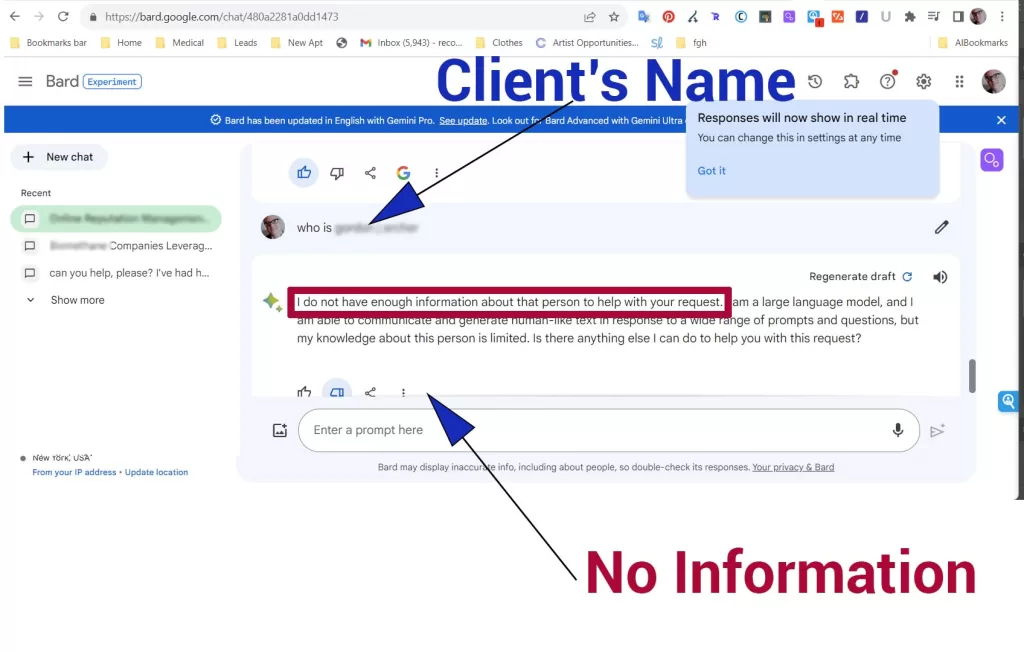
Key References Can AI ChatGPT Damage Your Online Reputation? Yes. Here’s How The Rise Of AI-Generated Photos Using Midjourney: An Online Reputation Risk? ChatGPT continues to be one of the fastest-growing services ever Holistic Reputation Management Meta’s Threads app launches across EU in blow to competitor X Forecasting Trends and What’s Next for 2024 With an eye toward the future, i.e., 2024, let’s ponder possible developments in online reputation management (ORM). Everything is evolving rapidly, driven by tech, business, and consumers. Let\’s dive into some key trends that are shaping web reputation management for next year. 1. Shifting From Google to AI-Driven Search Tools There will be less reliance on Google searches. (Young people are turning more to TikTok and Instagram, and I have drastically cut down on seeking solutions from Google, and look to ChatGPT and Bard where there is less spam.) Tools are jockeying constantly for the top position and might change over the next year, but AI-generated answers from ChatGPT, among other things, seem to be clearly here and now. What does that mean for your online reputation? If you don’t show up in AI results, you don’t exist. Many businesses or owners have spent years building their online brand but it could disappear quickly as more people shift to machine learning. I think this is the biggest, most important trend to look out for. 2. Navigating the Risks of AI-Generated Content in Digital Reputation Strategies Not surprisingly, AI technologies are set to revolutionize ORM, but maybe not in the way you think. Individuals and agencies look toward AI-content creation as a panacea to churning out quick, effortless information. Yet, unfiltered reliance on ChatGPT, Bard, Midjourney, etc. can actually lead to reputation damage. These tools will always be smarter, faster, and more precise as AI continues to advance–but everyone will have the same access, which just raises the bar for genuine, authentic blogs, articles, videos, photos, and audio. Keep an eye on quality to avoid being mired in poor content. 3. Combating AI-Weaponized Fake Content in Reputation Management AI will continue to be “weaponized”. Competitors, disgruntled ex-clients, unhappy previous employees can and will use ChatGPT, Bard, Midjourney, etc., to purposely make fake content that causes reputation damage. Since it’s easy to create and difficult to immediately detect, new tools will lead to a nearly endless supply of hurtful reputation management tactics. 4. Avoiding Reputation Pitfalls on Declining Social Platforms: Twitter/X We’ve come to the point where just using a platform can lead to a bad web presence. Posting on X is a bad move and it will get worse. The toxicity of Twitter might get to the level of OnlyFans, adult sites, and far-right platforms, and I don’t think I’ve ever seen this happening for a mainstream product. Yet, given the turmoil we’ve all heard about, this is no surprise if you’ve glanced at news headlines. Elon Musk’s ownership has driven away advertisers. Why? Because brands are not fond of seeing Nazi posts next to their ads. Stay clear. 5. Emerging Online Opportunities on Rising Social Platforms: Reddit, Quora, Threads Some old platforms will see a continued rise, while a new one will expand. It seems that Google has been focusing more on Reddit, the raucous online forum, and Quora, the answer-based site for searches, and this will continue in 2024. Meanwhile, as users and advertisers abandon X, the social media site Threads by Meta seems to be on the rise. As a result, these are sites to place extra emphasis on in 2024 for reputation management. 6. The Growing Importance of Localized Online Image Maintenance Local, local, local. For businesses, localized reputation strategies will gain more importance. Consider regional social media platforms, search engines, and cultural nuances. You might be surprised that regions or even some countries have their own platforms (such as Xing, a LinkedIn-like platform in German). Flesh out local connections on Yelp, Google My Business, Bing Places, Patch, Next Door, and more. 7. Assessing Bing\’s Potential Rise in the Digital Brand Management Landscape Given the current popularity of ChatGPT, which is part-owned by Microsoft, will it see more traffic and be a competitor to Google? Traffic yes; competitor, no. Bing will receive new interest and get a boost but probably not at a major level. Still, don’t forget about Bing when it comes to your online reputation, since search results differ somewhat between that of Google. 8. Leveraging Video Content for Effective Digital Reputation Management Platforms like YouTube and TikTok continue to be pivotal for ORM. Videos are something that AI tools, for the moment at least, can’t “scrape”, or seamlessly replicate. Managing video content and addressing reputation issues on these platforms will be crucial for maintaining a positive online presence. If it feels overwhelming to learn editing techniques and polished visual elements, start with just holding your phone up to your face, and make a thirty-second video on something helpful for a client–while not perfectly crafted, it is authentic. 9. Adapting to the Changing Impact of Social Media on Online Reputation Management Social media\’s influence on reputation management stays the same or dips. While it’s important to continue to maintain and optimize social media profiles, the importance of sites like Facebook will stagnate. As always, however, address negative comments and leverage platforms for positive engagement, ensuring that every social interaction enhances your online reputation. 10. Integrating ORM with Broader Digital Marketing Efforts Online reputation management is becoming more integrated with other digital marketing strategies like SEO, content marketing, and social media marketing and this is true for 2024 (in reality, it always was–just people are starting to see the connections). This holistic approach is crucial for creating a cohesive and impactful digital presence. 11. Prioritizing Transparency and Authenticity in Internet Reputation Maintenance People demand transparency and authenticity from brands, especially since AI can easily generate content. Reputation management must reflect this in 2024. Strategies need to focus more on genuine engagement and transparent communications to build and maintain trust. 12. Addressing