Image Online Reputation Management

AI Reputation Management: How Algorithms Actually “See” Your Brand 

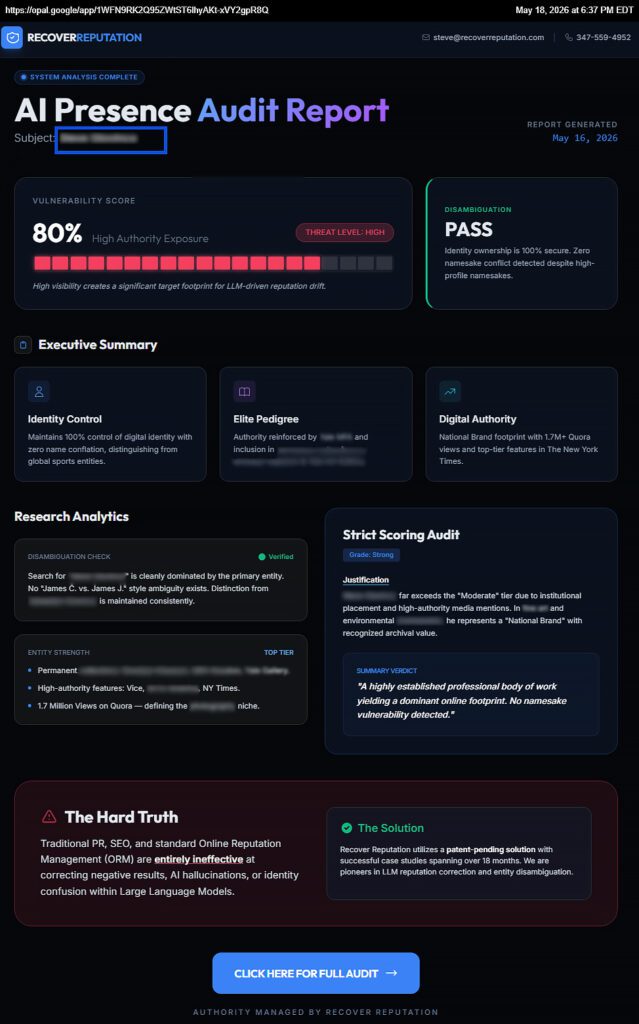
Why Traditional Online Reputation Management (ORM) is Failing  For the last twenty years, online reputation management meant appearing on page one of Google. If a negative article appeared, traditional ORM would publish targeted content to push it down to page two or further.  Today, that strategy is obsolete. With the rapid integration of Large Language Models (LLMs) like ChatGPT, Gemini, and Claude into search engines–or replacing them entirely–the concept of “Page Two” no longer exists. AI models don’t give you a list of blue links; they synthesize the entire internet into a single, confident-sounding narrative. If your online reputation has gaps, overlapping identities, or negative data, the AI will hallucinate an inaccurate summary of your career or brand. To fix an algorithmic problem, you need an initial algorithmic diagnosis. We realized that executives and brands cannot fix their AI narrative until they understand exactly how LLM sees them. So we engineered the AI Presence Audit Report, a proprietary, diagnostic tool that analyzes AI results the exact way an LLM does. Here is a detailed how our AI Presence Audit breaks down digital vulnerabilities, using a real analysis of a high-authority entity. The AI Vulnerability Score: Are You at Risk for AI Hallucinations?  The foundation of our report is the Vulnerability Score. Most executives assume that if they have “good PR” and a clean search history, they are safe from AI hallucinations. Our algorithm often proves otherwise. In this section, the audit flagged an 80% Vulnerability Score (High Authority Exposure). High visibility is a double-edged sword: it means the LLM has a lot of data to pull from, but it also creates a massive surface area for algorithmic mischaracterization if that information isn’t properly structured. As the report notes, “High visibility creates a significant broad footprint for LLM-driven reputation shifts.” Next to the score, we evaluate the immediate Threat Level. In this example, the entity achieved a “PASS” for Identity Control. If you share a name with a controversial figure, a politician, or a criminal, this is where the AI will flag a Critical Threat of “Entity Conflation.” Mapping Your Knowledge Graph: How LLMs Evaluate Your Identity  When an AI model generates a brand or personal summary, it isn’t “thinking”, it is connecting nodes in a knowledge graph. Our Executive Summary breaks down the three pillars that LLMs look for when deciding if you are a credible entity: Identity Control: Do you own your narrative? We analyze if your primary digital assets are verified and clearly disambiguated from old firms, past lawsuits, or namesakes. In this case, the subject maintains 100% control of their digital identity. Elite Pedigree (Trust Anchors): AI models weigh certain institutions heavier than others. Having verifiable ties to Tier-1 institutions acts as an “anchor” that prevents the AI from generating low-tier hallucinations. Digital Authority: We measure your footprint’s reach. A massive footprint across mainstream publications (like The New York Times) proves to the AI that you are a recognized national brand, not an obscure entity it needs to guess about. Entity Disambiguation: Stopping AI from Confusing Your Brand  Traditional reputation management measures success by looking at search volume, i.e., the number of entries on the front page of Google. For AI, however, we measure success by looking at Algorithmic Weight and Disambiguation. One of the most dangerous, yet overlooked, threats in Generative Search is when an AI confuses you with someone else. Our audit performs a Disambiguation Check. In the dashboard above, the engine verifies that the subject has cleanly dominated their primary entity status. In this case, distinctly separating someone with the same last name (a global sports entity) with the target subject. Our Strict Scoring Audit bypasses less authoritative references. We test if the AI recognizes your brand based on institutional placement rather than generic search keywords. For example, here AI ultimately concluded that this subject possesses “recognized archival value.” If AI cannot connect your name to your highest achievements, it creates an “Information Vacuum” that competitors or negative press will easily fill. The Hard Truth: Why You Need Generative Reputation Management (GenRM)  The foundation of our report is the Vulnerability Score. Most executives assume that if they have “good PR” and a clean search history, they are safe from AI hallucinations. Our algorithm often proves otherwise. In this section, the audit flagged an 80% Vulnerability Score (High Authority Exposure). High visibility is a double-edged sword: it means the LLM has a lot of data to pull from, but it also creates a massive surface area for algorithmic mischaracterization if that information isn’t properly structured. As the report notes, “High visibility creates a significant broad footprint for LLM-driven reputation shifts.” Next to the score, we evaluate the immediate Threat Level. In this example, the entity achieved a “PASS” for Identity Control. If you share a name with a controversial figure, a politician, or a criminal, this is where the AI will flag a Critical Threat of “Entity Conflation.” The most important takeaway from our AI Presence Audit is the reality check it provides to clients. Traditional PR, SEO, and standard Online Reputation Management are ineffective at correcting negative results, AI hallucinations, or identity confusion within LLMs. You cannot “spin” an algorithm. To securely overwrite AI training data, establish a verifiable ground truth, and fix these vulnerabilities at the root code level, you require Generative Reputation Management (GenRM). We have developed a patent-pending solution that doesn’t just push bad links down; it restructures the semantic architecture of digital identities so that AI engines have the correct data to output the truth. Ready to See How AI Views You? Request Your Custom AI Presence Audit  Before you launch a new venture, seek investment, or attempt to bury a past crisis, you need to know exactly what the algorithm is telling your prospects behind closed doors. Click here to request your custom AI Presence Audit and secure your digital identity today. https://www.recoverreputation.com/contact/

AI Reputation Management: How Algorithms Actually “See” Your Brand  Read More »

the rise of ai generated photos using midjourney: an online reputation risk?

The Rise of AI-Generated Photos Using Midjourney: An Online Reputation Risk?

The use of AI-generated photos is becoming increasingly prevalent. Platforms such as Midjourney have emerged, offering a simple and quick solution to generate realistic images. However, this introduces potential pitfalls regarding online reputation. As straightforward as it may seem to use these AI-created images, both businesses and individuals should be aware of the possible reputation risks. Authenticity Concerns: The Illusion vs Reality A major concern lies in the question of authenticity, or the lack thereof. Businesses and individuals should strive for genuine engagement with their clients. However, resorting to stock images or poorly-made AI-generated photos from Midjourney can significantly diminish the perceived integrity of your brand or identity. In an era where transparency is highly valued, using artificially created images could potentially harm the credibility that you\’ve worked hard to establish. Customers and clients are discerning and possess a keen eye for generic and inauthentic imagery. The overuse of AI-generated photos might result in poor consumer confidence and decreased interest in your products, services, or personal brand. If the audience can’t trust your images, they might question your authenticity and, ultimately, your integrity. Online Reputation Management Ramifications: The SEO Perspective Beyond the issues of authenticity, there are also ramifications to consider regarding the technical side of online reputation management. Search engines like Google and Bing prioritize websites that feature original, high-quality content. Resorting to AI-generated images could potentially result in lower page rankings in searches. This could lead to decreased website traffic and visibility, adversely affecting your online reputation. Appearing less prominently in search rankings could hinder potential customers or followers from finding your website or social media platforms, further harming your online reputation. Therefore, considering the SEO implications of using AI-generated images is essential for maintaining a positive online presence. Unique Risks with Midjourney: It’s Not Always Private Midjourney, in contrast to other AI photo-generation platforms, poses a distinctive risk. Unless users opt for the premium version, it offers visibility into the activities of other users, including their image creations, text requests, and usernames. This level of transparency could inadvertently invite online trolling and disclosure of users\’ utilization of AI-generated photos, both of which could potentially tarnish their online reputations. Or, an individual may repurpose or take someone else\’s image. This underscores the importance of considering the privacy implications of using platforms like Midjourney. Diversity and Inclusion: The AI Bias Another issue surrounding AI-generated images relates to diversity and inclusion. Despite advancements in AI technology, it is currently incapable of adequately replicating the unique traits that distinguish individuals or groups. As a result, using AI-generated images may inadvertently exclude certain demographics or perpetuate damaging stereotypes. If not handled carefully, these can harm your reputation and alienate potential customers, followers, or partners. As we become more conscious of diversity and inclusion, it is essential to consider how your online presence reflects these values. Legal Implications: The Copyright Conundrum There might also be potential legal complications associated with using AI-generated photos. Platforms like Midjourney utilize algorithms to produce images that bear a striking resemblance to real-life pictures. This could inadvertently lead to copyright infringement. Legal repercussions and fines from using an AI-generated image that mirrors a copyrighted one could be damaging not only to your reputation but also to your financial standing. Therefore, understanding the legalities surrounding AI-generated photos is essential. The Bottom Line: Invest in Authentic, High-Quality Photos While the allure of quick and easy AI-generated photos through Midjourney can be tempting, it\’s crucial to weigh the possible implications for your online reputation. The optimal strategy lies in dedicating time and resources to produce authentic, high-quality content that genuinely mirrors your brand\’s core values. This approach, though requiring more effort, is best for your reputation. The photograph included is original, made by a camera and was created by the author.

The Rise of AI-Generated Photos Using Midjourney: An Online Reputation Risk? Read More »

7 ways to gain clients using online reputation management, recover reputation

7 Ways to Gain Clients Using Online Reputation Management 

Build Your Online Reputation To Gain Prospective Clients Want to get clients? Build a great online reputation. People search on Google before, after, and during connecting with you to see what kind of experience you have and if you can solve their problem. Having a strong web presence generates trust, leading to converting prospective clients into paying ones. If the first page of Google searches is full of positive articles and links, prospective clients see you as trustworthy. This helps close the deal. However, if something negative appears, potential customers just move on to someone else–a competitor. Almost as importantly, if minimal information shows up in searches, you might appear unreliable or not real, also causing prospects to move on. Understand Your Client An online reputation should resonate and align with your clients’. But in order to do so, you need to know precisely who your prospective customers are. Research them thoroughly. Without an ideal customer composite, it’s difficult or nearly impossible to know where to start building an online reputation that resonates with clients. Understand who to target, think about what drives them, then present clear solutions that help. To completely grasp your clients’ needs, analyze them by drafting a detailed and comprehensive profile. This persona drives all content creation, marketing messages, and sales conversations. Gathering and sharing this targeted content allows you to speak directly to the wants, needs, and desires of your ideal buyer. Also, it crystallizes the kind of companies you like working with and what their pain points are. You can then craft the exact solution that they need. For example, if your prospective clients are a professional urban New York-area couple in their 30s and have a joint salary of $300K, then your reputation approach needs to appeal directly to them. Deliver Trust and Solutions Potential clients seek out a business that seems trustworthy, effective, and fixes their problem. An accomplished online reputation draws in prospects naturally and turns them into paying customers. Businesses often neglect to align their offers with what their clients really need the most and instead focus on what they want to sell. You should deliver solutions that your clients really need. Many times, however, clients think they need one solution but you, as the expert, know they need another. Be ready to explain the advantages of your approach. This continues to build trust. Continually building a positive reputation is key to reaching new customers. Once you have a comfortable connection, educate them on recognizing the superior value of your service. Overdeliver For All Clients, Especially the Best Ones Do really great work, naturally. This earns referrals and builds a reputation of excellence. Craft well-researched strategies, offer pinpointed analysis, answer questions immediately, give effective solutions, and be extremely professional–always. Very satisfied clients generate positive feedback that influences and encourages others to use your business. Existing clients bring business partners, friends, neighbors, or even their own professionals that they deal with (dentists, accountants, etc.). These satisfied clients can–and should–be used as a part of your reputation marketing strategy. Since nearly eighty percent of most business income comes from about twenty percent of their clients, this all makes sense. That’s why keeping current clients happy matters so much for building a positive reputation. Excelling for every single client all the time, while admirable, is not realistic or productive, however. Over-deliver for those best customers, but focus on delivering extraordinary service to the twenty percent that brings in the most business. Focusing on your best consumers results in retaining them, generating excellent recommendations, and most importantly, builds strong online and offline integrity. Blog Like Crazy What is one of the best ways to build or boost your reputation? Write. One of the best tools in your online toolkit is crafting well-made blogs. Writing great pieces not only brings eyeballs online to draw in potential customers, but it also highlights you as an industry expert in your niche. Everyone is looking for solutions on Google. For you to be discovered in search results requires the creation of truly exceptional work. Writing excellent blogs increases the chance of being found on the first page of Google, which leads to visibility, more clients, and a trustworthy reputation. Think of it like this: if a prospective client is searching for your business online and sees the first page filled with positive articles and links, they probably would pick you over a competitor who has minimal (or negative) information. The key is drafting the best blog possible. But a blog can be nearly anything: articles, audio recordings, videos, presentations, white papers, photos, infographics, graphs, and even memes. Another powerful feature of blog posts is that they generate “backlinks” or ties that connect to your content, which Google considers as an important page-ranking signal. Each time a new blog post is published, a new searchable article–and backlink–can point back to your website. If a blog piece is published every few weeks, that means several dozen new links potentially create many new ways to be found, leading to new sales opportunities, and more chances that you’ll be seen as an expert. But while frequent publishing is important, paramount is producing high-quality content. Have a Search Engine Optimization Strategy Being on the top of Google search results means business. Search engine optimization (SEO) helps drive prospective clients to your website and is a crucial part of an online reputation strategy. Since about 95% of clicks occur on the first page of searches, having a presence there builds trust and substantially helps in closing deals. High-quality content along with leveraging SEO builds an online reputation that strongly increases the chance of being seen first on Google, which leads to visibility, more clients, and additional online confidence. Google uses many ways to determine where to rank a website. While this is a massive topic in itself, to be found predominantly in search results requires the creation of exceptional work, such as high-quality blogs and some behind-the-scenes technical work, such as backlink creation

7 Ways to Gain Clients Using Online Reputation Management  Read More »

Scroll to Top