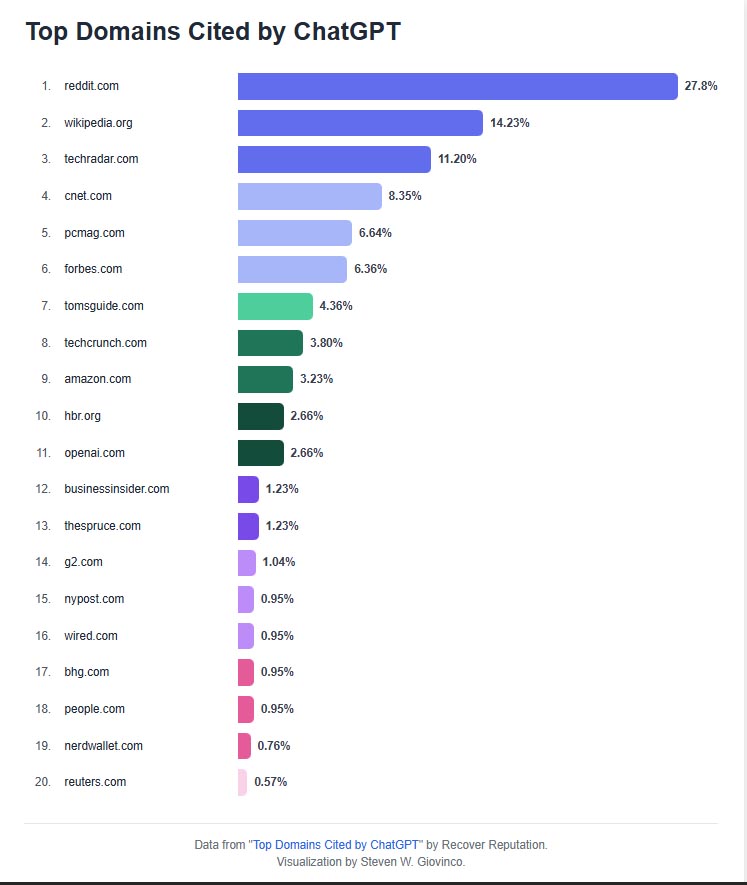
Building a presence on these platforms are crucial to having an AI presence
Generative AI platforms like ChatGPT and Google’s Gemini are no longer novelties; they are the new information gatekeepers. When asking a question, unlike Google results, they don’t list links—they provide a single answer synthesized from sources they deem credible.
For businesses, content creators, or individuals concerned with online reputation, this raises a critical question: where exactly are they getting this information? And how can I use this to build an AI presence?
Understanding which websites these AI models trust and cite is the first step in a new digital strategy of Generative AI Optimization (GAIO) and GenAI Reputation Management. To be visible in the AI-driven answers, you need to know which sources are shaping deep learning models.
Recover Reputation analyzed multiple large-scale studies and conducted direct research to deconstruct the information ecosystems of the two biggest Large Language Models. Knowing these platforms are crucial to building an AI presence. Here are the definitive lists of the websites that ChatGPT and Gemini rely on the most.
The ChatGPT Canon: Authority and Community Rule
ChatGPT’s sourcing strategy is built on a core “canon” of trusted domains. It has a clear preference for two types of content: authoritative, encyclopedic knowledge and vast, community-vetted conversations. This is supplemented by established media outlets and specialized review sites for consumer-related questions.
Across the board, two giants stand out: Wikipedia for factual information (cited in 7.8% to 15% of cases) and Reddit for real-world experience (cited anywhere from 1.8% to a staggering 29.4% of the time, depending on the query type). This reliance is so significant that it’s clear these two platforms form the foundational pillars of ChatGPT’s knowledge base.
Here is a consolidated ranking of the top 20 domains most frequently cited by ChatGPT, along with their share of citations as found in major studies.
Rank | Domain | Primary Category | Share of Citations (%) | Source Study |
1 | reddit.com | Conversational UGC | 1.8% – 29.4% | Ahrefs, Profound |
2 | wikipedia.org | Encyclopedic UGC | 7.8% – 15.0% | Ahrefs, Profound |
3 | forbes.com | News / Media | 1.1% – 6.7% | Ahrefs, Profound, Wellows |
4 | businessinsider.com | News / Media | 0.8% – 1.3% | Ahrefs, Profound |
5 | techradar.com | Tech Review | 0.9% – 11.8% | Profound, Wellows |
6 | amazon.com | E-commerce | ~3.4% | Ahrefs |
7 | nypost.com | News / Media | 0.7% – 1.0% | Ahrefs, Profound |
8 | g2.com | Software Review | ~1.1% | Profound |
9 | nerdwallet.com | Finance | ~0.8% | Profound |
10 | thespruce.com | Lifestyle / Home | ~1.3% | Ahrefs |
11 | cnet.com | Tech Review | ~8.8% | Wellows |
12 | pcmag.com | Tech Review | ~7.0% | Wellows |
13 | wired.com | Tech / Media | ~1.0% | Ahrefs |
14 | reuters.com | News / Media | ~0.6% | Profound |
15 | tomsguide.com | Tech Review | ~4.6% | Wellows |
16 | bhg.com | Lifestyle / Home | ~1.0% | Ahrefs |
17 | people.com | Entertainment / Media | ~1.0% | Ahrefs |
18 | techcrunch.com | Tech / Media | ~4.0% | Wellows |
19 | hbr.org | Business / Media | ~2.8% | Wellows |
20 | openai.com | Corporate / Tech | ~2.8% | Wellows |
Gemini’s Playbook: Context is Everything
Google’s Gemini operates slightly differently. Instead of relying on a fixed set of top domains, it acts as a “balanced synthesizer,” dynamically choosing its sources based on the specific topic of the query. This makes its citation patterns more diverse and highly specialized.
One of Gemini’s biggest advantages is its deep integration with its own ecosystem, especially YouTube, which accounts for approximately 3% of its citations in some studies. For health queries, it shows a unique preference for government and NGO sources, citing them nearly 25% of the time.
Because Gemini’s sources change dramatically depending on the topic, we’ve broken down the top domains by category.
Top 20 Cited Domains for General Queries (Google AI Mode)
For broad, everyday questions, Gemini (powering Google’s AI Mode) pulls from a wide range of user-generated content, reference sites, and major online platforms.
- en.wikipedia.org (12.0% share)
- www.youtube.com (1.8% – 10% share)
- blog.google
- www.reddit.com (2.2% – 14% share)
- www.google.com (7.4% share)
- www.amazon.com
- www.quora.com (1.5% share)
- www.facebook.com
- m.yelp.com
- www.instagram.com
- www.imdb.com
- www.tripadvisor.com
- www.linkedin.com (1.3% share)
- www.mapquest.com
- www.walmart.com
- www.britannica.com
- www.healthline.com
- www.yahoo.com
- www.ebay.com
- my.clevelandclinic.org
Top Cited Domains for Health & Medicine
When it comes to health, Gemini shows a strong preference for official, institutional, and highly authoritative medical sources over general media.
- pmc.ncbi.nlm.nih.gov (PubMed Central) (~7.0% share)
- my.clevelandclinic.org (~3.2% share)
- www.mayoclinic.org (~3.0% share)
- www.ncbi.nlm.nih.gov (National Center for Biotechnology Information) (~2.7% share)
- www.sciencedirect.com (~1.7% share)
- www.healthline.com
- www.webmd.com
- www.medicalnewstoday.com
- www.verywellhealth.com
- www.goodrx.com
- medlineplus.gov
- www.drugs.com
- www.cdc.gov (Centers for Disease Control and Prevention)
Top Cited Domains for Automotive
For car and auto insurance queries, Gemini leans on a mix of specialized review sites, industry authorities, and major media outlets.
- bankrate.com (6.7% share)
- thezebra.com (7.2% share)
- nerdwallet.com
- edmunds.com
- kbb.com (Kelley Blue Book)
- caranddriver.com
- cars.usnews.com
- www.cars.com
- forbes.com
- en.wikipedia.org
- reddit.com
- youtube.com
Top 20 Cited Domains for B2B Tech
For business-to-business technology questions, Gemini shifts its focus to company blogs, niche industry publications, and professional platforms.
- Company Websites/Blogs (~17% share)
- Niche B2B Publications (e.g., TechTarget)
- Mainstream News (~10% share)
- linkedin.com (~2% share)
- Analyst Reports (e.g., Gartner)
- forbes.com
- businessinsider.com
- pcmag.com
- cnet.com
- techradar.com
- tomsguide.com
- techcrunch.com
- hbr.org (Harvard Business Review)
- zapier.com (Blog)
- medium.com
- www.nytimes.com
- www.cnbc.com
- play.google.com
- apps.apple.com
- www.investopedia.com
What Does This Mean for You?
These lists reveal a clear roadmap for anyone looking to build authority, visibility and a reputation in the age of AI. The models are designed to prioritize signals of trust and expertise.
- Authority is Paramount: High-authority domains like Wikipedia, Forbes, and major health institutions are consistently favored. Building genuine credibility in your niche is more important than ever.
- User-Generated Content is King: Platforms like Reddit and YouTube are not just social networks; they are massive repositories of human experience that AI models rely on heavily. Authentic participation in these communities is extremely crucial.
- Content Must Be Contextual: For Gemini, in particular, the best source depends on the topic. Your content strategy must be tailored to your specific industry, whether that means creating in-depth health guides, authoritative financial reviews, or engaging B2B tech videos.
As AI continues to evolve, the websites it trusts will shape what the world knows. By understanding these preferences, you can position your content to be a source of truth for both humans and the machines that guide them.
Conclusion: Your Roadmap to AI Visibility
The shift from traditional search engines to AI-driven answers is one of the most significant changes in the digital landscape. Both ChatGPT and Gemini have developed distinct but understandable preferences for sourcing information. They rely on a combination of high-authority media, specialized industry sites, and, most importantly, massive user-generated content platforms like Reddit and YouTube.
For any brand or individual looking to manage their reputation and ensure visibility, the message is simple. To be found in AI, it’s crucial to build an active, authoritative presence on these key platforms. This is no longer just about SEO or online reputation management; it’s about becoming part of the foundational knowledge that these models use to shape their answers. By strategically creating and sharing valuable content on the domains AI trusts most, you can directly influence how you are represented in ChatGPT and Gemini.
Appendix: About the Data and Sources
The lists in this post are a synthesis of findings from several major research studies that analyze AI citation patterns. It’s important to note that different studies often produce different top-10 lists. This is because the results depend heavily on the methodology used, such as the types of questions asked (e.g., general vs. commercial) and the specific AI model version being tested.
The percentages shown reflect the share of total citations as reported in specific studies. These figures can vary significantly based on the types of questions asked in each study, which is why a range is provided for some domains. Full credit for the original data and research belongs to these organizations, and we encourage you to view their original reports for a deeper dive.
The primary sources for this analysis include:
- Ahrefs: Conducted the most extensive studies, analyzing 9.6 million ChatGPT queries and 5.5 million Google AI Mode queries to identify the top 100 most-cited domains for each.
- Profound: An AI visibility tool whose research is based on a massive database of 680 million citations across different AI platforms.
- Wellows: An AI agent whose study analyzed 7,785 queries, offering a look into citations for more commercially-focused or B2B questions.
- Vertical-Specific Studies: To understand Gemini’s contextual sourcing, we incorporated findings from specialized reports on health citations (Digital Information World), B2B vs. B2C queries (Search Engine Land), and high-value consumer categories like automotive and finance (Amsive).